studio / on-this-day / Dec 2
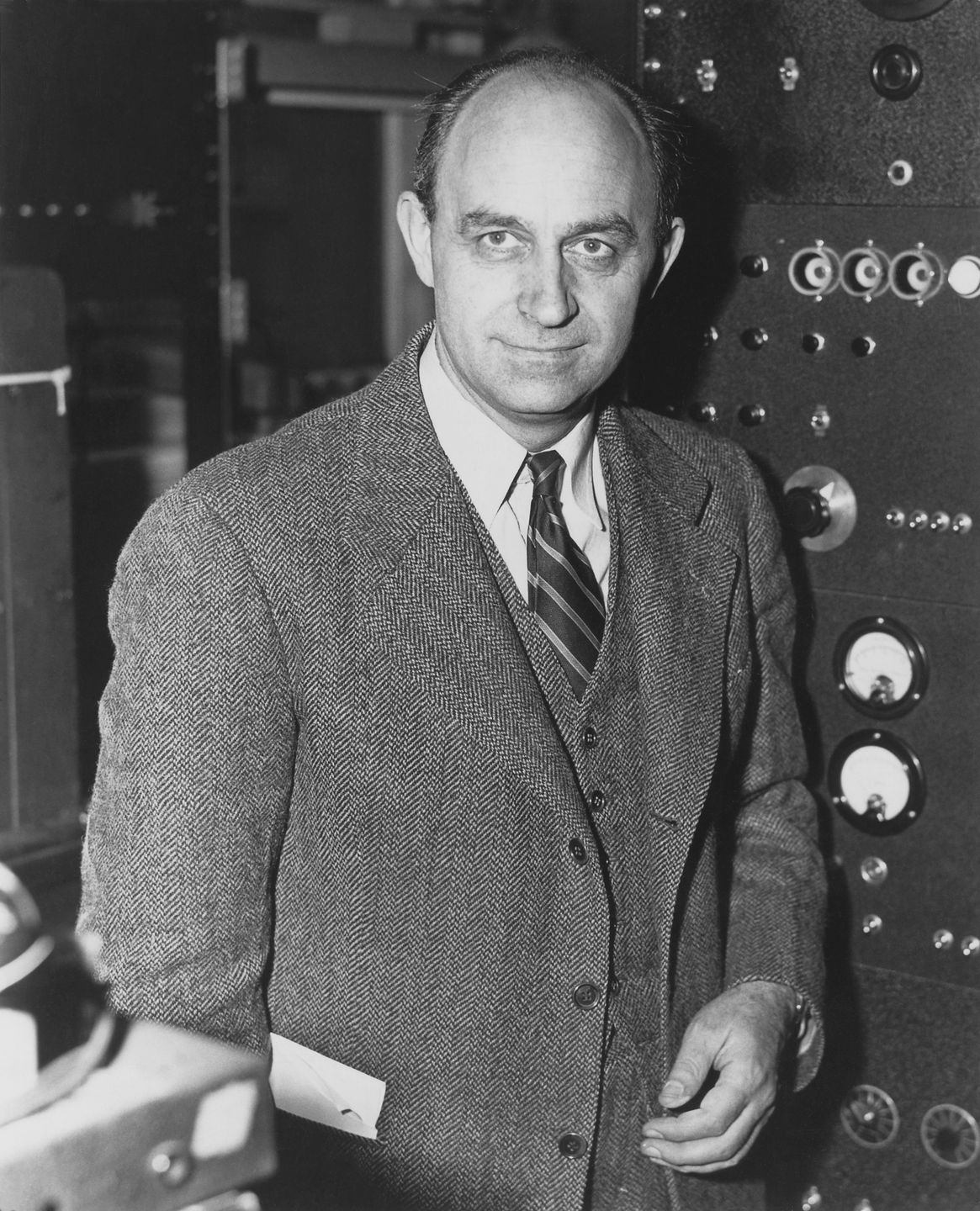
Enrico Fermi, circa 1943–49. Department of Energy-Office of Public Affairs, restored by Yann, Public domain, via Wikimedia Commons
The Pile Under the Squash Court
On this day in 1942 — Enrico Fermi coaxed the first controlled nuclear chain reaction to life beneath a Chicago squash court.
3 min read
At 3:53 p.m. on December 2, 1942, in a squash court beneath the west stands of Stagg Field at the University of Chicago, 49 scientists watched instruments click faster and faster. Enrico Fermi directed the operators to pull the control rods slowly from a 7.6-meter pile of graphite bricks and uranium. When the neutron count climbed exponentially and held, Fermi announced that the reaction was self-sustaining. For the first time in history, humans had initiated and controlled a nuclear chain reaction. The atomic age began not with a bang, but with the quiet hum of instruments and Fermi's calm instruction to shut it down after 28 minutes.
The reactor, code-named Chicago Pile-1, was a crude machine by modern standards. It consisted of 45,000 graphite blocks, 19,000 pieces of uranium metal and uranium oxide, and wooden supports, all stacked by hand into an irregular sphere. There was no radiation shielding. No backup cooling system. The only safety mechanism was a trio of control rods and a single emergency rope that, if pulled, would drop cadmium-coated panels into the pile to absorb neutrons and stop the reaction. One scientist stood on a platform above the pile holding a bucket of cadmium solution, ready to pour it in if the instruments showed a runaway chain reaction. They called him the "suicide squad."
Fermi's achievement was as much about precision as physics. He had calculated the exact configuration needed to reach criticality, the point where each fission event produces enough neutrons to sustain the reaction. Too few neutrons, and the chain dies. Too many, and it accelerates out of control. Fermi designed the pile so that pulling the control rods would bring it just over the critical threshold, allowing the reaction to continue at a steady, manageable rate. It was the first time anyone had treated nuclear fission as an engineering problem rather than a laboratory curiosity.
The experiment was part of the Manhattan Project, the secret Allied program to build an atomic bomb before Nazi Germany could. Fermi's pile proved that a sustained chain reaction was possible, a necessary step before designing a weapon. But the implications extended far beyond warfare. The same principles that powered the pile would eventually power reactors generating electricity, propelling submarines, and producing medical isotopes. Fermi didn't just split atoms. He turned nuclear physics into a technology with industrial applications.
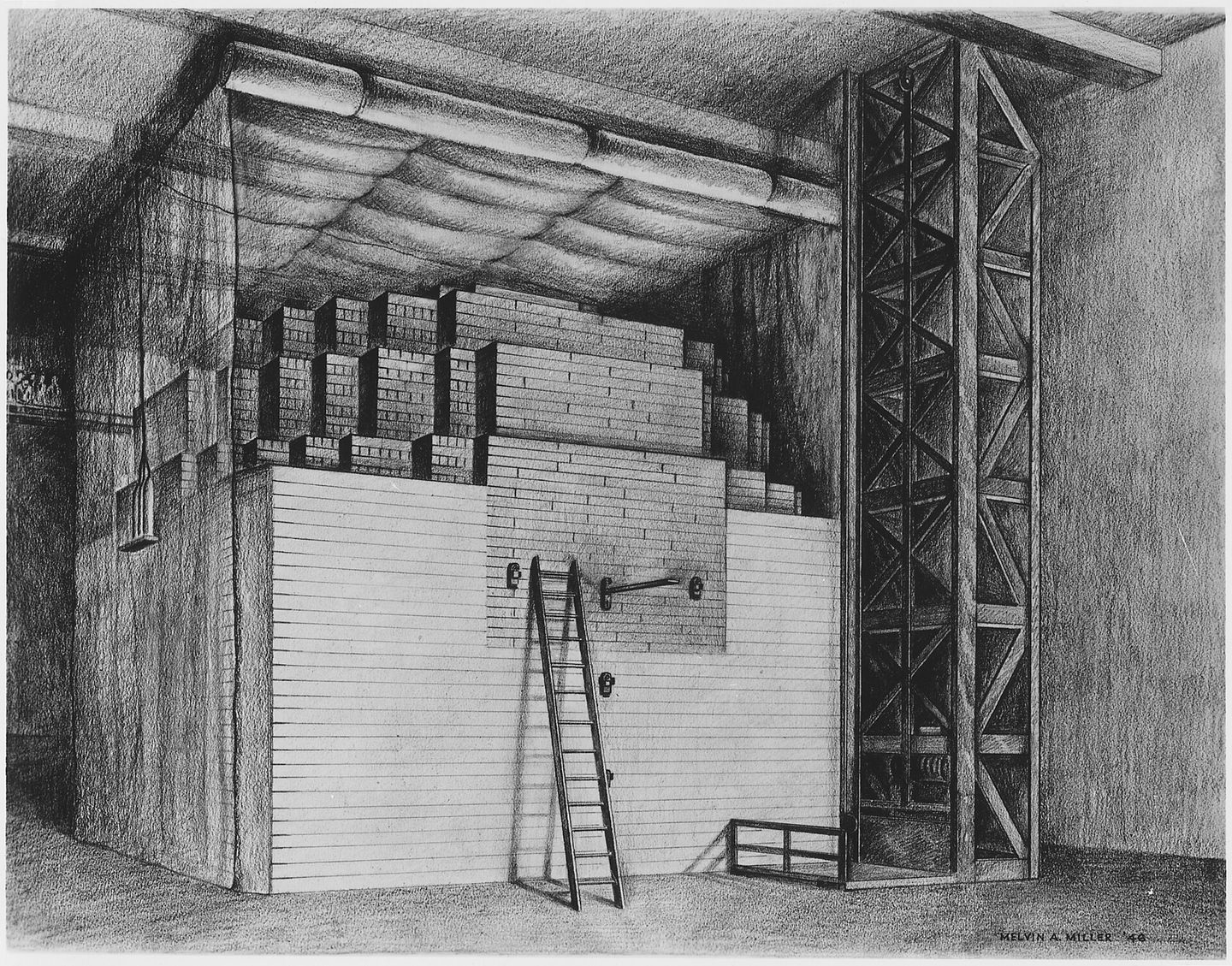
Chicago Pile-1 at the University of Chicago, 1942. Melvin A. Miller of the Argonne National Laboratory, Public domain, via Wikimedia Commons
The success was celebrated quietly. Physicist Eugene Wigner produced a bottle of Chianti he had been saving for the occasion. Each scientist drank from paper cups, then signed the bottle's straw wrapper. The only message sent to Washington was a coded phone call: "The Italian navigator has landed in the New World." The response: "How were the natives?" Answer: "Very friendly." There was no public announcement. The work remained classified. Most of the world would not learn of Chicago Pile-1 until after atomic bombs destroyed Hiroshima and Nagasaki in August 1945.
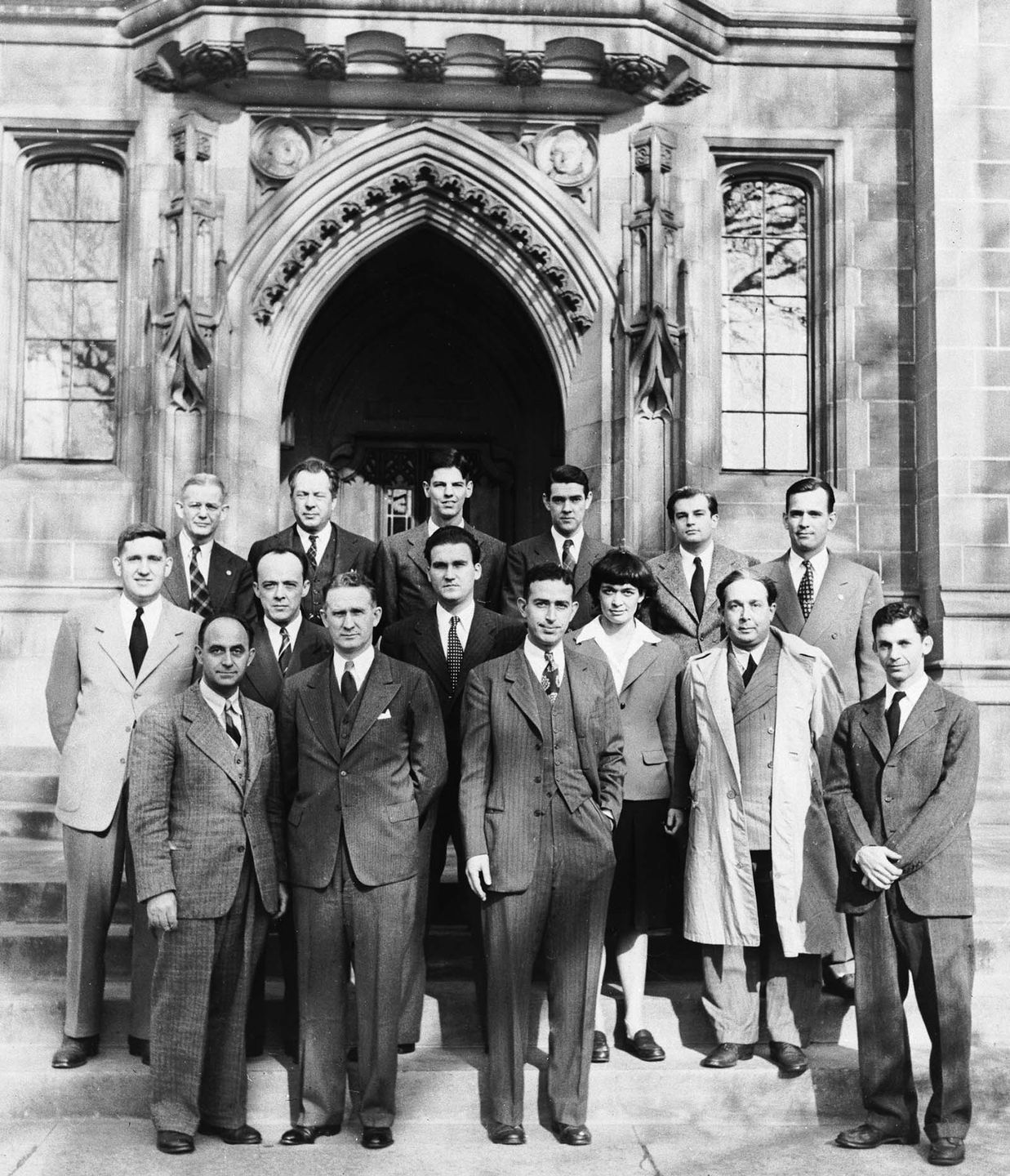
Members of the Chicago Pile-1 team, reunited at the University of Chicago in 1946. National Security Research Center / Los Alamos National Laboratory, Attribution, via Wikimedia Commons
The ethical weight of that December afternoon is impossible to ignore. The same reactor that validated peaceful nuclear energy also validated the atomic bomb. Fermi himself was ambivalent. He had fled Fascist Italy in 1938, partly to escape anti-Semitic laws targeting his Jewish wife. He believed stopping Hitler was paramount, but after the war, he opposed the development of the hydrogen bomb, arguing that the atomic bomb was destructive enough. His Chicago experiment became a dividing line in history: before it, nuclear energy was theoretical. After it, the atom was a tool, a weapon, and a responsibility.
What Chicago Pile-1 represents is the transformation of knowledge into infrastructure. Fermi's pile was not elegant. It was not safe by modern standards. But it worked. And in working, it demonstrated that humans could harness the force binding atomic nuclei, not through uncontrolled explosions, but through deliberate, measured design. Just as Ernest Rutherford split the atom and found it mostly empty, Fermi filled that emptiness with intention. The reactor was a prototype, the first iteration of a technology that would reshape energy production, medicine, and military strategy. The pile under the squash court was small and ungainly, but it was the beginning of everything that followed. The reaction Fermi started has never really stopped.
studio / on-this-day / Dec 2