studio / on-this-day / Dec 17
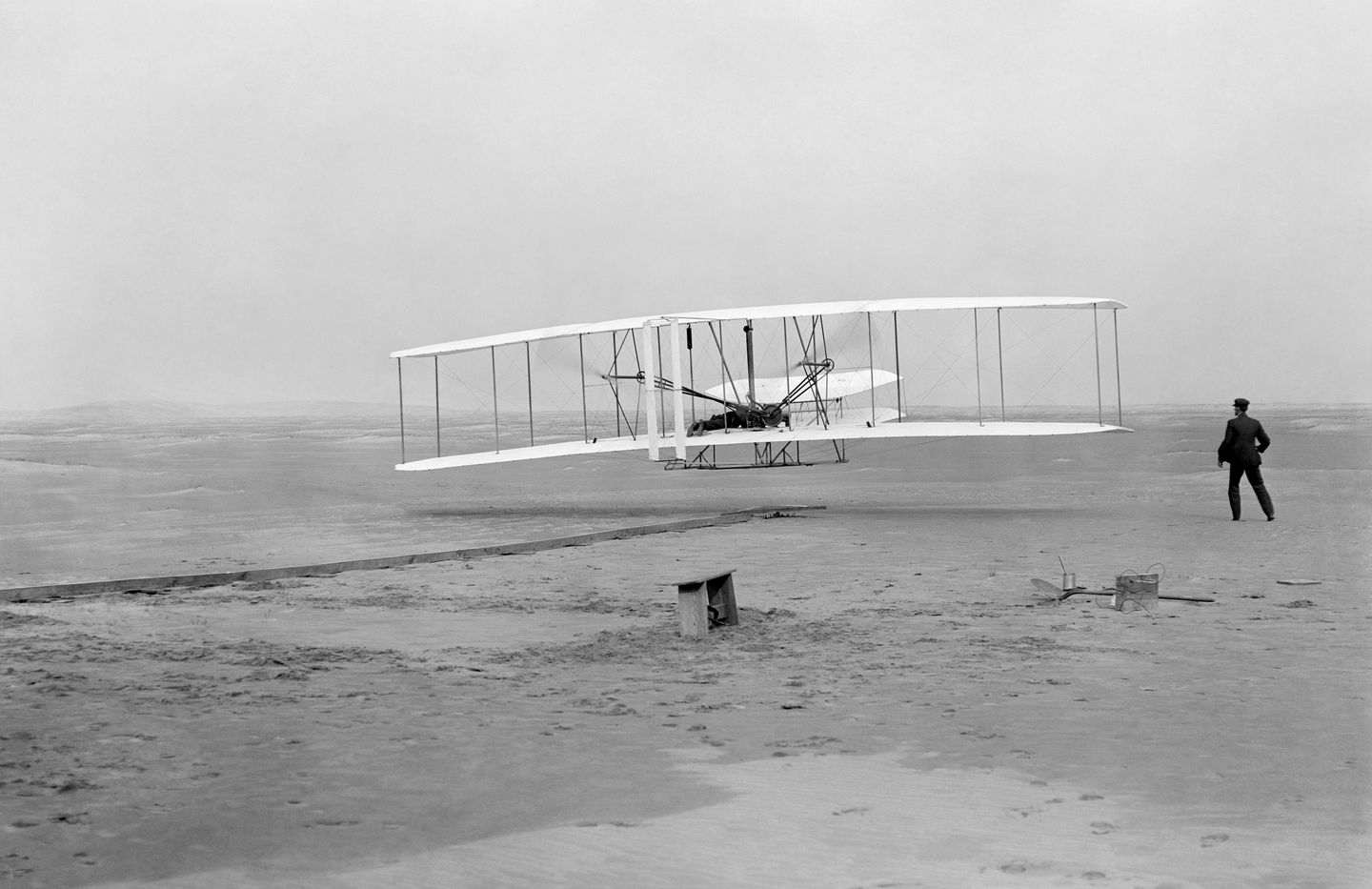
The first powered Flight, Kitty Hawk, North Carolina, December 17, 1903. John T. Daniels, Public domain, via Wikimedia Commons
Twelve Seconds Above the Sand
On this day in 1903 — the Wright brothers flew for twelve seconds over the sand at Kitty Hawk, and heavier-than-air flight stopped being a dream.
3 min read
At 10:35 in the morning on December 17, 1903, Orville Wright climbed onto the Wright Flyer and flew 120 feet in twelve seconds. It was the first controlled, sustained flight of a powered heavier-than-air aircraft. Five witnesses stood on the sand dunes of Kitty Hawk, North Carolina. One of them, John Daniels, had never operated a camera before. He clicked the shutter at the exact moment the plane left the ground. That photograph became one of the most important images in technological history.
The Wright brothers were not the first to attempt flight. Otto Lilienthal had built gliders. Samuel Langley had built a powered machine, though it crashed into the Potomac nine days before the Wrights succeeded. What set Wilbur and Orville apart was not ambition but method. They approached flight as an engineering problem with three distinct challenges: lift, propulsion, and control. Most experimenters focused on the first two. The Wrights obsessed over the third.
They built a wind tunnel in their bicycle shop in Dayton, Ohio. They tested over two hundred wing shapes, recording data with meticulous care. They understood that flight was not just about staying in the air. It was about steering. Their innovation was wing warping, a system that twisted the edges of the wings to control roll. It was the ancestor of modern ailerons, the control surfaces that allow every airplane to bank and turn.
Kitty Hawk was chosen for its wind and isolation. The Wright brothers camped in a shed, ate cold beans, and waited for the right conditions. December 17 was brutally cold, with winds up to 27 miles per hour. They made four flights that day. The first, Orville's, lasted twelve seconds. The fourth, Wilbur's, covered 852 feet and stayed aloft for 59 seconds. Just after noon, a gust of wind caught the Flyer and flipped it. The machine was destroyed. It never flew again.
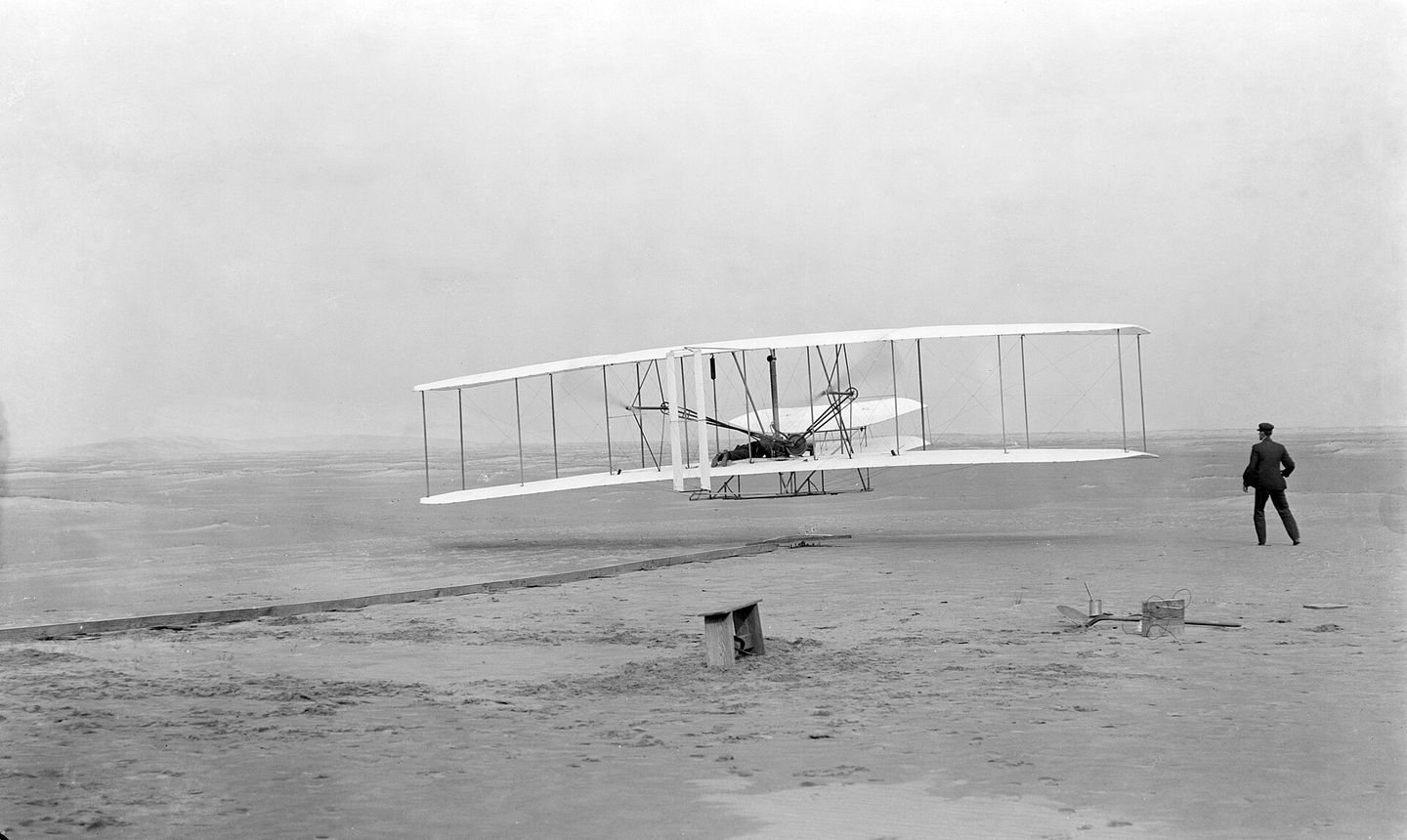
The Wright Flyer, restored and on display. John T. Daniels, Public domain, via Wikimedia Commons
What strikes you about the Wrights is how little fanfare followed. They sent a telegram to their father. Orville wrote, "Success four flights thursday morning all against twenty one mile wind started from Level with engine power alone average speed through air thirty one miles longest 57 seconds inform Press home Christmas." A local newspaper ran a brief, error-filled story. The world did not pay attention.
It took years for the significance to register. The Wrights continued refining their designs in obscurity. By 1905 they had built the Flyer III, which could fly for 39 minutes and execute figure eights. That machine was the first practical airplane, but almost no one saw it fly. The brothers were secretive, worried about patent theft. They stopped flying publicly until they could secure contracts. It was not until 1908, when Wilbur demonstrated the plane in France, that the world finally understood what had been achieved five years earlier.
The Wright Flyer was not a sudden leap. It was the result of thousands of incremental decisions, each one tested and refined. The brothers did not work from blueprints or theory alone. They iterated. They failed. They measured. This was design thinking before the term existed. As Henry Ford would later industrialize the assembly line, the Wrights industrialized the process of invention itself, turning intuition into a repeatable system.
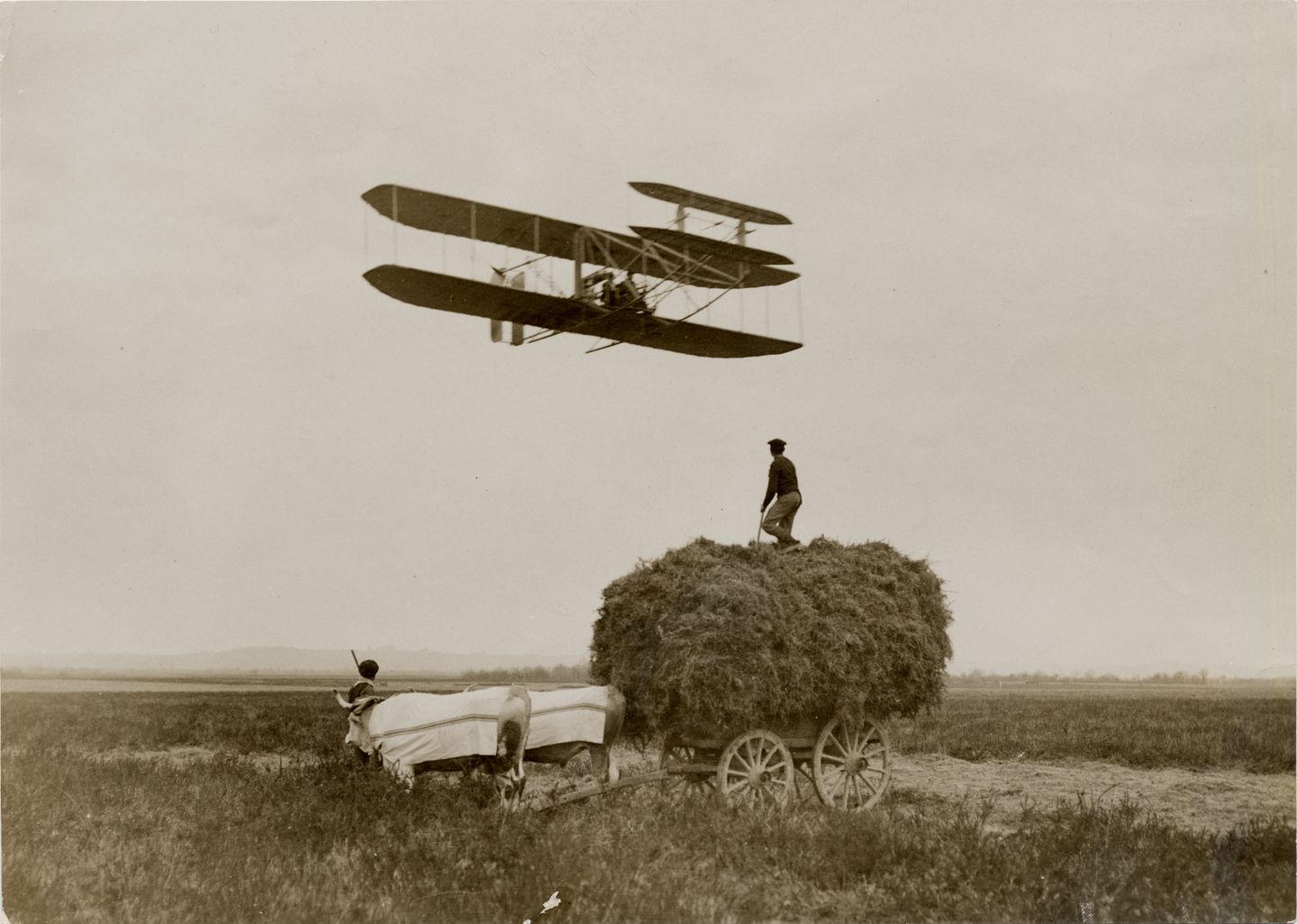
Wilbur Wright demonstrating the Flyer at Pau, France, 1908 — the flights that finally convinced the world. Philipp Kester, Public domain, via Wikimedia Commons
Flight changed everything. Within a decade, airplanes were used in war. Within two decades, they carried mail. Within four decades, they carried passengers across oceans. The first flight lasted twelve seconds and covered less distance than the wingspan of a modern 747. But it was enough. It proved that controlled, powered flight was not magic. It was engineering. The sky became navigable, and the world became smaller. All of it started with two brothers from Ohio, a homemade airplane, and a cold December morning on a beach in North Carolina.
studio / on-this-day / Dec 17