studio / on-this-day / Dec 13
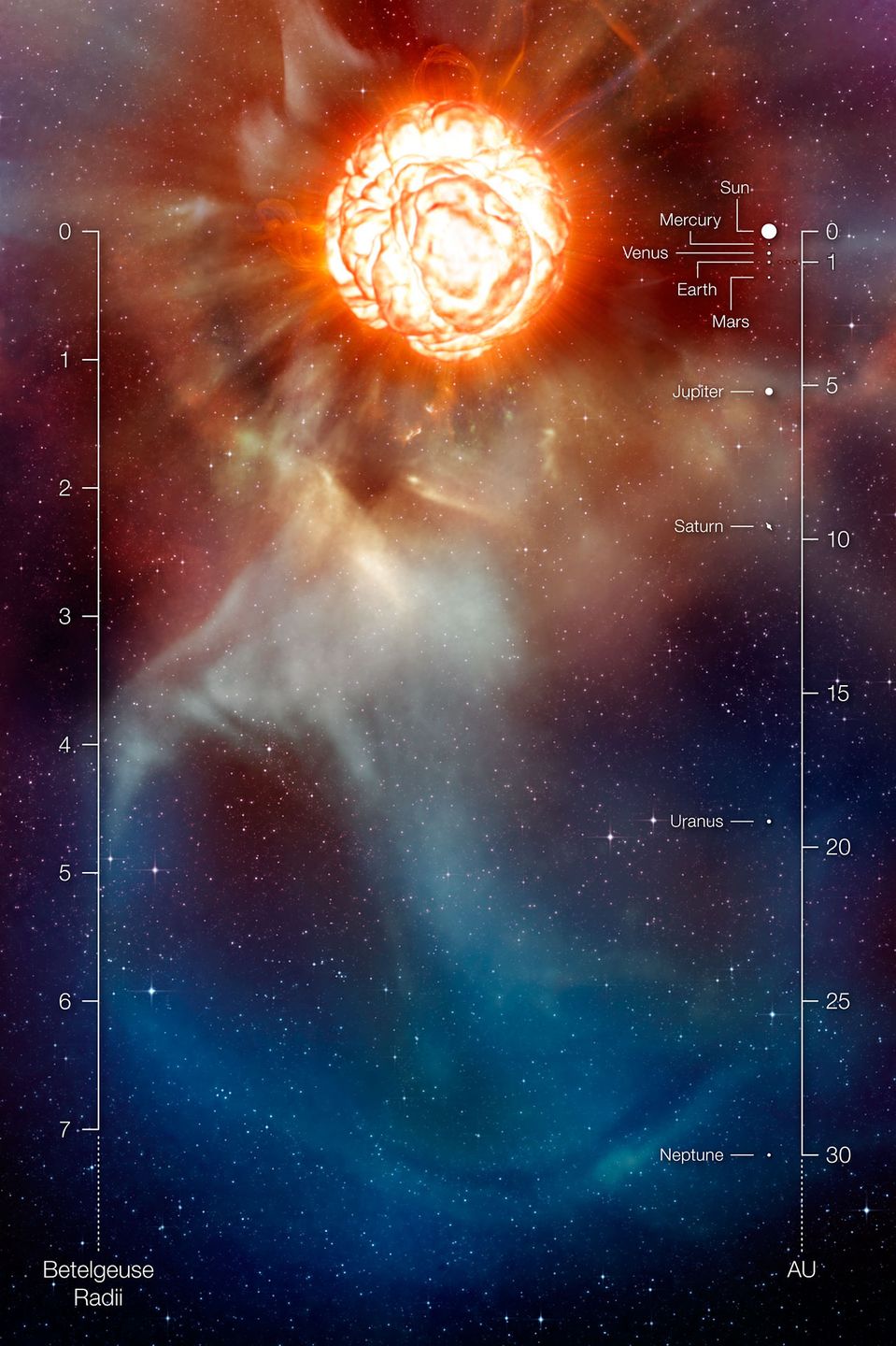
Betelgeuse, red supergiant in Orion, eso image. ESO/L. Calçada, CC BY 4.0, via Wikimedia Commons
Measuring a Giant Star
On this day in 1920 — astronomers measured a star's size for the first time, and Betelgeuse turned out to be staggeringly vast.
3 min read
On December 13, 1920, astronomers Francis Pease and Albert Michelson used an interferometer attached to the 100-inch Hooker Telescope at Mount Wilson Observatory in California to measure the angular diameter of Betelgeuse, a red supergiant star in the constellation Orion. It was the first time anyone had measured the size of a star other than the Sun. The result was astonishing. Betelgeuse had an apparent diameter of about 0.047 arcseconds, which, given its known distance of roughly 500 light-years, translated to a physical diameter of approximately 370 million miles. If Betelgeuse replaced the Sun in our solar system, its surface would extend past the orbit of Mars.
Before 1920, stars were effectively points of light. Even through the largest telescopes, they appeared as tiny dots. Astronomers could measure a star's brightness, color, and spectrum, but not its size. Stars were too far away and too small in angular extent to resolve as disks. The interferometer changed that. It used the principle of wave interference, combining light from two widely separated mirrors to create an interference pattern. By analyzing that pattern, astronomers could calculate the angular diameter of the star with extraordinary precision. Michelson had won the Nobel Prize in Physics in 1907 for similar work measuring the speed of light. Now he was applying the same technique to measure stars.
Betelgeuse was an ideal target. It's one of the brightest stars in the night sky and one of the largest known. Its immense size made it just barely resolvable with the interferometer. The measurement required perfect atmospheric conditions, precise alignment, and hours of painstaking observation. But it worked. For the first time, humans had a direct measurement of a star's physical size. The universe stopped being a collection of abstract points and became a place with objects that had measurable dimensions.
The measurement revealed something profound about stellar evolution. Betelgeuse is nearing the end of its life. It has exhausted most of the hydrogen in its core and expanded into a red supergiant. Stars like the Sun will eventually do the same, swelling into red giants before shedding their outer layers and collapsing into white dwarfs. Betelgeuse is far more massive than the Sun, so its fate is more violent. It will eventually explode as a supernova, briefly outshining its entire galaxy before collapsing into a neutron star or black hole. The measurement in 1920 was the first direct confirmation that stars evolve, grow, and die. They are not eternal. They have life cycles, and those cycles can be studied.
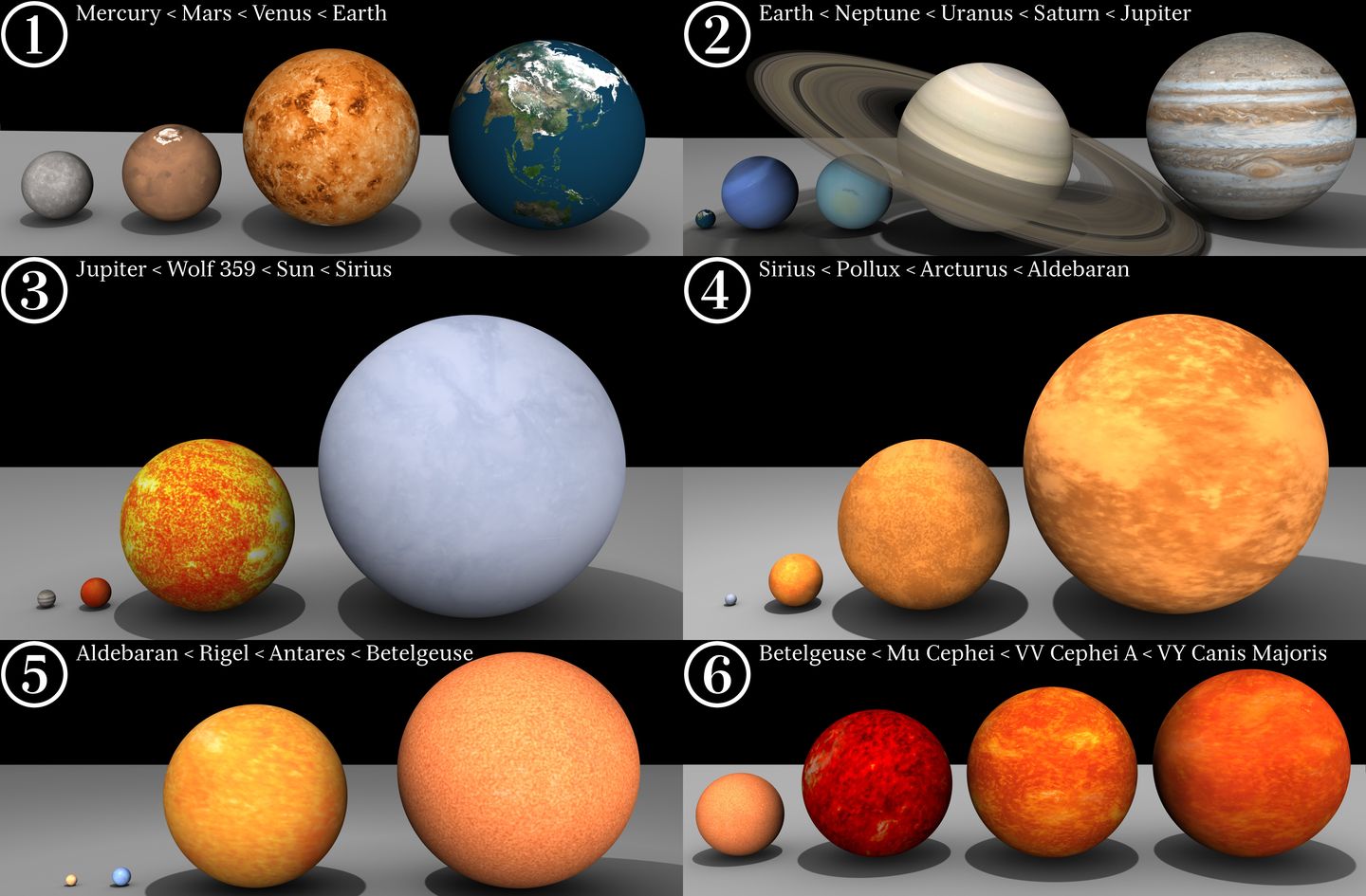
Star size comparison: Betelgeuse dwarfs our Sun. Dave Jarvis (https://dave.autonoma.ca/), CC BY-SA 3.0, via Wikimedia Commons
The interferometric technique pioneered by Michelson and Pease became a standard tool in astronomy. By the 1970s, interferometry had been used to measure the sizes of dozens of stars. Modern interferometers, using multiple telescopes linked together, can resolve details far smaller than what was possible in 1920. The Atacama Large Millimeter Array in Chile and the Very Large Telescope Interferometer in Chile can measure stellar diameters, detect exoplanets, and even image the surfaces of distant stars, revealing features like starspots and convection cells.
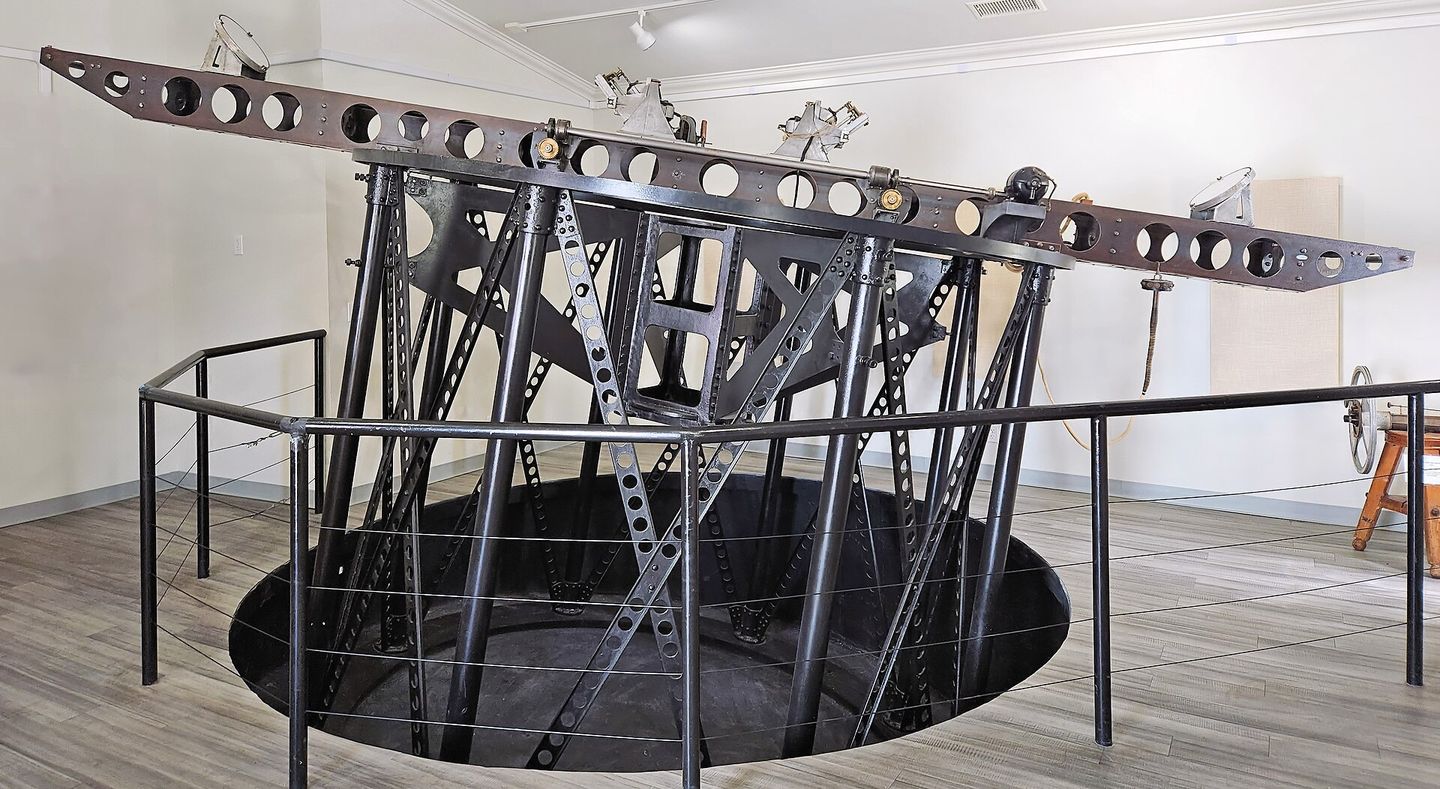
The Michelson-Pease Interferometer used to measure Betelgeuse. Eric Polk, CC BY-SA 4.0, via Wikimedia Commons
What makes the 1920 measurement significant is not just the technical achievement but the conceptual shift. Before Michelson and Pease, stars were abstractions. They could be modeled, theorized about, and categorized, but they couldn't be directly measured in the way you can measure a building or a planet. The interferometer made stars tangible. It turned points of light into objects with geometry. Astronomy became less about observation and more about measurement. The universe could be quantified.
Betelgeuse itself remains a subject of intense study. In late 2019 and early 2020, it dimmed dramatically, leading to speculation that it might be about to explode. It didn't. The dimming was likely caused by a massive dust cloud ejected from the star's surface. But the event reminded astronomers that Betelgeuse is unstable and could go supernova at any time. When it does, it will be visible from Earth in daylight, as bright as the full Moon, for weeks or months. It could happen tomorrow or 100,000 years from now. The star doesn't care about human timescales. But when it explodes, it will be one of the most spectacular astronomical events in recorded history. And we'll know its size, its distance, and its fate, all because of a measurement made on December 13, 1920.
studio / on-this-day / Dec 13