studio / on-this-day / Nov 9
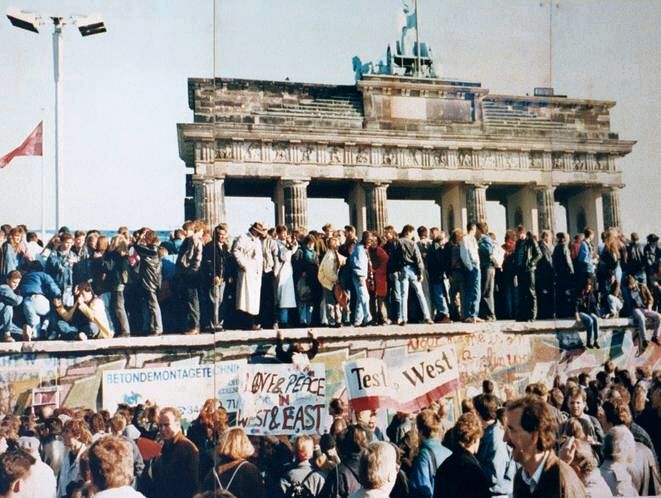
People on the Berlin Wall, November 9, 1989. CC BY-SA 3.0, via Wikimedia Commons
The Wall Came Down
On this day in 1989 — the Berlin Wall fell, a concrete system built to divide a city, taken apart by ordinary people with hammers.
3 min read
On the evening of November 9, 1989, East German official Günter Schabowski held a press conference in East Berlin. He announced new travel regulations that would allow East Germans to cross into West Berlin. When a reporter asked when the new rules would take effect, Schabowski shuffled through his notes and said, "As far as I know, immediately, without delay." He was wrong. The policy was supposed to begin the next day, with controlled checkpoints. But his words went out live on television, and within hours, thousands of East Berliners gathered at the Wall's crossing points, demanding to pass through.
The guards had no orders. The crowds kept growing. At 10:45 PM, border guards at the Bornholmer Street crossing, overwhelmed and unsure what to do, opened the gates. People poured through. They climbed onto the Wall, danced on it, took hammers and chisels to it. The barrier that had divided Berlin since 1961, a 96-mile scar of concrete and barbed wire, began to crumble. Not because of diplomacy or military action, but because one official misspoke and a crowd refused to wait.
The Berlin Wall was built in a single night in August 1961, cutting the city in half. East Germany called it the Anti-Fascist Protection Rampart. Everyone else called it what it was: a prison wall, designed to keep people in. It started as barbed wire and quickly became concrete, reinforced with watchtowers, guard dogs, and a kill zone called the death strip. Over its 28-year existence, at least 140 people died trying to cross it. It was a monument to the Cold War, the physical embodiment of an ideological divide.
The Wall's fall was less a decision than a collapse of will. By 1989, the Soviet Union under Gorbachev had stopped enforcing communist orthodoxy in Eastern Europe. Poland and Hungary had already begun opening their borders. East Germany's government was isolated, sclerotic, and losing legitimacy. Protests in Leipzig and Dresden had grown too large to suppress without violence, and the regime hesitated. When Schabowski opened the gates by accident, the system had no mechanism left to close them.
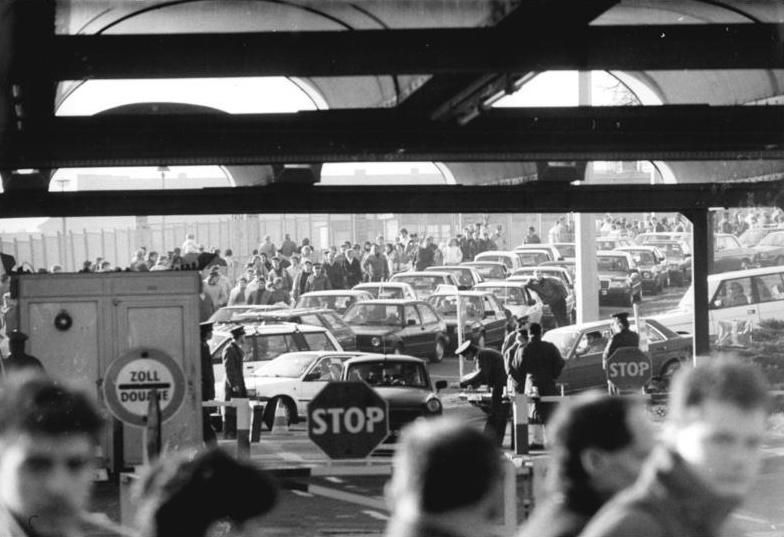
The Bornholmer straße crossing, where guards opened the gates first on the night of November 9, 1989. Roeske, Robert, CC BY-SA 3.0 de, via Wikimedia Commons
The symbolic weight of the Wall's destruction was immediate. News cameras captured people with hammers breaking off chunks of concrete as souvenirs. Strangers embraced across the border. David Hasselhoff sang "Looking for Freedom" atop the remnants. It was messy, chaotic, and joyful. Within a year, Germany would reunify. Within two years, the Soviet Union would dissolve. The Wall became the marker: before and after, division and unity, Cold War and whatever came next.
What fell on November 9, 1989, wasn't just a wall. It was the idea that walls could hold. The Berlin Wall had been designed as a permanent fixture, a solution to the problem of people choosing freedom over ideology. It failed because walls, no matter how well-designed, can't fix systemic failures. They can only delay the inevitable. When enough people stop believing in a system, the infrastructure that supports it becomes irrelevant. The Wall stood for 28 years. It fell in a single night because someone said the wrong words at the wrong time, and a crowd decided to see if they were true. They were.
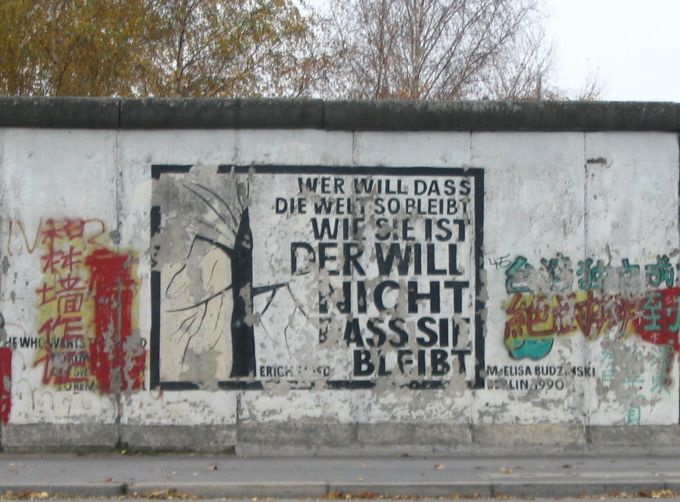
The Berlin Wall, viewed from the West. The death strip is visible on the Eastern side. CC BY-SA 3.0, via Wikimedia Commons
studio / on-this-day / Nov 9