studio / on-this-day / Nov 15
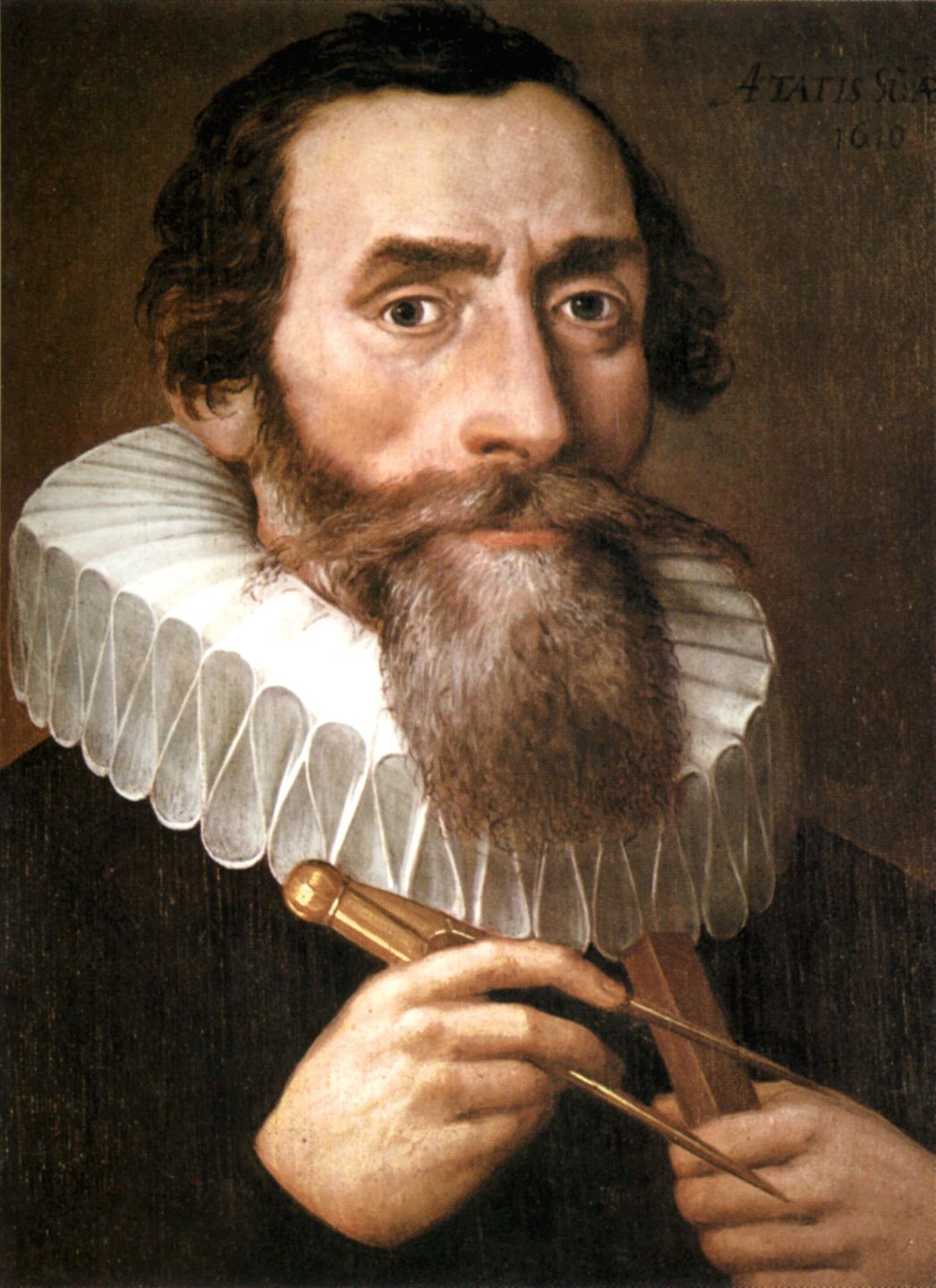
Johannes Kepler, 1610. Unidentified painter, Public domain, via Wikimedia Commons
The Laws That Steer Spacecraft
On this day in 1630 — Johannes Kepler died, leaving behind laws of planetary motion still used to steer spacecraft today.
3 min read
Johannes Kepler died on November 15, 1630, in Regensburg, Germany. He was 58, impoverished, and far from home, traveling to collect unpaid salary from the Holy Roman Emperor. He left behind three laws of planetary motion that redefined how we understand the solar system. Those laws are still in use. Every spacecraft trajectory, every satellite orbit, every interplanetary mission is calculated using the mathematics Kepler derived from data collected by a man who didn't believe in heliocentrism.
Kepler was born in 1571 in Weil der Stadt, a small town in what is now Germany. He survived smallpox as a child, which left him with weakened vision and crippled hands. He studied theology and mathematics, intending to become a Lutheran minister. But in 1600, he became an assistant to Tycho Brahe, the most precise observational astronomer of the pre-telescope era. Tycho had spent decades measuring the positions of planets with unprecedented accuracy. When Tycho died in 1601, Kepler inherited his data and spent the next decade trying to make sense of it.
The problem was Mars. Its orbit didn't fit the prevailing models, which assumed that planets moved in perfect circles at constant speeds. Kepler tried every variation he could imagine: circles within circles, offset centers, variable speeds. Nothing worked. After years of calculations, he discovered that Mars's orbit wasn't a circle. It was an ellipse, with the Sun at one focus. This became his First Law: planets move in elliptical orbits.
His Second Law followed: a line connecting a planet to the Sun sweeps out equal areas in equal times. This meant planets move faster when they're closer to the Sun and slower when they're farther away. It was elegant, counterintuitive, and accurate. It explained variations in planetary speed that circular models couldn't account for. His Third Law, published in 1619, showed that the square of a planet's orbital period is proportional to the cube of its average distance from the Sun. This law allowed astronomers to calculate distances and periods across the entire solar system using just one known reference.
Kepler's laws didn't just describe motion. They revealed an underlying order to the cosmos. Newton would later use Kepler's work as the foundation for his law of universal gravitation, proving that the same force that pulls an apple to the ground keeps planets in orbit. Kepler's laws became the blueprint for celestial mechanics, the science of predicting how objects move in space. When NASA calculates a trajectory to Mars, it uses Kepler's equations. When a satellite needs to maintain a specific orbit, engineers rely on the same mathematics Kepler derived 400 years ago.
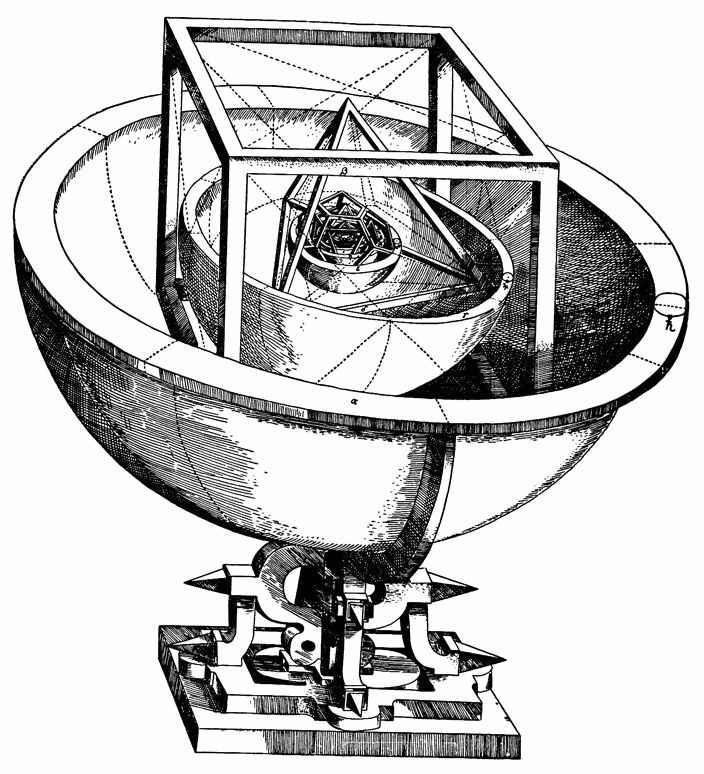
Kepler's early model of the solar system from the mysterium cosmographicum (1596), nesting the planetary orbits inside the five Platonic solids. Johannes Kepler, Public domain, via Wikimedia Commons
Kepler lived through war, poverty, and personal tragedy. His first wife and two of his children died. His mother was accused of witchcraft, and he spent years defending her. He was forced to leave his teaching position because of religious persecution. He worked for emperors who rarely paid him. He supplemented his income by casting horoscopes, a practice he privately considered nonsense but publicly defended as applied astronomy. He died trying to collect money he was owed, far from his family, in a city he had no connection to.
What survived him was precision. Kepler's laws work because they're based on observation, not philosophy. He didn't impose a belief system on the data. He followed the data wherever it led, even when it contradicted centuries of accepted wisdom. Circles were considered divine, perfect, eternal. Ellipses were messy, asymmetrical, imperfect. Kepler chose accuracy over aesthetics. That choice made modern astronomy possible. Every rocket launch, every satellite deployment, every flyby of a distant planet relies on the laws Kepler discovered by refusing to accept that the universe had to be what people wanted it to be. It just had to be what it was.
studio / on-this-day / Nov 15