studio / on-this-day / Nov 12
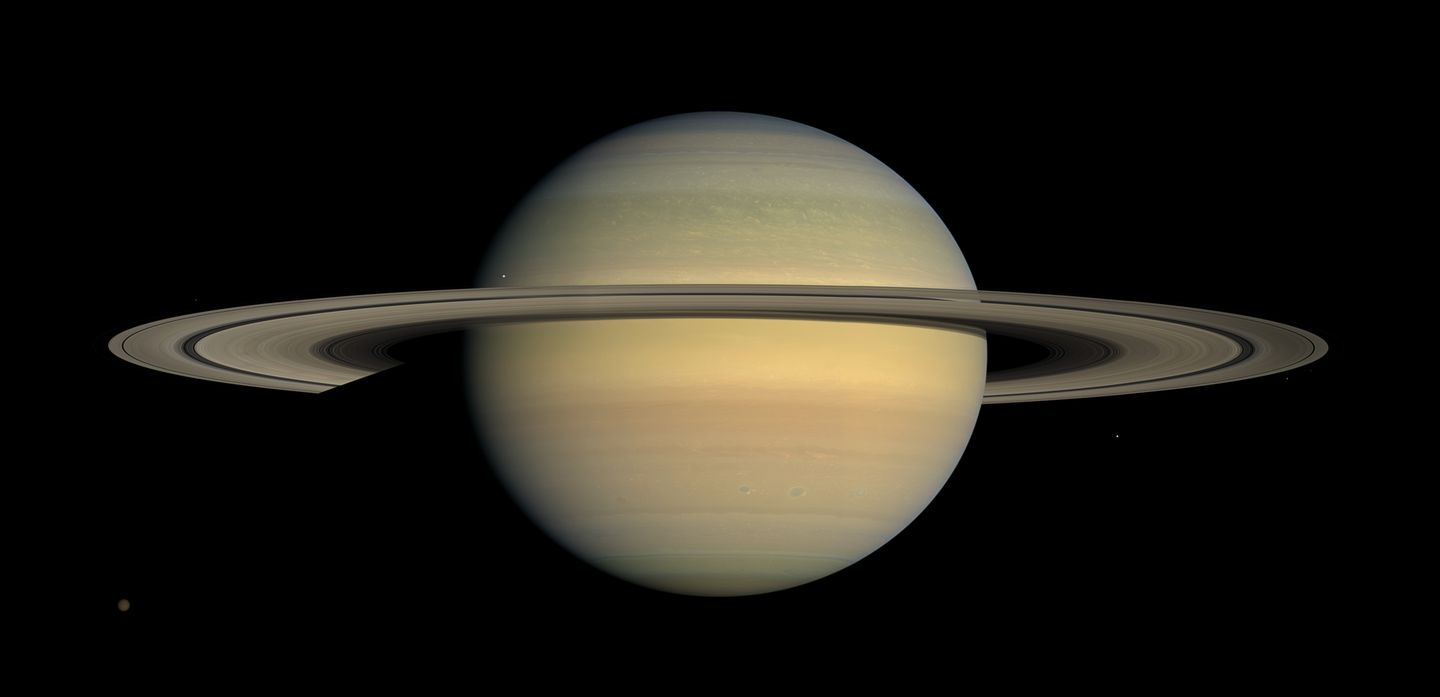
Saturn's rings photographed by Cassini. NASA / JPL / Space Science Institute, Public domain, via Wikimedia Commons
The View From 78,000 Miles
On this day in 1980 — Voyager 1 swept past Saturn and sent back photographs that changed how we picture its rings.
3 min read
On November 12, 1980, Voyager 1 passed within 78,000 miles of Saturn's cloud tops, moving at 44,000 miles per hour. It spent six hours in the planet's gravitational embrace, photographing the rings, moons, and atmosphere with instruments that had traveled 934 million miles from Earth. The spacecraft sent back images that revealed Saturn not as a static jewel in the sky but as a complex, dynamic system of ice, rock, and gas. What looked smooth and continuous from Earth resolved into thousands of individual ringlets, braided, kinked, and shepherded by tiny moons. The rings weren't solid. They were chaos organized by gravity.
Voyager 1 was launched in September 1977 as part of a twin mission with Voyager 2, designed to take advantage of a rare planetary alignment that occurs once every 176 years. The plan was to visit Jupiter, Saturn, and potentially Uranus and Neptune using gravitational assists, slingshot maneuvers where a spacecraft steals momentum from a planet's orbit to accelerate toward the next target. Voyager 1 reached Jupiter in March 1979, discovered active volcanoes on the moon Io, and then bent toward Saturn, the mission's primary scientific target.
Saturn's rings had been observed since Galileo first saw them in 1610, though he couldn't resolve what they were. He thought the planet had ears. Christiaan Huygens figured out in 1655 that Saturn was encircled by a flat ring. Later astronomers discovered gaps and divisions. But from Earth, the rings appeared as broad bands separated by dark spaces: the A ring, the Cassini Division, the B ring. Voyager's cameras revealed that these bands were themselves composed of countless narrow ringlets, some only a few miles wide, separated by gaps filled with even fainter material. The rings weren't simple. They were fractal.
The spacecraft also discovered new moons and confirmed theories about ring dynamics. Some moons acted as shepherds, their gravity confining ring particles into narrow bands. Others created gravitational resonances, clearing gaps where particles would otherwise accumulate. The F ring, discovered by Pioneer 11 a year earlier, turned out to be braided, a structure caused by two small moons pulling and twisting the ring material as they orbited. The rings were a laboratory for celestial mechanics, a place where theory met observation at the scale of planetary systems.
Voyager's flyby lasted only hours, but the data took months to transmit and years to analyze. The spacecraft used a radio dish to beam information back to Earth at 21 watts, about the power of a refrigerator light bulb. The signal traveled at the speed of light and took 86 minutes to reach NASA's Deep Space Network antennas. Engineers had designed the spacecraft to survive radiation, extreme temperatures, and micrometeorite impacts. They gave it a plutonium power source that would outlast the mission by decades. They built redundancy into every system. They assumed failure and engineered around it.
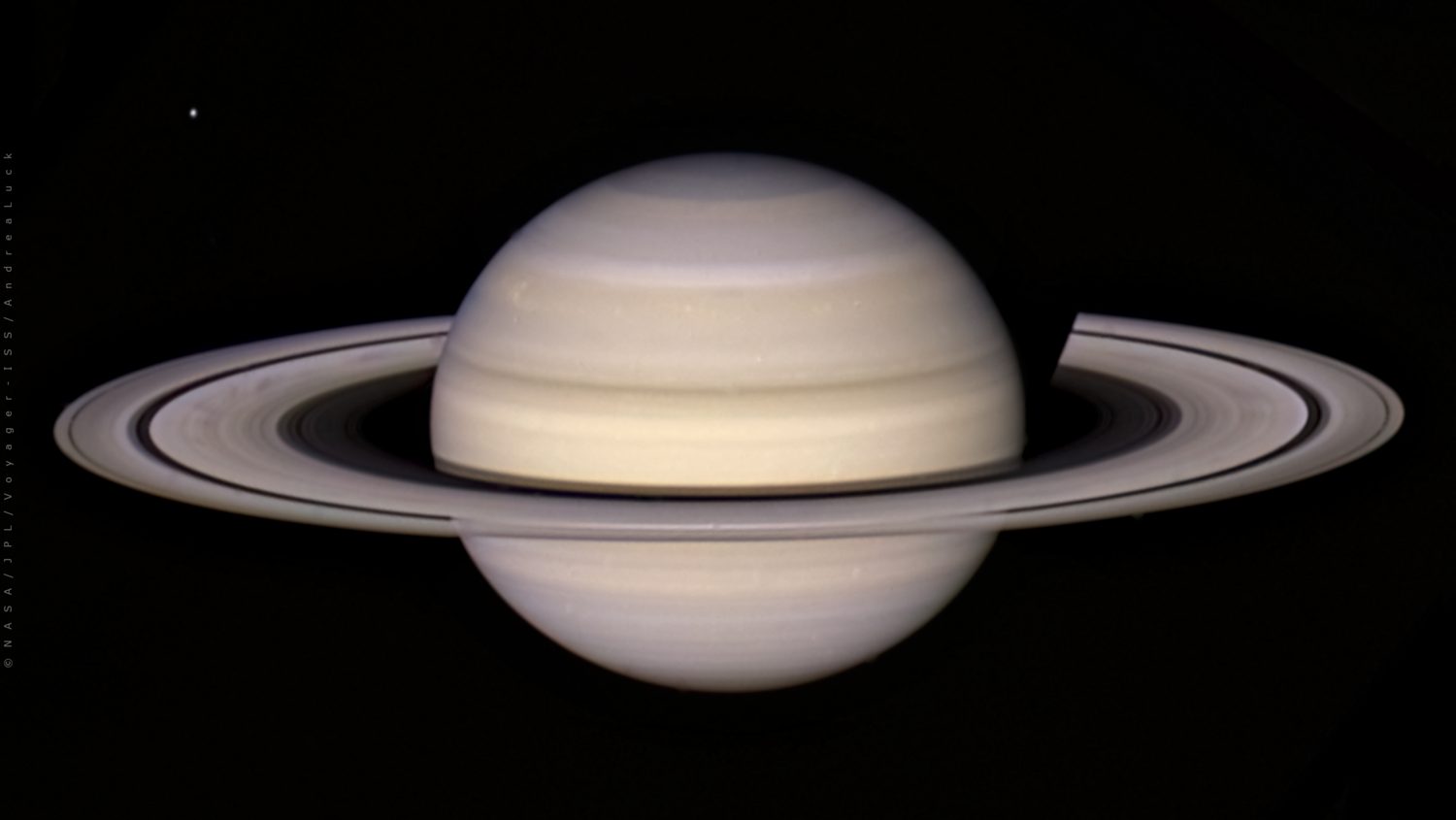
Saturn and its rings, imaged by Voyager 1 in 1980. Andrea Luck, CC BY 2.0, via Wikimedia Commons
After Saturn, Voyager 1's mission was essentially complete. It had visited two giant planets, sent back unprecedented images, and rewritten the textbook on the outer solar system. But it kept going. It's still going. As of 2025, Voyager 1 is more than 15 billion miles from Earth, the farthest human-made object in space. It left the heliosphere in 2012, crossing into interstellar space. Its instruments are failing one by one as power fades, but it continues transmitting. The view from Saturn was just the beginning. What Voyager showed us wasn't just what the rings looked like up close. It was that distance is not an obstacle. It's a design constraint, and with enough planning, redundancy, and patience, you can send a machine to the edge of the solar system and keep it working for decades. Exploration isn't about going once and coming back. It's about going and never stopping.
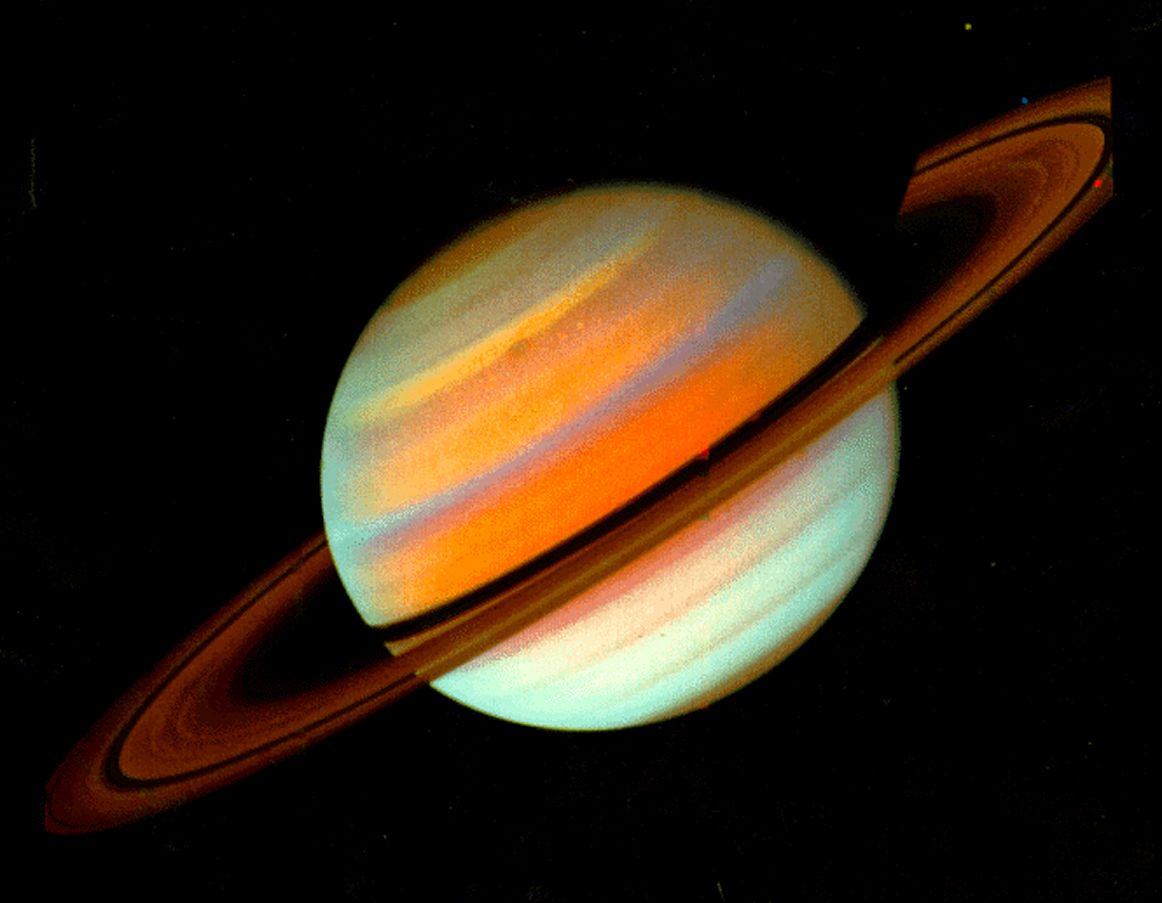
Saturn in false color, photographed by Voyager 1 during its 1980 flyby. NASA, Public domain, via Wikimedia Commons
studio / on-this-day / Nov 12