studio / on-this-day / Oct 17
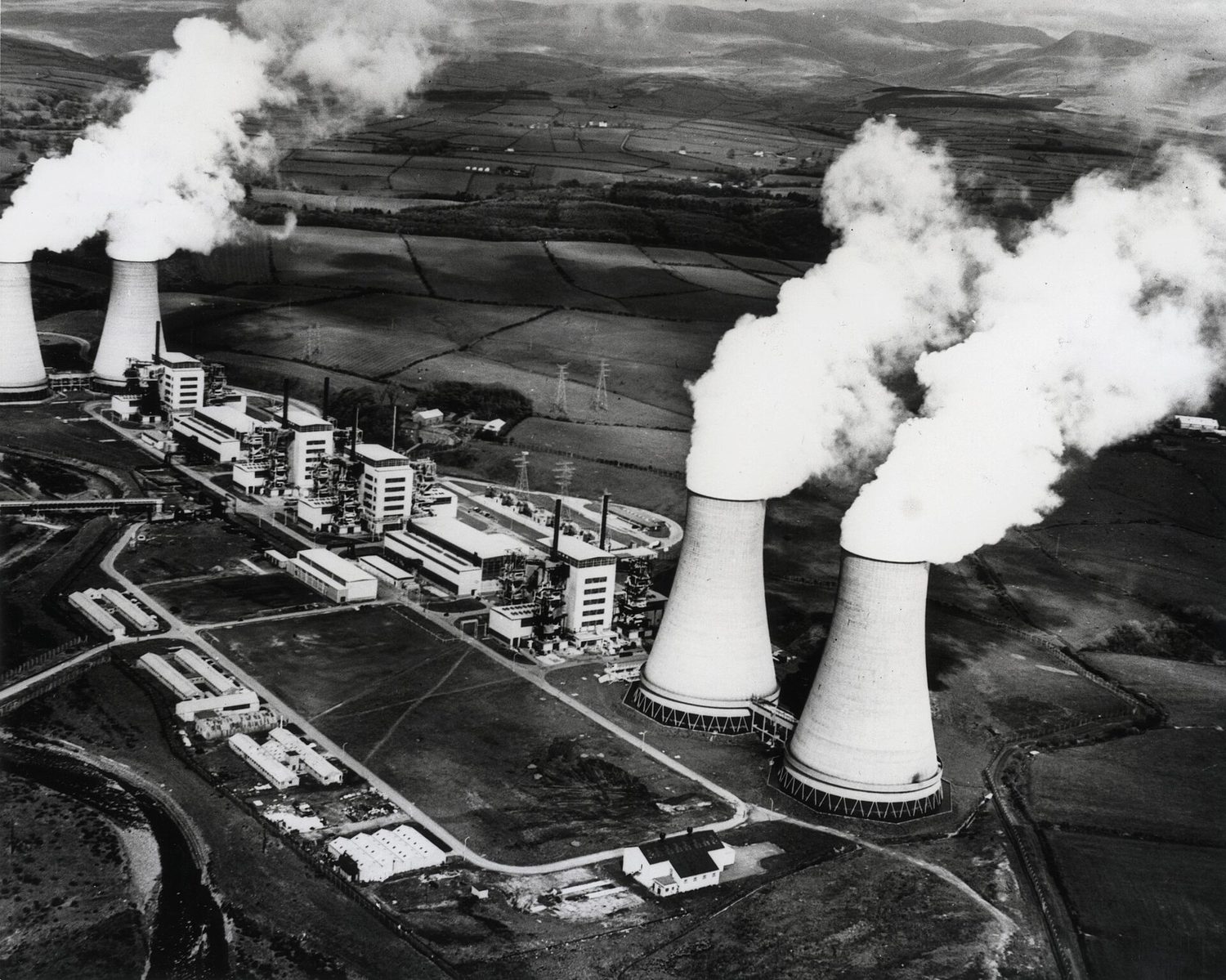
Calder Hall in Cumbria, England, the world's first commercial nuclear power station. Public domain, via Wikimedia Commons
The Fire That Needs No Fuel
On this day in 1956 — the first commercial nuclear power station opened in England, turning fission into a source of ordinary electricity.
3 min read
On October 17, 1956, Queen Elizabeth II opened Calder Hall in Cumberland, England. It was the first nuclear power plant in the world to deliver electricity to a commercial grid at scale. This was not a laboratory experiment or a one-off demonstration. It was industrial infrastructure, designed to run continuously and supply power to homes and factories across the country.
Nuclear fission had been understood in theory since the 1930s and weaponized horrifically in the 1940s. But turning it into a reliable energy source required solving an entirely different set of design problems. You had to control a chain reaction with enough precision to sustain it indefinitely without letting it run away. You had to extract the heat safely, convert it to steam, and drive turbines without exposing workers or the public to radiation. You had to design containment systems that could fail gracefully rather than catastrophically.
Calder Hall had four reactors, gas-cooled and graphite-moderated, each capable of producing 50 megawatts of electrical power. The design was conservative by necessity. The engineers had no long-term operational data to rely on. They built in redundancy, shielding, and monitoring systems that would later seem excessive but were appropriate given what they did not yet know.
The plant had a dual purpose that reveals the complicated politics of the era. While it generated electricity for the National Grid, its primary function was producing weapons-grade plutonium for Britain's nuclear arsenal. Energy production was the public face of a program designed to keep Britain competitive in the Cold War arms race. This was infrastructure with a military pedigree, repurposed for civilian use.
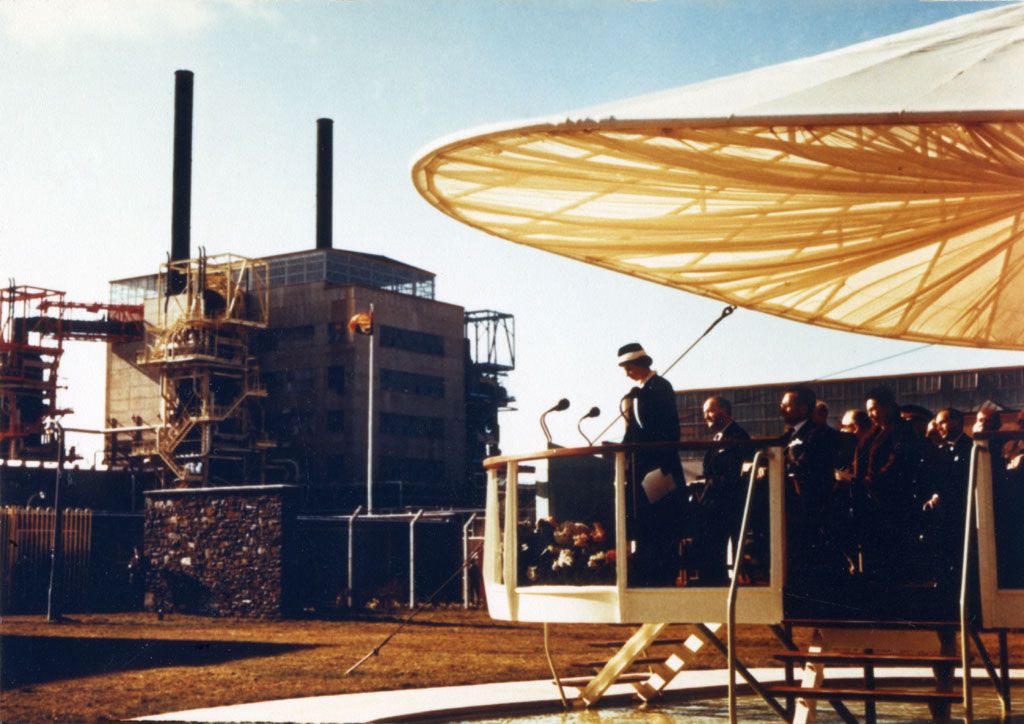
Queen Elizabeth II opening Calder Hall nuclear power station, October 17, 1956. UK government agencies, OGL 3, via Wikimedia Commons
What made Calder Hall significant was not the technology itself but the decision to integrate it into the grid. Other countries had built reactors. The Soviet Union had connected a small reactor to the grid two years earlier. The United States had the Shippingport plant under construction. But Calder Hall was the first to operate at commercial scale with the explicit goal of replacing fossil fuel generation. It was a bet on nuclear power as the energy system of the future.
The bet was partially right. Nuclear power now supplies about 10 percent of global electricity and significantly more in countries like France. But the vision of reactors as the primary replacement for coal and oil never materialized at the scale imagined in the 1950s. The economics proved harder than the engineering. Public fear, regulatory complexity, and waste disposal problems created friction that slowed deployment.
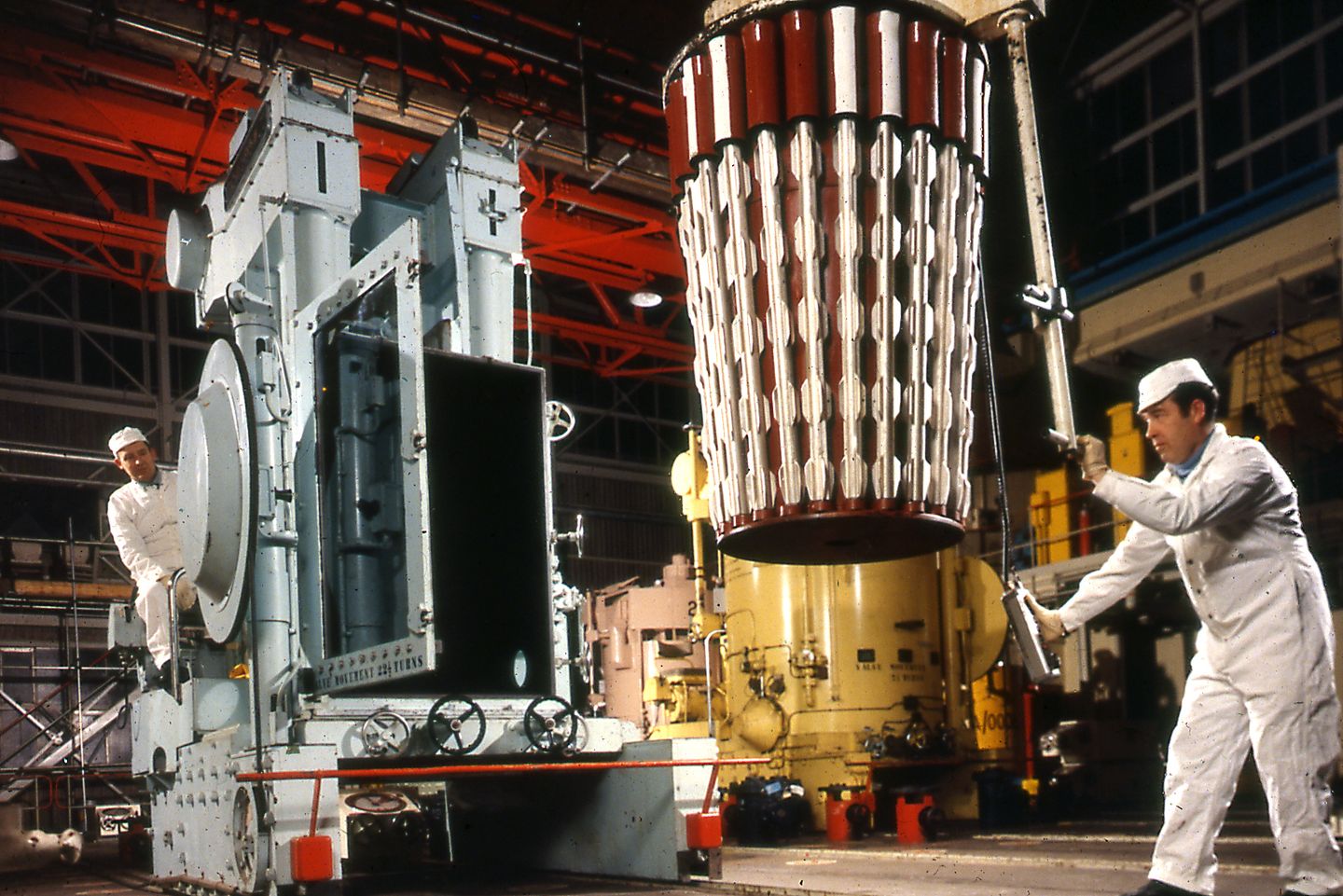
Fuel being loaded into a reactor at Calder Hall. UK government agencies, OGL 3, via Wikimedia Commons
Calder Hall ran for 47 years before it was decommissioned in 2003. That is a longer operational life than most software systems, most bridges, and many buildings. The reactors were machines designed to run for decades without stopping, producing power from a fuel source so energy-dense that a single uranium pellet the size of a fingertip contains as much energy as a ton of coal. This was energy design at the atomic level, extending the work Enrico Fermi began with the first controlled chain reaction.
Today, we talk about energy systems in terms of sustainability, grid resilience, and carbon intensity. Nuclear power sits awkwardly in these conversations. It produces no carbon emissions during operation but creates radioactive waste that remains hazardous for millennia. It is extraordinarily reliable but carries catastrophic downside risk. It represents a design tradeoff that every generation has to evaluate for itself: whether the benefits of abundant, low-carbon baseload power outweigh the risks of accidents and the burden of waste. Calder Hall did not settle that question. It just made it impossible to ignore.
studio / on-this-day / Oct 17