studio / on-this-day / Jan 27
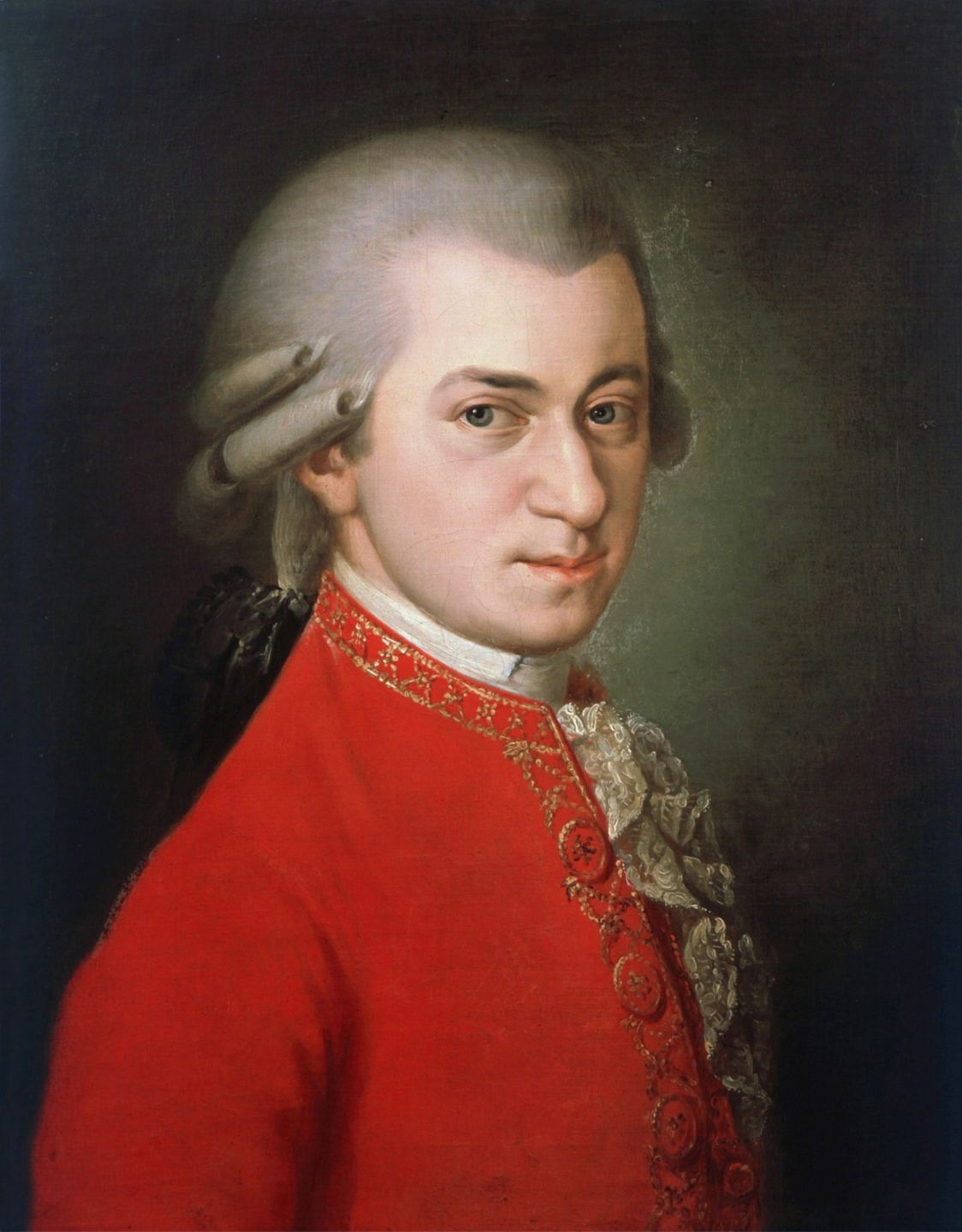
Posthumous portrait of wolfgang Amadeus Mozart by barbara krafft, 1819 — commissioned by the breitkopf and härtel publishing house. Barbara Krafft, Public domain, via Wikimedia Commons
Music as Mathematics
On this day in 1756 — Wolfgang Amadeus Mozart was born, and would turn the strict mathematics of music into something that sounds like pure feeling.
3 min read
Wolfgang Amadeus Mozart was born in Salzburg on January 27, 1756. By age five, he was composing music. By six, he was performing for European royalty. By his death at 35, he had written over 600 works: symphonies, concertos, operas, chamber music, sacred music. The volume alone is staggering, but what made Mozart singular wasn't productivity. It was the structural clarity of his compositions. Every note served a purpose. Nothing was wasted. The music felt inevitable, like solving an equation where all the variables align perfectly.
Mozart understood music as a formal system. Melodies followed patterns. Harmonies resolved according to rules. Rhythms created expectations, then satisfied or subverted them. He worked within strict constraints, the sonata form, the conventions of opera, the limitations of 18th-century instruments, and used those constraints as creative scaffolding. His innovations came from rearranging known elements into unexpected configurations, not from breaking the system but from mastering it so thoroughly he could make it do things no one else had thought possible.
His process was famously effortless. Mozart reportedly composed entire pieces in his head before writing them down, fully formed, with minimal revision. Whether this is literally true or a romanticized myth doesn't matter. What's documented is the speed and fluency of his output. He could write a symphony in a few days, an opera in weeks. For Mozart, composition wasn't laborious. It was fluent translation of internal structures into notation. The music already existed in his mind. Writing it down was transcription.
The mathematical precision of his work is most obvious in his use of symmetry and variation. A theme introduced in one key reappears in another, transformed but recognizable. Melodies invert, compress, expand. He built complex structures from simple motifs, the way fractal patterns generate infinite complexity from basic rules. Listen to the variations in his piano concertos or the fugal passages in his Requiem. They're exercises in permutation, exploring how many ways a single idea can be reconfigured while remaining coherent.
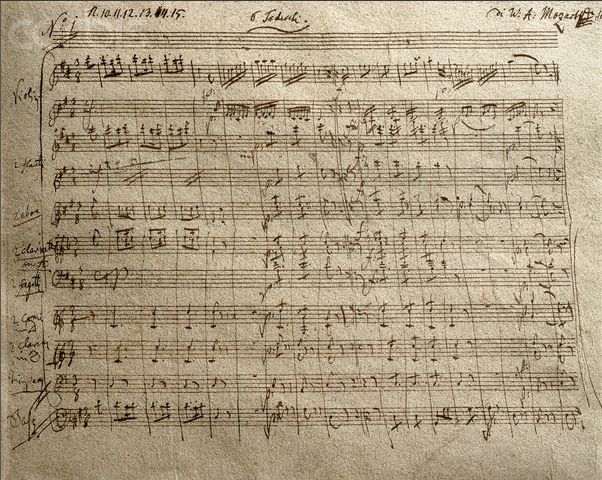
Mozart's autograph musical score for the prague symphony (k. 504), showing his handwritten notation — compositions formed fully in mind before reaching paper. Wolfgang Amadeus Mozart, Public domain, via Wikimedia Commons
Mozart's operas reveal another kind of structural intelligence: character as musical identity. In "Don Giovanni," each character has a distinct musical style. The Don's music is confident, seductive. Leporello, his servant, sings in rapid patter. Donna Anna's music is tragic and formal. The orchestra comments on the action, foreshadows events, reveals subtext the characters themselves don't acknowledge. Mozart used music the way architects use space, creating environments where relationships and tensions become perceptible through sound.
He died in Vienna in December 1791, in debt, in the middle of composing his Requiem. The cause of death is still debated. What's not debated is the influence. Every composer who came after had to reckon with Mozart. Beethoven studied his scores obsessively. Brahms said he felt Mozart's shadow behind him whenever he wrote. Modern musicians still use his work as a benchmark for clarity, balance, and formal perfection. The music remains in constant performance because the structures hold. They don't age or become obsolete. Mathematics doesn't expire.
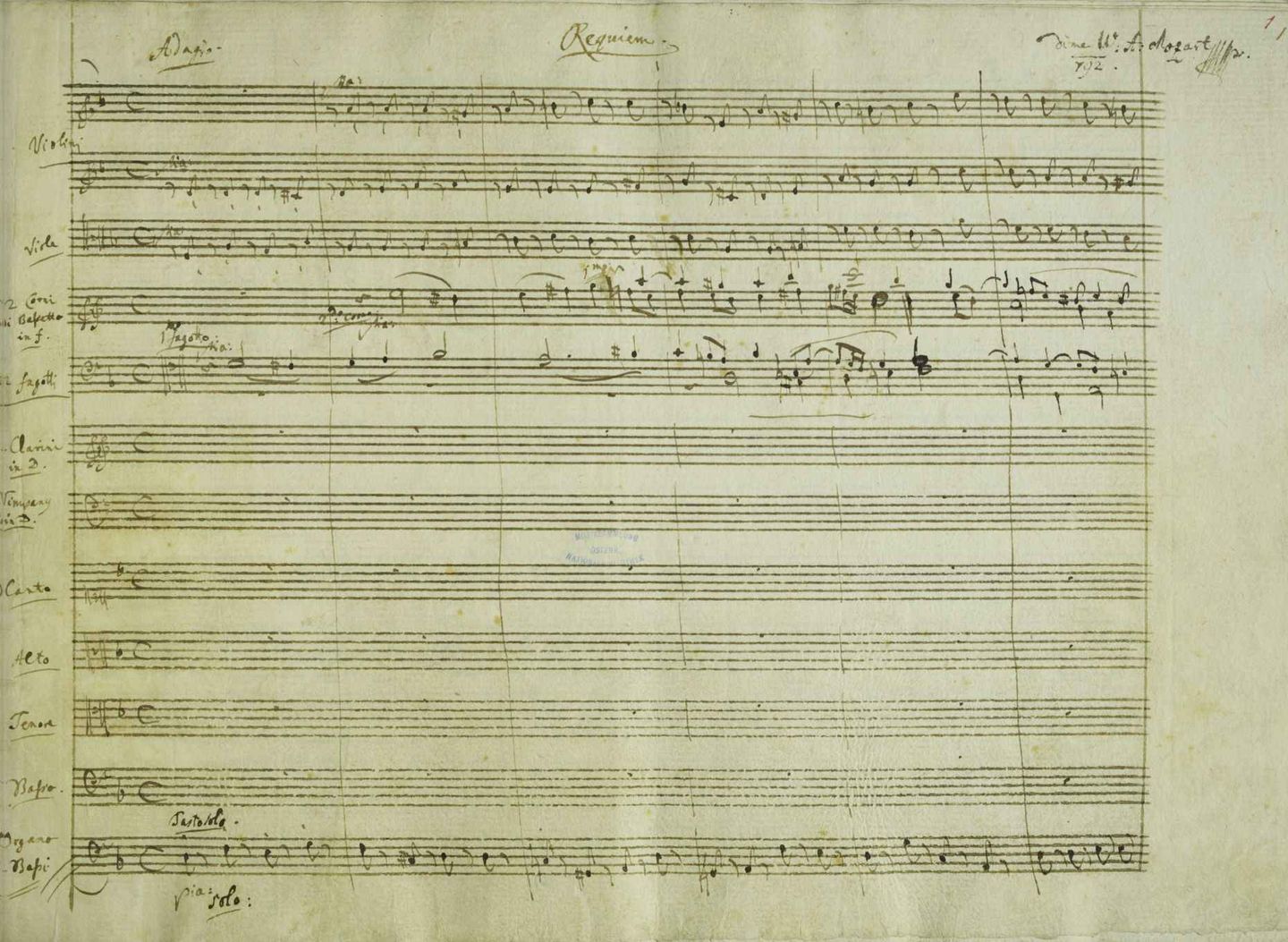
Title page of the Requiem in d minor (k. 626), the work Mozart left unfinished at his death in Vienna, 1791. Public domain, via Wikimedia Commons
Mozart didn't invent musical forms. He perfected them. He showed that working within constraints doesn't limit creativity. It focuses it. Every design system, every modular architecture, every set of rules that generates infinite variations traces back to this principle: structure enables rather than restricts. Beauty emerges from solving problems elegantly within given parameters. Mozart proved that 250 years ago. The proof still plays.
studio / on-this-day / Jan 27