studio / on-this-day / Jan 23
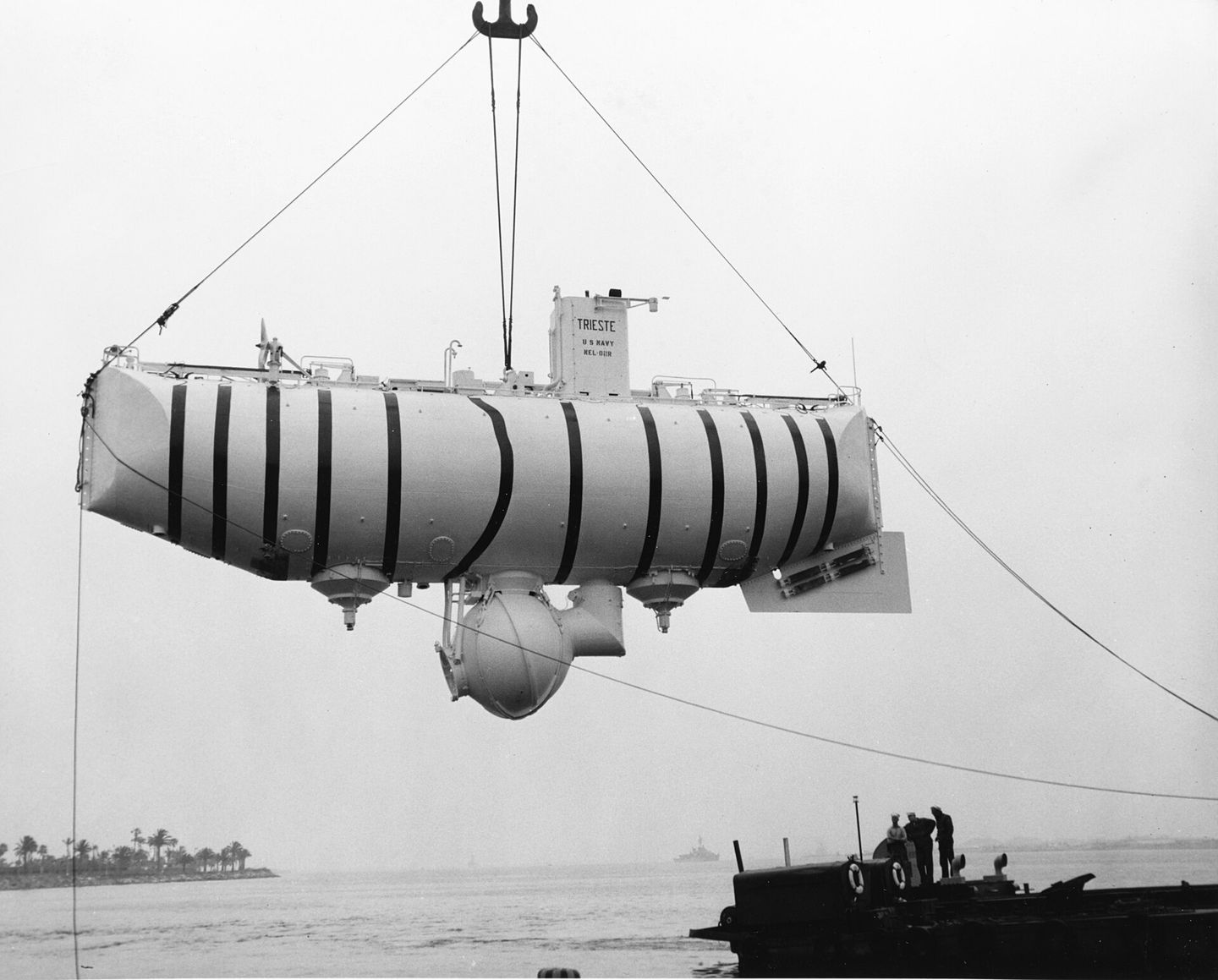
The bathyscaphe Trieste. U.s. navy, public domain, via Wikimedia Commons
Seven Miles Down
On this day in 1960 — two men rode a steel sphere to the deepest point in the ocean, nearly seven miles down, and found it was not empty.
4 min read
On January 23, 1960, in the Pacific Ocean far southwest of Guam, two men climbed into a cramped steel ball bolted beneath a float the size of a railcar and began, deliberately, to sink. Jacques Piccard and Don Walsh were headed for the Challenger Deep, the lowest known point on the surface of the Earth, almost seven miles straight down. No human had ever been there. Almost no one believed anything could survive the pressure at the bottom.
That pressure is the whole problem. At the floor of the Mariana Trench, the weight of the water above presses down at roughly eight tons on every square inch, more than a thousand times the pressure at the surface. It would crush an ordinary submarine hull like a can. The bathyscaphe, invented by Jacques's father Auguste Piccard, got around it by refusing to fight it. A thick steel sphere held the crew, and it hung beneath a huge tank of gasoline, which is lighter than water and barely compresses. Iron shot held in ballast tanks pulled the craft down; drop the shot, and it floated back up. It was, essentially, a submarine built like a balloon.
The descent took about five hours, and it was cold, cramped, and dark. A few hundred feet down the sunlight was gone and everything past the sphere's small window was black. Partway down, one of the outer window panes cracked with a bang loud enough to shake the vessel. They talked it over and kept going.
They reached the bottom at nearly 36,000 feet, and there, in the beam of the lamp, Piccard reported seeing a flatfish glide slowly across the sediment, a vertebrate, alive, under pressure that should have flattened it. The sighting has been argued about ever since; some biologists think what he saw was more likely a sea cucumber, since no flatfish has been confirmed at that depth. But the claim, right or wrong, reframed the deepest ocean in a single instant: not a dead void, but a place where something could live.
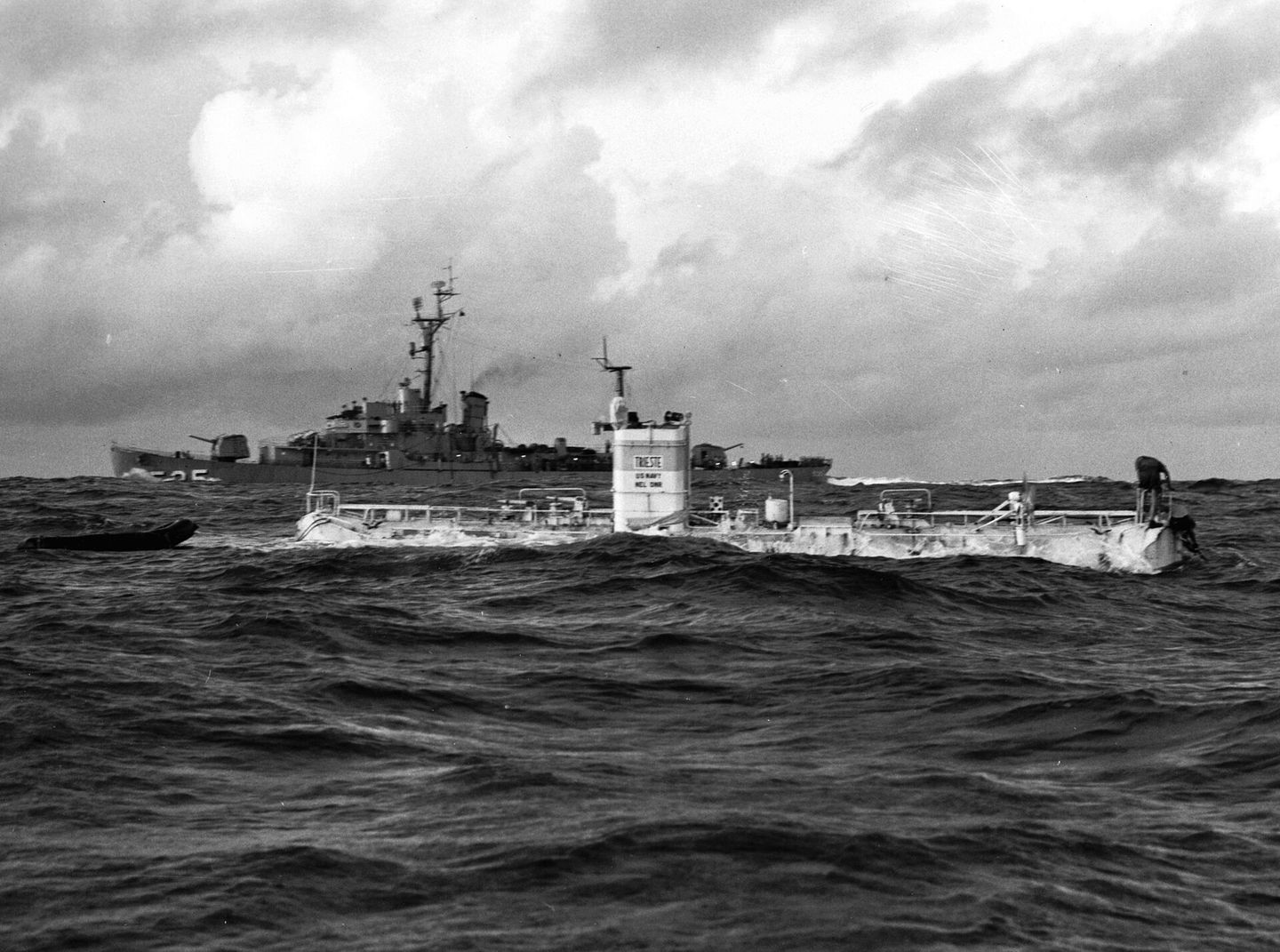
Trieste being tended over the Mariana Trench on the day of the dive, January 23, 1960. U.S. navy, public domain, via Wikimedia Commons
They stayed about twenty minutes. Their landing had stirred up a cloud of silt that hung in the water and ruined the view, so they released the iron ballast and began the long, slow rise back toward the light. The whole trip to the bottom of the world and back took the better part of a day.
No one returned to the Challenger Deep for fifty-two years, until a filmmaker made the descent alone in 2012. Trieste had proven a principle that keeps showing up wherever engineers face an overwhelming force: you do not usually beat it by building something big enough to resist it head-on. You design around it. A small strong sphere, a tank of gasoline, a handful of iron pellets, and suddenly the most hostile place on the planet is somewhere a person can visit and come home from.
The Trieste sits in a museum now. The Challenger Deep is still down there, still black, still crushing, still almost entirely unexplored. For twenty minutes on a January afternoon in 1960, it had two visitors, and what they carried back was not a sample or a map but a single stubborn fact: even at the very bottom, in the dark, under all that weight, there was something moving.
studio / on-this-day / Jan 23