studio / on-this-day / Jan 19
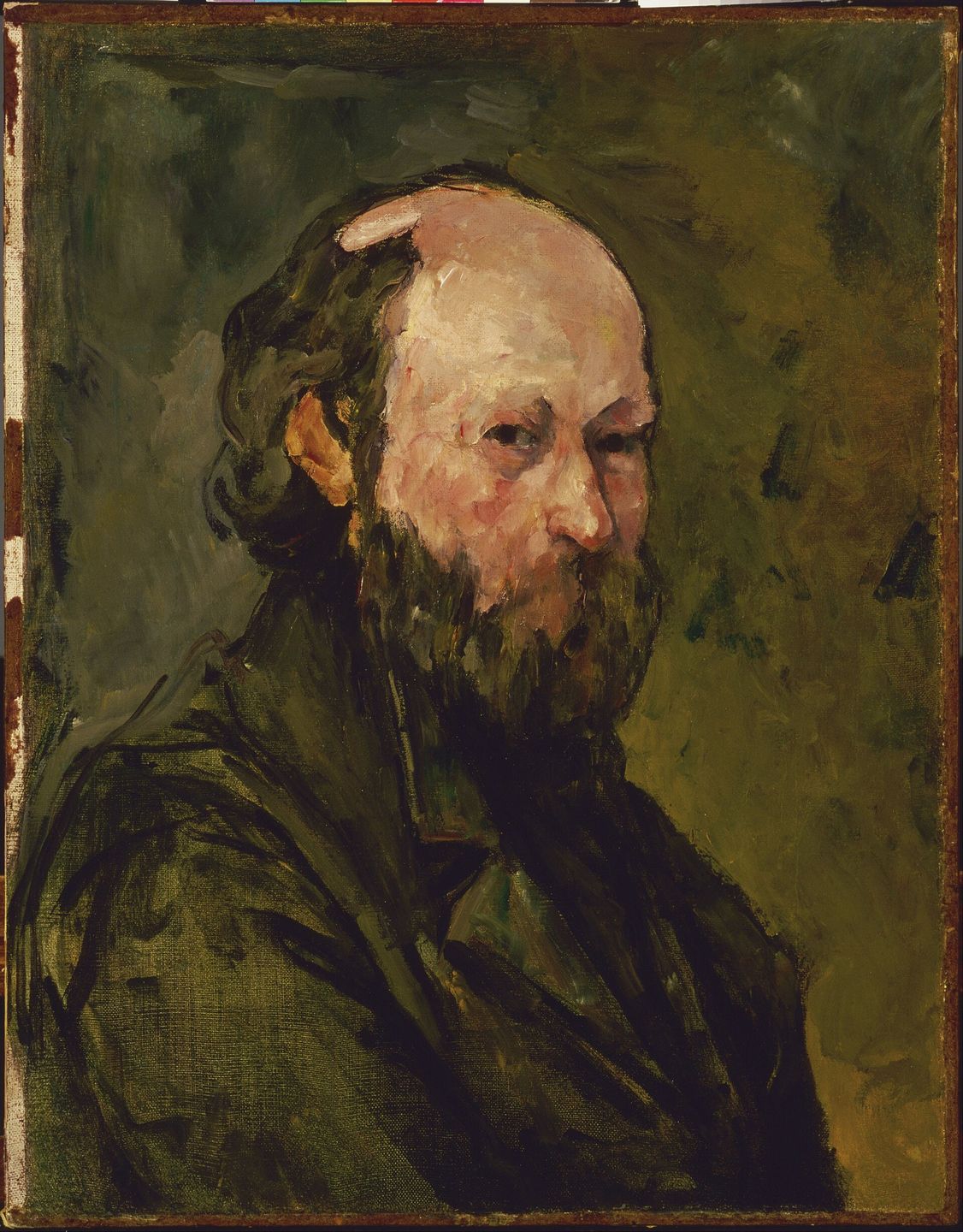
Self-portrait of paul cézanne, c. 1880, showing the artist who rebuilt painting from the ground up. Paul Cézanne, Public domain, via Wikimedia Commons
Geometry in Nature
On this day in 1839 — Paul Cézanne was born, and taught painting to see the cones and spheres hiding inside a mountain, an apple, a face.
3 min read
Paul Cézanne was born in Aix-en-Provence on January 19, 1839. His father owned a bank. Cézanne studied law, hated it, and moved to Paris to paint. He failed the entrance exam to the École des Beaux-Arts. For years, the Paris Salon rejected his work. Critics called his paintings clumsy, unfinished, incomprehensible. He kept painting anyway, mostly in isolation, reworking the same subjects over and over: apples on a table, Mont Sainte-Victoire, bathers in a landscape.
What Cézanne was doing, though no one understood it at the time, was rebuilding painting from the ground up. He rejected the idea that a painting should look like a photograph or imitate reality. Instead, he treated the canvas as a surface where forms, colors, and spatial relationships could be constructed deliberately, like an architect designs a building. He painted apples not as they appear to the eye but as simplified volumes in space. Mountains became geometric planes. Trees turned into interlocking cylinders and cones.
His technique was obsessive. He would spend weeks on a single still life, adjusting angles, reworking color relationships, shifting perspectives within the same composition. The table in one of his paintings might be viewed from above while the fruit on it is seen from the side. Multiple viewpoints coexist in a single frame. This wasn't a mistake or a lack of skill. It was a deliberate attempt to show how vision actually works: not as a fixed snapshot but as accumulated information from shifting positions over time.
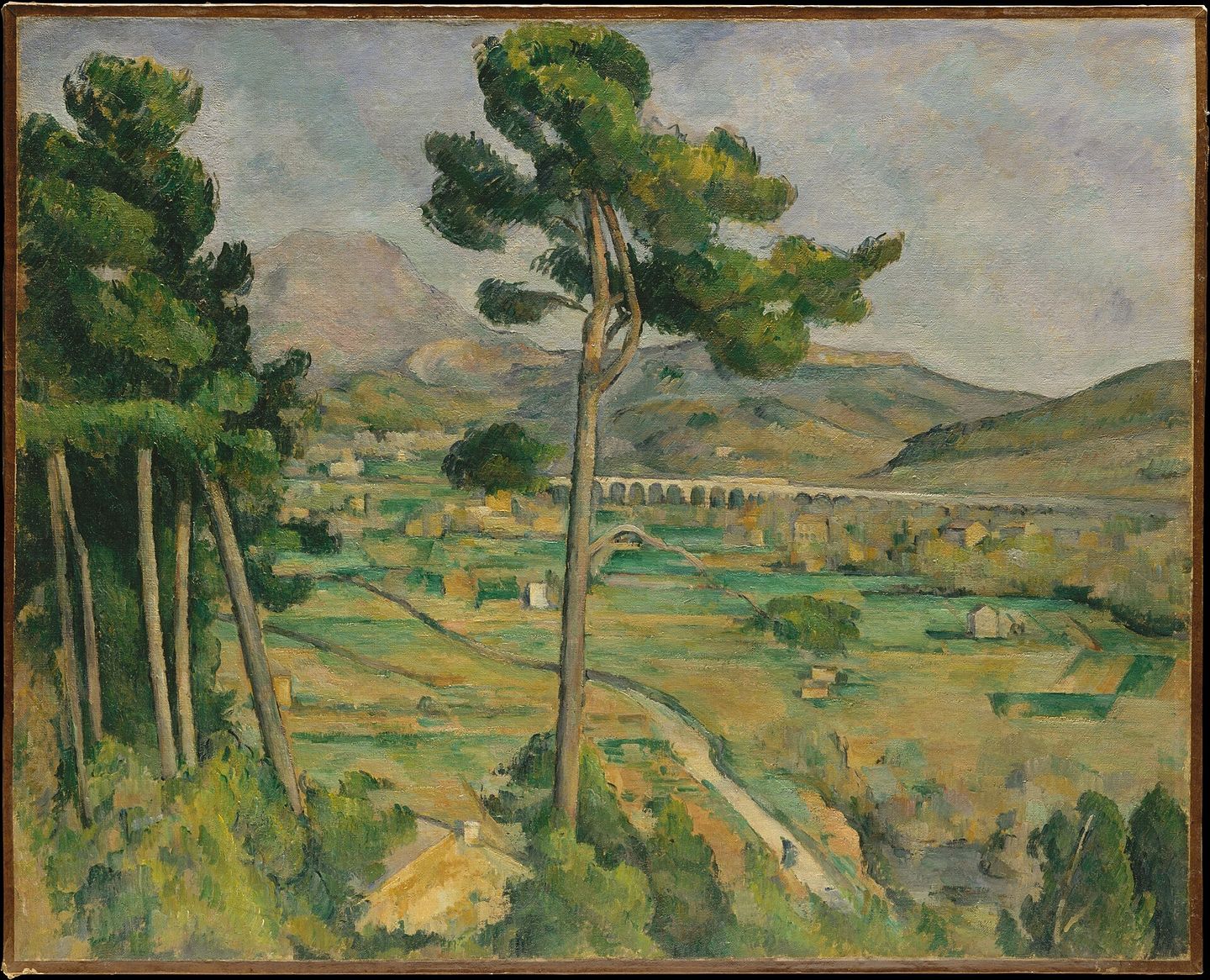
Mont Sainte-Victoire and the viaduct of the arc river valley, paul cézanne, c. 1882–85. metropolitan museum of art. Paul Cézanne, Public domain, via Wikimedia Commons
Cézanne once told a young painter to treat nature by means of the cylinder, the sphere, and the cone. This advice became a foundational principle for the generation that followed him. Pablo Picasso and Georges Braque studied Cézanne's work obsessively and used it as the starting point for cubism. The idea that objects could be broken into geometric components, viewed from multiple angles simultaneously, and reassembled on a flat surface came directly from Cézanne's patient dismantling of traditional perspective.
He worked slowly. He was never satisfied. He abandoned more paintings than he finished. Near the end of his life, he told a friend that he was still a student of nature, still searching for the right way to see. In October 1906, he was caught in a rainstorm while painting outdoors. He collapsed, was carried home by a passing laundry cart, and died a week later at 67. By then, younger artists had begun to recognize what he'd done, even if the broader public hadn't.
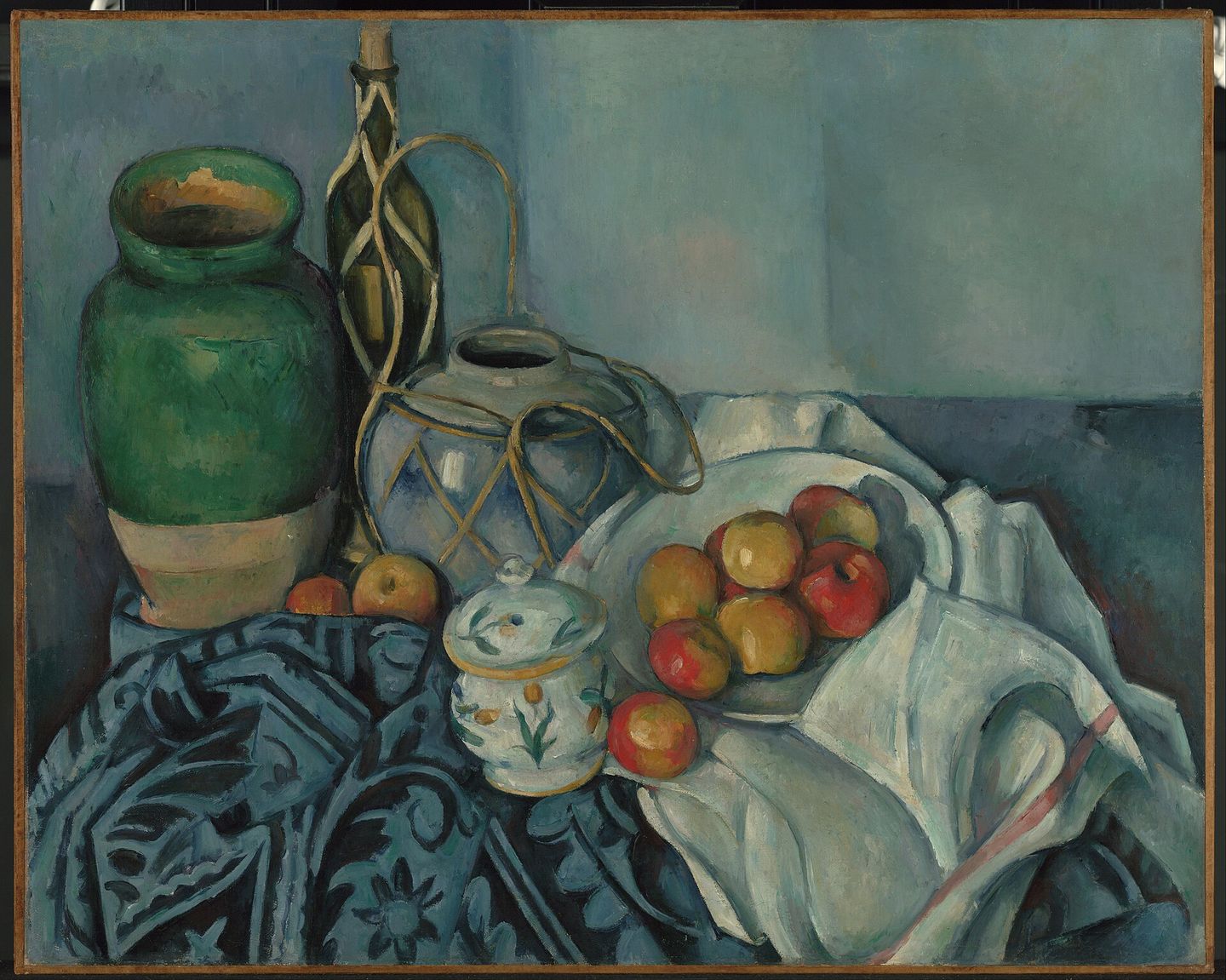
Still life with apples, paul cézanne, c. 1893–94. the simple fruit he reworked obsessively, treating each form as a volume in space. Public domain, via Wikimedia Commons
Within a decade of his death, Cézanne was understood as the bridge between 19th-century realism and 20th-century abstraction. He showed that visual representation could be a constructed system rather than an imitation of nature. Every designer working with grids, modular systems, or spatial composition owes something to this shift in thinking. Cézanne proved that breaking something into its underlying structure doesn't destroy it. It reveals what was there all along.
studio / on-this-day / Jan 19