studio / on-this-day / Jan 18
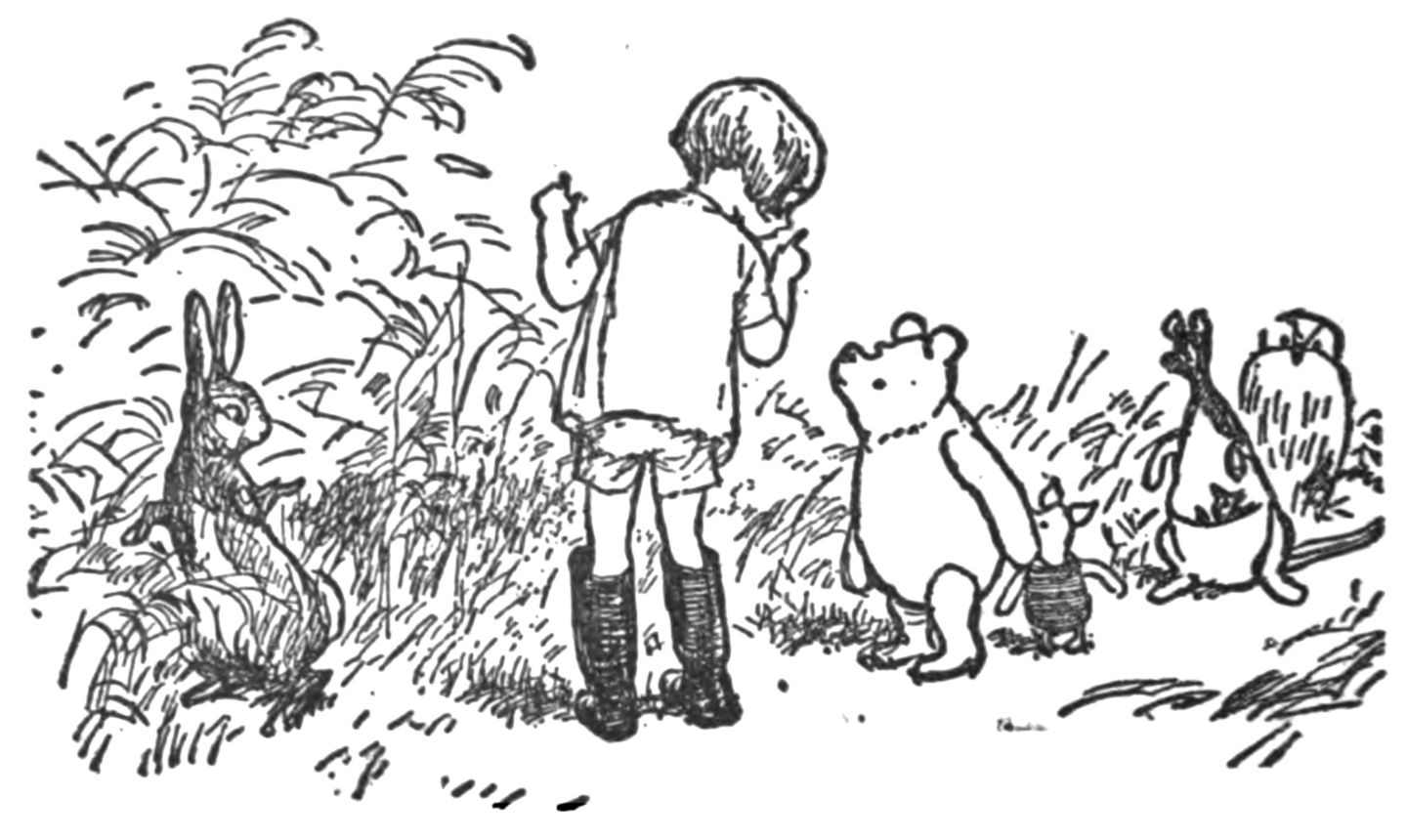
Illustration of winnie-the-Pooh by ernest h. shepard from the original 1926 book by a.a. Milne. Ernest Howard Shepard, Public domain, via Wikimedia Commons
A Universe From Simplicity
On this day in 1882 — A.A. Milne was born, and would build the Hundred Acre Wood, an entire world assembled from a child's few stuffed toys.
3 min read
Alan Alexander Milne was born in London on January 18, 1882. He studied mathematics at Cambridge, became a playwright and Punch magazine editor, and served in World War I. None of that is why anyone remembers him. He's remembered because in 1926, at age 44, he wrote a children's book about a bear with very little brain who lived in a forest with a boy, a donkey, a pig, and a tiger. It sold millions of copies and has never gone out of print.
Winnie-the-Pooh is deceptively simple. The Hundred Acre Wood has no villains, no quests, no moral lessons. Characters wander around looking for honey, getting stuck in rabbit holes, and worrying about imaginary creatures called Heffalumps. The stakes are low. The vocabulary is limited. The illustrations by E.H. Shepard are line drawings with minimal detail. And yet the world feels complete, internally consistent, emotionally true.
Milne built the Hundred Acre Wood the way a designer builds a product: by defining constraints and working within them. The geography is small and circular. The cast is limited. Each character has one or two defining traits. Pooh is hungry and kind. Eeyore is gloomy but loyal. Piglet is anxious but brave. These aren't characters with arcs or development. They're fixed archetypes, and the stories emerge from how they interact under changing conditions.
The structure mirrors how children actually play. There's no overarching plot, just a series of small situations: a walk in the woods, a search for a missing tail, a picnic disrupted by rain. The format anticipates episodic television, modular narrative design, and the procedural storytelling that defines so much of modern entertainment. Each chapter is self-contained but part of a larger fabric. You can read them in any order and the world still holds together.
What Milne understood, perhaps better than any children's author before him, was that simplicity is a design choice, not a limitation. Dr. Seuss would later prove the same thing with an even more constrained vocabulary, but Milne got there first by stripping away everything that wasn't essential. No backstories. No subplots. No explanations for why a bear and a boy are best friends. The world just is, and that's enough.
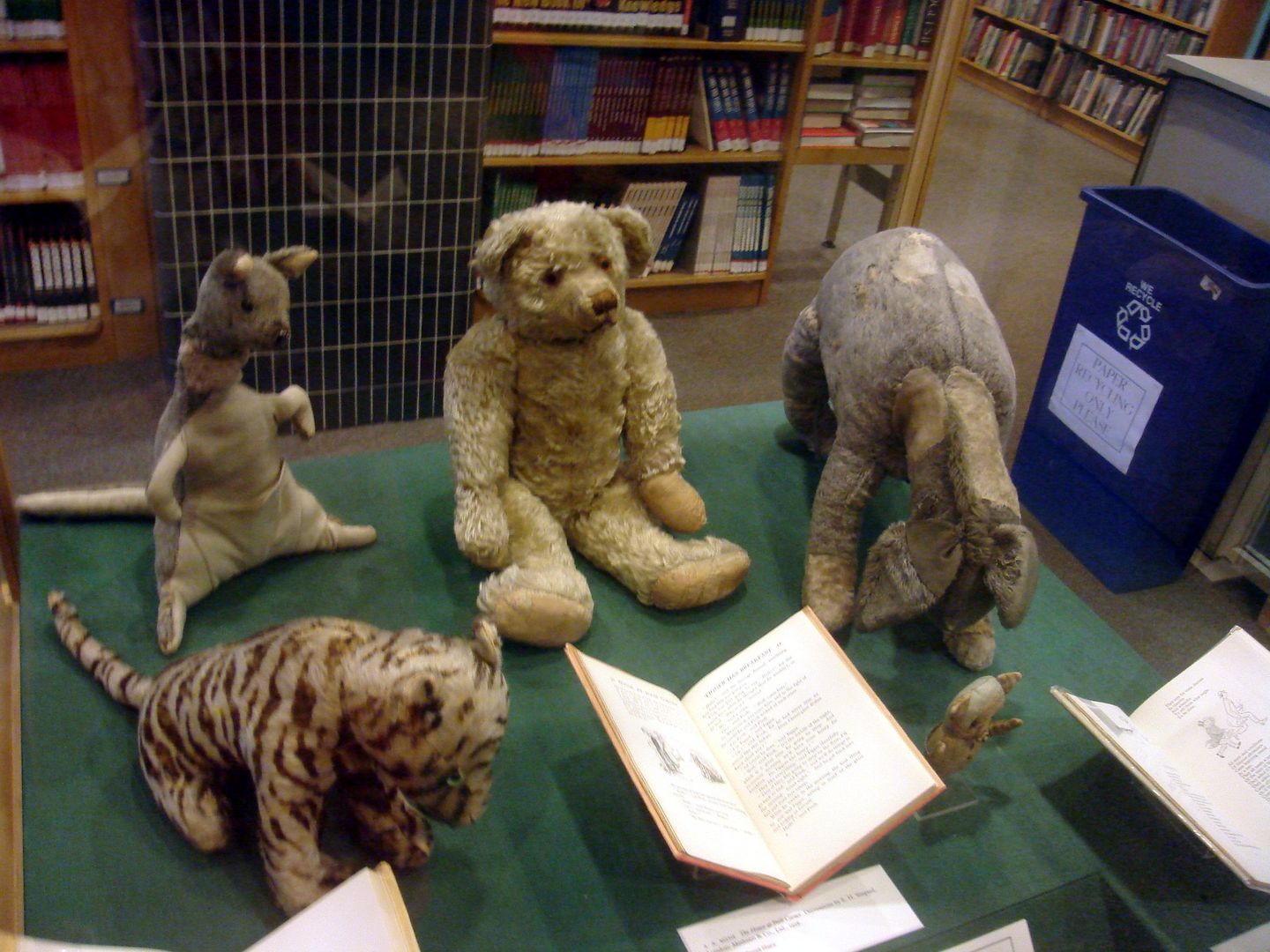
The original stuffed animals that belonged to Christopher Robin Milne — winnie-the-Pooh, Piglet, Eeyore, Kanga, and Tigger — now held at the new York Public library. Spictacular (talk · contribs), Public domain, via Wikimedia Commons
Milne's son, Christopher Robin, became the boy in the books, and the real stuffed animals in his nursery became Pooh, Piglet, Eeyore, Kanga, and Tigger. This collapsed the boundary between fiction and reality in a way Christopher Robin never forgave his father for. He grew up resenting the fame, the association, the way his childhood had been turned into intellectual property. The same creative decision that made the books feel authentic made his actual life feel public and performed.

Poohsticks bridge in ashdown forest, east sussex — the real woodland near Milne's home that became the Hundred Acre Wood. Robin Webster, CC BY-SA 2.0, via Wikimedia Commons
Milne died in 1956. The Hundred Acre Wood outlived him, and it will outlive everyone reading this. Disney adapted it, merchandise flooded the market, and the characters became global icons. But the original books remain small, quiet, and structurally elegant. They prove that you don't need complexity to create depth, that constraint can be generative, and that the simplest systems often scale the furthest. Sometimes a bear, a forest, and a jar of honey are enough to build a universe that lasts.
studio / on-this-day / Jan 18