studio / on-this-day / Jan 14
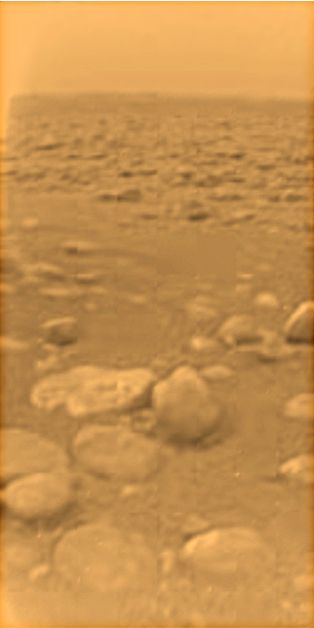
The surface of Titan, photographed by Huygens after touchdown on January 14, 2005, showing rounded pebbles of ice on a frozen plain. NASA / ESA / University of Arizona, public domain, via Wikimedia Commons
A Postcard from Titan
On this day in 2005 — the Huygens probe fell through the orange haze of Saturn's largest moon and became the first spacecraft to land in the outer solar system.
4 min read
On January 14, 2005, a small probe named Huygens let go of the spacecraft it had ridden for seven years and fell toward a moon no one had ever seen the surface of. Titan, the largest moon of Saturn, is wrapped in a thick orange haze that no telescope can see through. For all of human history it had been a smudge, a blank disc. Huygens was built to fall through that haze and find out what was underneath.
Titan is a strange place to send anything. It is bigger than the planet Mercury, and it is the only moon in the solar system with a dense atmosphere, a nitrogen sky heavier than Earth's, laced with methane and a smog of complex organic molecules. Under the clouds, scientists could only guess. Maybe there were oceans of liquid methane. Maybe there was solid ice. Maybe there was a shoreline. You could not answer the question by looking. You had to go, and you had to land.
Huygens had crossed nearly a billion miles bolted to NASA's Cassini orbiter. When it separated and began its descent, it was entirely on its own. Titan is so far away that a radio signal takes more than an hour to reach it, which meant no one on Earth could fly the probe. Every decision, every parachute release, every instrument reading had to be handled by the machine itself, in real time, with no second chances. The descent would take about two and a half hours, and it would happen once.
As Huygens fell, the haze thinned and a landscape resolved beneath it. What it saw looked eerily familiar: dark drainage channels branching like rivers, bright highlands, what appeared to be shorelines and floodplains. It was a world clearly shaped by flowing liquid, with weather and erosion, rain and runoff. But the liquid was not water. At around 290 degrees below zero Fahrenheit, the rivers of Titan run on methane. It was Earth's grammar written in an alien chemistry.
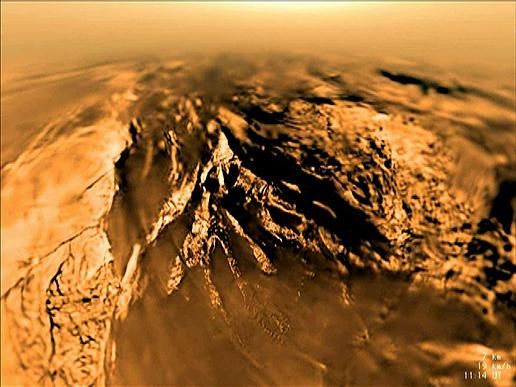
Titan's surface, stitched together from images taken during Huygens' descent. NASA / ESA / University of Arizona, public domain, via Wikimedia Commons
Then it touched down, on a flat, cold plain scattered with rounded pebbles of ice, cobbles smoothed and sorted the way stones are smoothed in a streambed. Huygens had landed on what looked like a dry riverbank at the edge of the solar system. It kept transmitting from the surface for about 72 minutes, until Cassini slipped below Titan's horizon and there was no longer anyone to hear it. Then it went quiet, and it is quiet still.
It was the first landing ever made in the outer solar system, and it remains the only one. The engineering behind it is almost absurd: build a machine, seal it up, fly it for seven years across the dark, and trust it to wake up, fall blind through an unknown sky, and describe what it finds, all before anyone back home even knows it has begun. Just as Deep Impact reached into a comet no instrument could see inside, Huygens reached through a veil no telescope could pierce, and reported back.
Titan matters because it is a chemistry set the size of a moon. Its thick, hazy, organic-rich atmosphere is thought to resemble, in a frozen and slowed-down way, the air of the early Earth before life began. Nowhere else can we watch that kind of chemistry running at planetary scale. To study Titan is to study a version of our own beginning, kept in cold storage a billion miles away.
The probe is still sitting there, on its plain of ice pebbles, the most distant object humans have ever set down on solid ground. It did not conquer Titan. It fell through the sky, landed on a shore, and spent its last hour sending home a single idea: this is what is under the clouds. For seventy-two minutes, a world that had been a blank disc for all of history had a picture, and it looked, impossibly, a little like home.
studio / on-this-day / Jan 14