studio / on-this-day / Jan 10
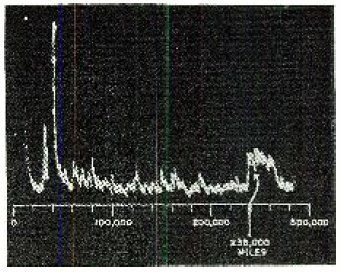
The first radar return Signal from the Moon, recorded during Project Diana, January 10, 1946. Public domain, via Wikimedia Commons
Touching the Moon with Radio
On this day in 1946 — a radar pulse was bounced off the Moon and back, the first time humans reached out and touched another world.
3 min read
On January 10, 1946, engineers at the U.S. Army Signal Corps laboratory in New Jersey pointed a radar antenna at the Moon and waited. They transmitted a pulse of radio waves at 111.5 megahertz, powerful enough to travel a quarter million miles through space, reflect off the lunar surface, and return to Earth. The round trip took 2.5 seconds. When the echo appeared on their oscilloscope, faint but unmistakable, it proved something that had never been demonstrated before: humans could touch another world with electromagnetic radiation.
The project was called Project Diana, named after the Roman goddess of the Moon. It was led by John DeWitt, a radio engineer who had spent the war years developing radar systems to detect incoming aircraft and missiles. Radar had been decisive in World War II, giving Allied forces the ability to see in the dark and through clouds. But no one had tried to bounce a signal off something 238,000 miles away. The Moon was a small target at an impossible distance, and the signal would spread and weaken as it traveled. Most experts thought it wouldn't work.
It worked. The signal that came back was weak, buried in noise, but it was there. The engineers had to average hundreds of pulses to extract it from the static, but the timing was perfect. Light travels at a fixed speed, and the delay matched the distance. The Moon had reflected radio waves the same way it reflected sunlight. Electromagnetic radiation behaved the same way at all scales.
The experiment had no immediate practical application. It was pure research, a proof of concept. But it opened a door. If you could bounce a signal off the Moon, you could measure the distance to it with extraordinary precision. You could map its surface using radio instead of light. You could communicate with spacecraft on the far side of it by using the Moon as a relay. Within a decade, radar would become the primary tool for studying the solar system, revealing the rotation of Venus, the rings of Saturn, and the surface features of Mars.
Project Diana also laid the groundwork for satellite communication. If a radio signal could travel to the Moon and back, it could certainly reach a satellite in low Earth orbit. By the 1960s, communications satellites were bouncing signals around the planet, making global television broadcasts and intercontinental phone calls possible. Just as Morse code had compressed communication into dots and dashes, radar compressed distance into time, turning the speed of light into a measuring tool.
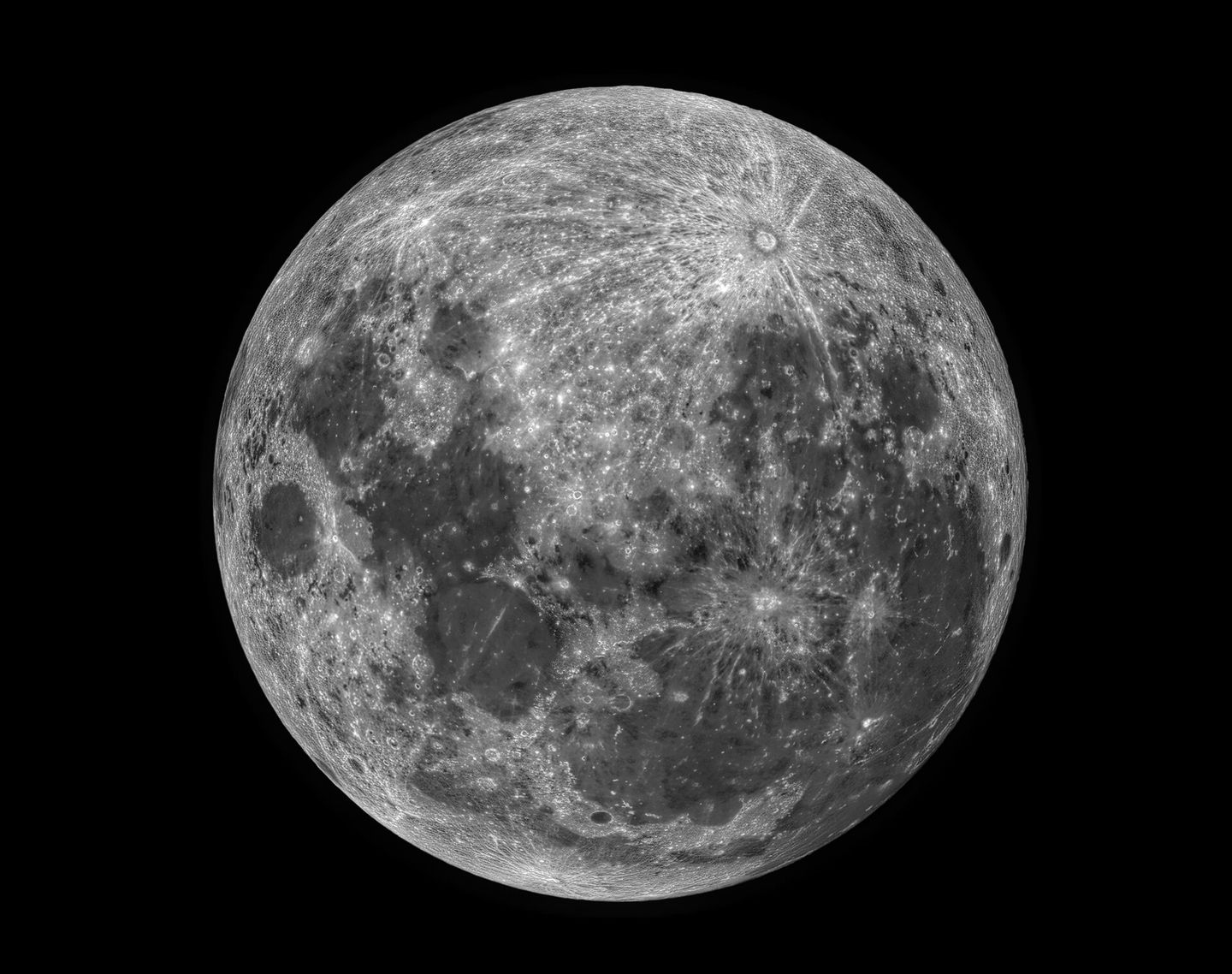
The full Moon — the target that reflected the first radar Signal sent from Earth in 1946. Ram samudrala, CC BY 4.0, via Wikimedia Commons
The technology was elegant in its simplicity. You send a pulse. You wait. You measure how long it takes to come back. The echo tells you the distance. If you send many pulses and analyze the reflections, you can build a picture of the surface. Radar doesn't care about clouds, darkness, or atmospheric distortion. It sees through all of them. It turned the invisible spectrum into a sense, a way of perceiving the world that human eyes could never access directly.
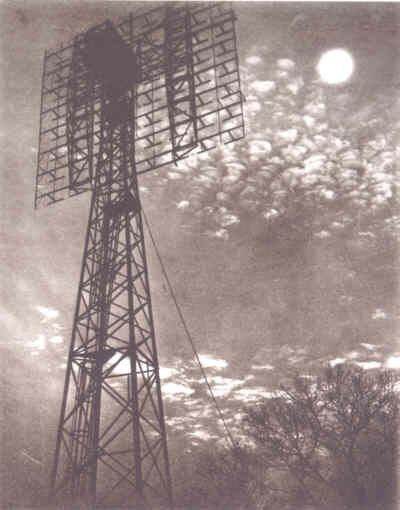
The Project Diana antenna at camp evans, New Jersey — the modified radar array that sent the pulse to the Moon and caught its echo. Public domain, via Wikimedia Commons
Today, radar is everywhere. It guides planes, tracks weather, maps terrain, monitors traffic, measures sea levels, and watches for asteroids. Spacecraft use it to land on other planets. Police use it to measure speed. Archaeologists use it to find buried cities. The principle is always the same: send a signal, listen for the echo, measure the delay. The technology that started with a faint blip on an oscilloscope in New Jersey became one of the fundamental tools of the modern world.
The first radar echo from the Moon was a moment of pure discovery, proof that human ingenuity could reach across the void and touch something impossibly far away. It didn't conquer the Moon. It just said hello. But that was enough. It showed that the distance between here and there was measurable, knowable, and ultimately, crossable.
studio / on-this-day / Jan 10