studio / on-this-day / Sep 7
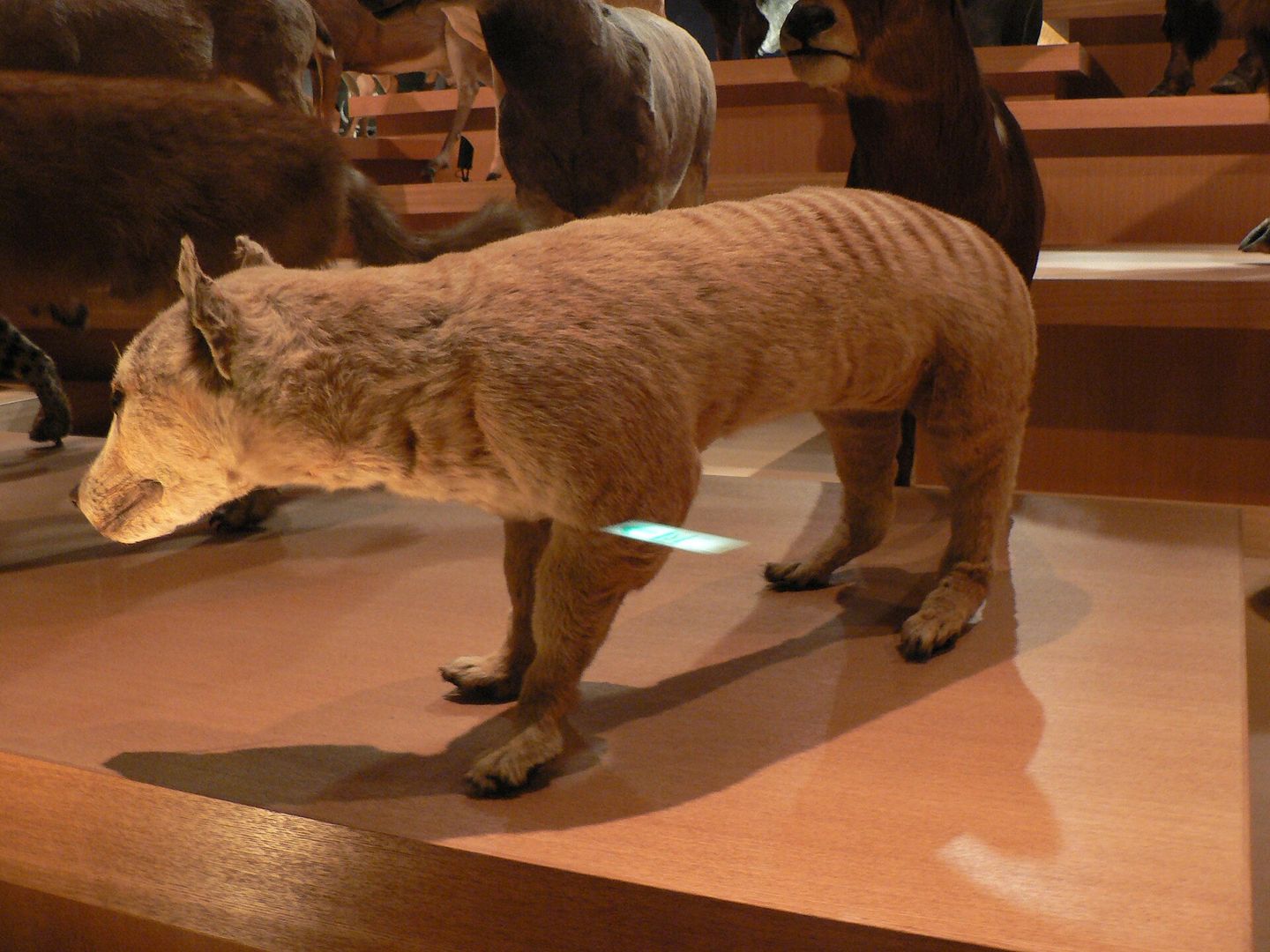
A thylacine at Beaumaris Zoo in Hobart, 1936. pengo-au (Peter Halasz), CC BY-SA 2.0, via Wikimedia Commons
The Last of Its Kind
On this day in 1936 — the last thylacine died in a Tasmanian zoo, extinction being the one design failure that can never be undone.
3 min read
On the night of September 7, 1936, the last known thylacine died alone in Hobart Zoo in Tasmania. The animal, believed to have been a female, had been locked out of its sleeping quarters during an unusually cold night. It died of exposure. No one even recorded its name. By the time keepers found the body the next morning, an entire species had vanished. The thylacine, also known as the Tasmanian tiger or Tasmanian wolf, was extinct.
The thylacine was not a tiger or a wolf. It was a marsupial carnivore, the largest predator of its kind to survive into modern times. It looked like a dog with a stiff tail and distinctive dark stripes across its back, but its evolutionary lineage diverged from placental mammals millions of years ago. The thylacine was what happens when evolution solves the same problem, predation, using entirely different architectural blueprints. Its rear-opening pouch, its unusual gait, and its ability to open its jaws to an almost impossible 120-degree angle made it one of the strangest creatures on the planet.
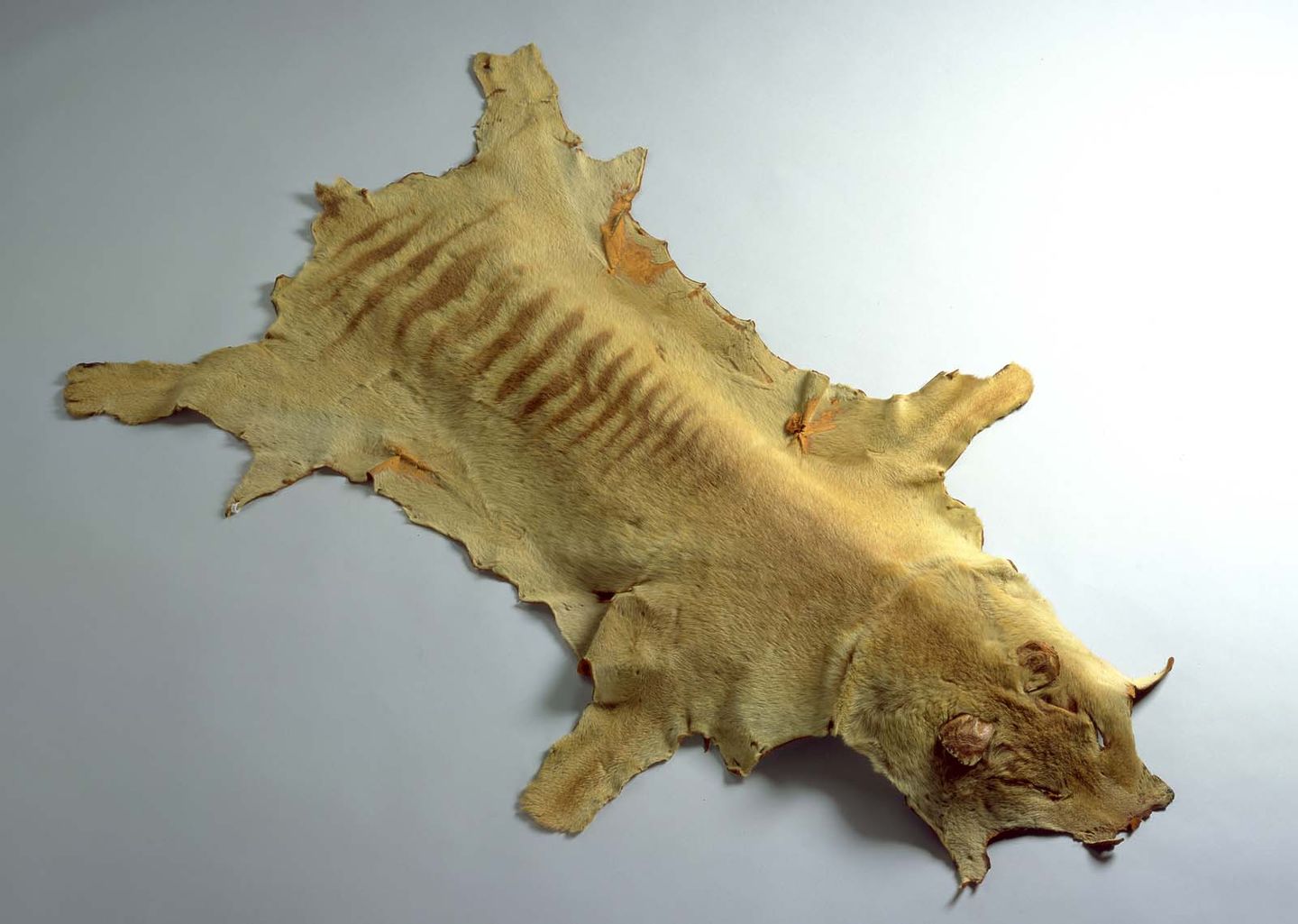
A thylacine pelt in the National Museum of Australia — the kind of trophy the Tasmanian bounty system rewarded. George Serras, National Museum of Australia, CC BY 3.0 au, via Wikimedia Commons
When European settlers arrived in Tasmania in the early 1800s, thylacines were still common. But sheep farming expanded rapidly, and the thylacine, like any apex predator, occasionally killed livestock. The response was systematic extermination. The Tasmanian government offered bounties for dead thylacines starting in 1888. Farmers shot them. Trappers poisoned them. Hunters tracked them with dogs. Over the next few decades, thousands were killed. By 1910, sightings had become rare. By 1930, the species was functionally extinct in the wild.
The tragedy is that the bounty program continued even as the thylacine disappeared. The last known wild thylacine was shot in 1930. The last captive animal died six years later. There was no coordinated conservation effort, no attempt to establish a breeding population, no recognition that the species was on the edge of oblivion until it was too late. The system designed to protect human economic interests worked exactly as intended. It just happened to erase an entire species in the process.
Extinction is irreversible. Unlike most design failures, you cannot iterate, patch, or rebuild. Once a species is gone, it takes its genetic information, its ecological role, and millions of years of evolutionary adaptation with it. The thylacine filled a niche as Tasmania's top predator. When it vanished, that niche remained empty. The ecosystem did not collapse, but it changed in subtle ways that are still being studied. The absence of an apex predator alters prey behavior, population dynamics, and vegetation patterns. The system reconfigured itself, but it is not the same system it was.
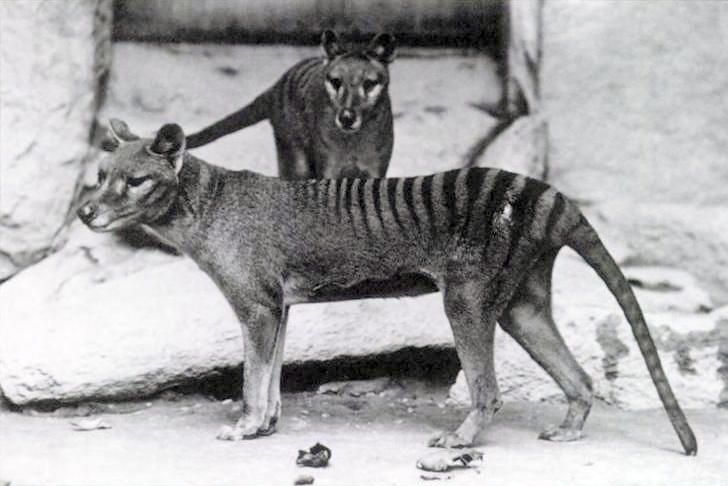
A captive thylacine — millions of years of evolution, erased in a few decades of bounty hunting. Baker; E.J. Keller., Public domain, via Wikimedia Commons
Since 1936, there have been hundreds of reported thylacine sightings in Tasmania. Most are misidentifications, wishful thinking, or outright hoaxes. People want to believe the species survived. There is something deeply unsettling about finality, about the idea that we could casually eliminate a creature that had existed for millions of years. But despite extensive searches, camera traps, and even efforts to extract DNA from preserved specimens, no living thylacine has ever been found.
In recent years, scientists have explored the possibility of de-extinction using genetic engineering. Tissue samples and even a preserved thylacine pup in ethanol exist in museum collections. The idea is to sequence the thylacine genome, edit the DNA of a closely related species like the Tasmanian devil, and essentially reverse-engineer a thylacine. Whether this is scientifically feasible, ethically justified, or ecologically sound remains an open question. Even if it works, the result would not be a true thylacine. It would be a designed approximation, a genetic reconstruction of something we destroyed.
The thylacine is now Tasmania's official animal emblem, a symbol of the island's unique wildlife and a reminder of what was lost. It appears on the Tasmanian coat of arms, on tourism brochures, and in countless documentaries. We memorialize the species we drove to extinction, turning it into an icon of conservation failure. September 7 is now National Threatened Species Day in Australia, chosen specifically to commemorate the night the last thylacine died in a cold, locked enclosure because no one bothered to check.
Extinction is a systems problem. It happens not because of a single bad decision but because of a network of incentives, policies, and cultural attitudes that collectively prioritize short-term economic gains over long-term ecological stability. The thylacine did not die out because it was weak or unfit. It died because human systems were designed without accounting for its existence. And once a species crosses that threshold, there is no undo button. There is only the empty space where something used to be, and the uncomfortable knowledge that we put it there.
studio / on-this-day / Sep 7