studio / on-this-day / Sep 2

Pope Gregory XIII, who introduced the Gregorian calendar in 1582; Britain adopted it in 1752. Public domain, via Wikimedia Commons
The Days That Never Were
On this day in 1752 — Britain switched calendars and simply deleted eleven days, so that September 2 was followed by September 14.
3 min read
On the night of September 2, 1752, the British Empire went to bed and woke up on September 14. Eleven days simply vanished. No one lived through them. No one aged during them. They existed only as gaps in the calendar, a deliberate deletion designed to bring Britain in line with most of Catholic Europe, which had made the same correction 170 years earlier.
The reason for the gap was mathematical. The Julian calendar, introduced by Julius Caesar in 45 BC, assumed that a year was exactly 365.25 days long. Close, but not quite right. The actual solar year is about 11 minutes shorter. Those 11 minutes add up. After 128 years, the calendar drifts a full day ahead of the seasons. By the 16th century, the spring equinox, which should have fallen on March 21, was occurring on March 11. Easter, calculated based on the equinox, was creeping earlier and earlier into the year.
In 1582, Pope Gregory XIII fixed the problem. His calendar dropped 10 days to realign the seasons and introduced a new rule for leap years: centennial years would only be leap years if divisible by 400. The year 1700 would not be a leap year, but 2000 would. It was a tiny algorithmic tweak that kept the calendar accurate to within one day every 3,236 years. Catholic countries adopted it immediately. Protestant countries, unwilling to follow a papal decree, did not.
For the next 170 years, Europe operated on two timelines. Catholic nations celebrated Christmas on one date. Protestant nations celebrated it 10 days later (11 days after 1700, when the calendars diverged further). Merchants traveling between countries had to mentally adjust dates. Diplomatic correspondence required clarification about which calendar was being used. The system was absurd, but ideological resistance kept it in place.
Britain finally relented in 1752, not out of deference to Rome but out of practical necessity. The Calendar (New Style) Act of 1750 decreed that September 2, 1752 would be followed by September 14, eliminating the accumulated drift in one legislative stroke. The same act moved the start of the legal year from March 25 to January 1, aligning Britain with most of the rest of Europe.
There were protests. Some people genuinely believed they had been robbed of 11 days of life. Landlords demanded a full month's rent despite September having only 19 days. Workers wanted to be paid for the days they didn't work. There were reports of riots, though historians debate how widespread they actually were. The phrase "Give us back our eleven days" became a slogan, though it may have been more myth than reality. What is certain is that the change caused confusion, resentment, and a lingering sense that time itself had been tampered with.
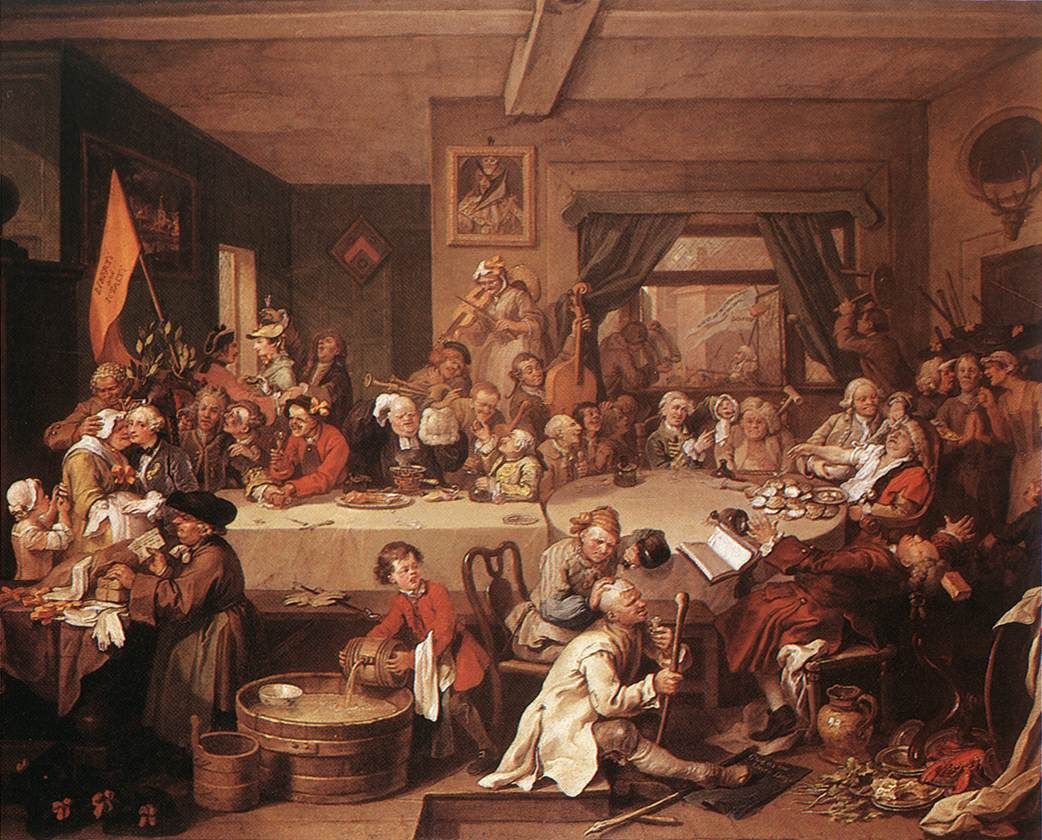
William Hogarth's "an Election Entertainment" (1755) shows a banner on the floor reading "Give us our Eleven Days," referencing the Calendar protests. William Hogarth, Public domain, via Wikimedia Commons
The technical problem was solved, but the social one persisted. Russia didn't adopt the Gregorian calendar until 1918, after the Bolshevik Revolution. Greece held out until 1923. Even today, some Orthodox churches still use the Julian calendar for religious purposes, celebrating Christmas 13 days after the rest of the Christian world. Time, it turns out, is more than just numbers on a page. It is culture, identity, and power.
The missing days of September 1752 are a reminder that even the most basic systems we take for granted are designed. The calendar is not a natural fact. It is a tool built to align human activity with celestial mechanics, and like all tools, it can be improved, resisted, and debated. The 11 days that never existed are not just a historical curiosity. They are proof that time itself is negotiable, a shared fiction we all agree to live by, until someone decides to rewrite the rules.
studio / on-this-day / Sep 2