studio / on-this-day / Sep 18
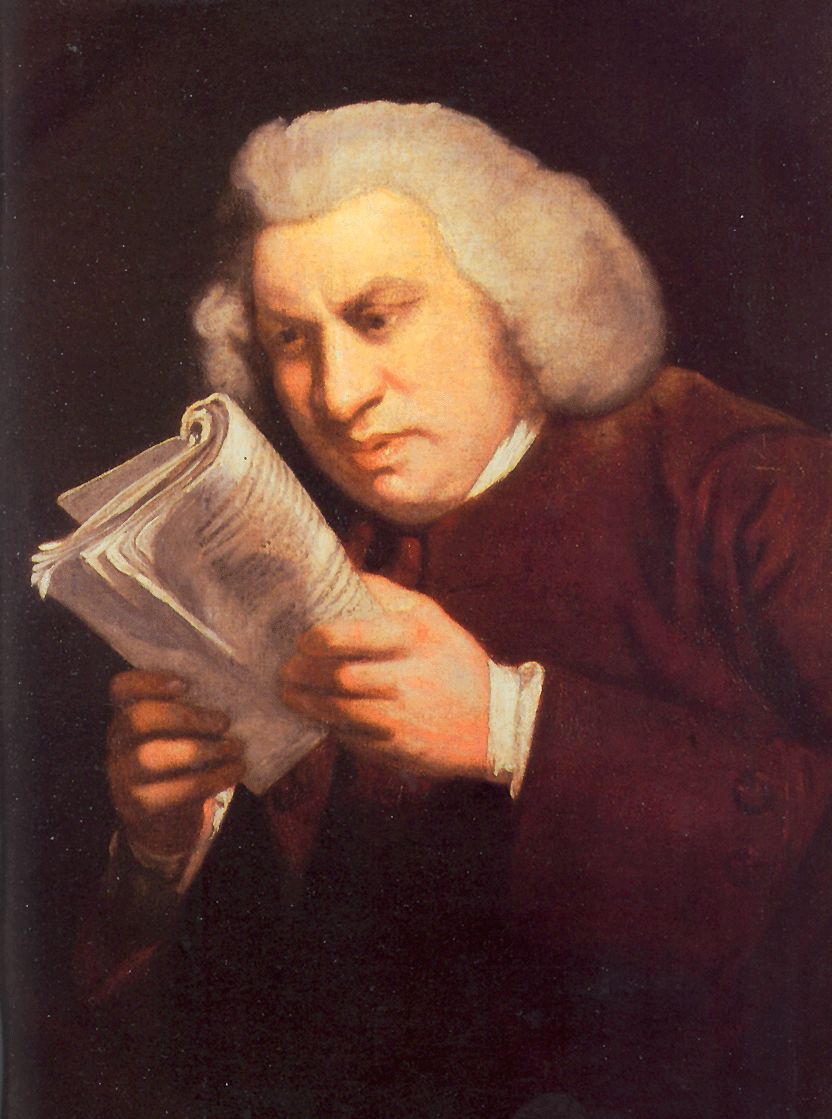
Samuel Johnson, portrait by Joshua Reynolds. Joshua Reynolds, Public domain, via Wikimedia Commons
Nine Years to Define a Language
On this day in 1709 — Samuel Johnson was born, and would spend nine years almost single-handedly writing the first great English dictionary.
3 min read
Samuel Johnson was born on September 18, 1709, in Lichfield, England. His father was a bookseller who struggled financially. Johnson grew up surrounded by books he could not afford to buy. He was sickly as a child, partially deaf, scarred by smallpox, and suffered from what would now be recognized as depression and obsessive-compulsive disorder. He was also brilliant, stubborn, and capable of sustained intellectual labor that would have broken most people.
In 1746, a group of London booksellers approached Johnson with a proposal: compile a comprehensive dictionary of the English language. It was an enormous task. The French Academy had spent 40 years producing their dictionary, with a team of scholars. Johnson was given three years and would work mostly alone, with help from six assistants who did little more than copy out quotations. He missed the three-year deadline by six years, finishing in 1755 after nine years of work. The result was a book that shaped how English would be understood for the next century.
What made Johnson's dictionary different was not just its scope, it was his method. Earlier dictionaries had been little more than word lists with brief definitions. Johnson built something closer to an architecture of meaning. He defined over 42,000 words, but more importantly, he showed how those words worked in context. He illustrated nearly every definition with quotations from English literature, pulled from the works of Shakespeare, Milton, Dryden, and dozens of others. He read everything, marking passages as he went, and his assistants copied them onto slips of paper that Johnson later organized and edited.
The definitions themselves were precise, often witty, sometimes opinionated. He defined "oats" as "a grain, which in England is generally given to horses, but in Scotland supports the people." He defined "lexicographer" as "a writer of dictionaries; a harmless drudge." He was not neutral. He had strong views on usage, spelling, and grammar, and he used the dictionary to advocate for them. This was not a descriptivist project documenting language as it was used in the wild. It was prescriptive, an effort to stabilize and standardize English at a time when spelling and usage varied wildly.
Johnson worked in a cramped attic in his home on Gough Square in London. The room was filled with books stacked everywhere. He wrote at a large table, often in poor light, while dealing with chronic pain and bouts of severe depression. His wife, Elizabeth, died partway through the project, and Johnson fell into a grief so deep that friends feared for his life. He kept working. The dictionary became a structure to hold himself together, a system of order he could impose when everything else felt chaotic.
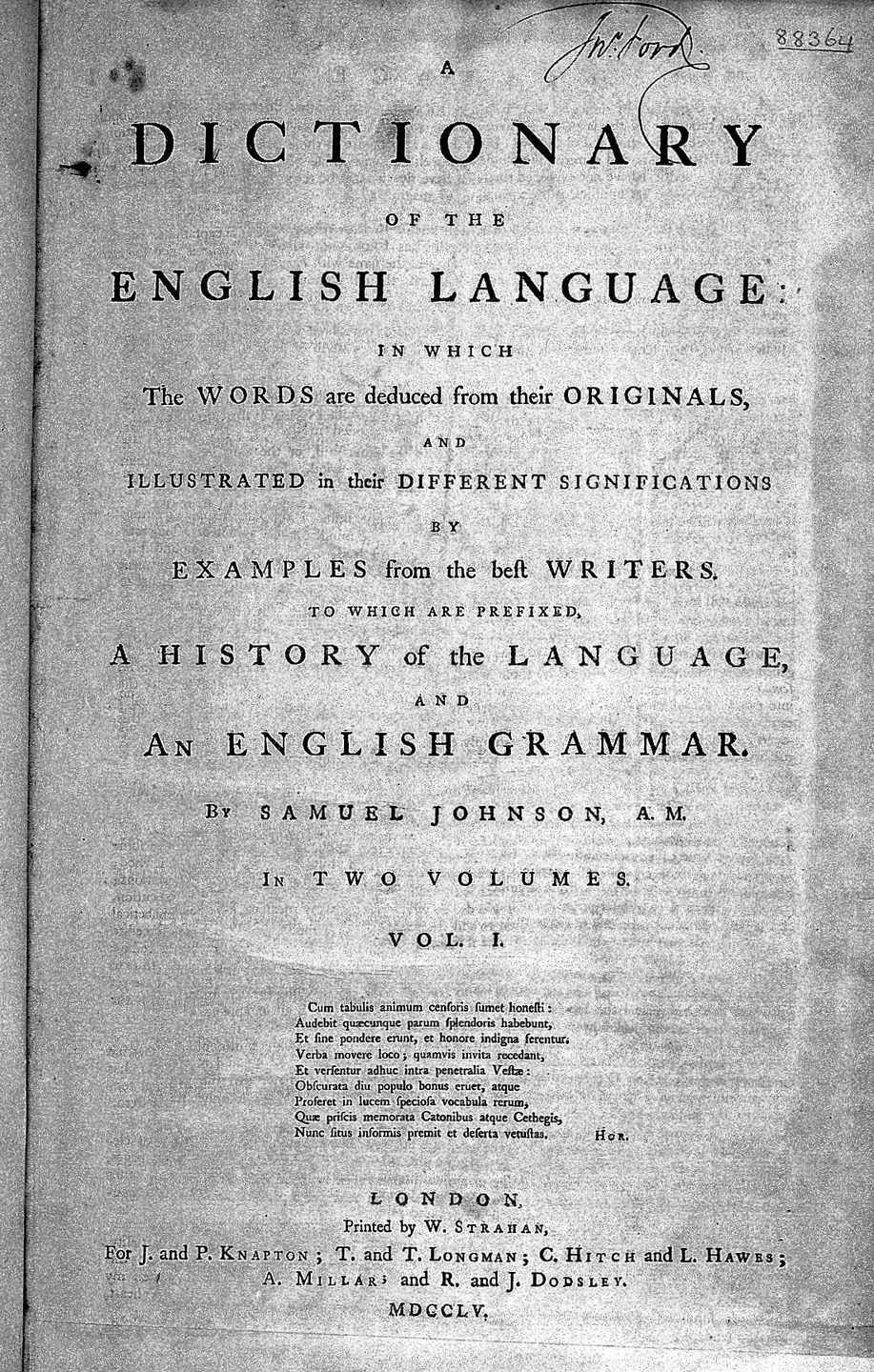
A page from Johnson's a Dictionary of the English Language (1755) — nine years of work, 42,773 entries, defined largely by one man. CC BY 4.0, via Wikimedia Commons
When A Dictionary of the English Language was published in two volumes in 1755, it was immediately recognized as a landmark. It was not perfect. Johnson admitted gaps and mistakes. He had underestimated the difficulty of the work and overestimated his stamina. But what he produced was the most comprehensive and authoritative dictionary in English up to that point. It became the standard reference for more than 150 years, until the Oxford English Dictionary began to appear in the late 19th century.
What Johnson understood was that a dictionary is not just a reference tool. It is a map of how a culture thinks. Words are not isolated units of meaning; they exist in relationship to each other, shaped by history, usage, and context. By grounding his definitions in literary quotations, Johnson was showing the reader not just what a word meant, but how it had been used by the best writers in the language. He was building a system for understanding, a kind of knowledge graph encoded in print.
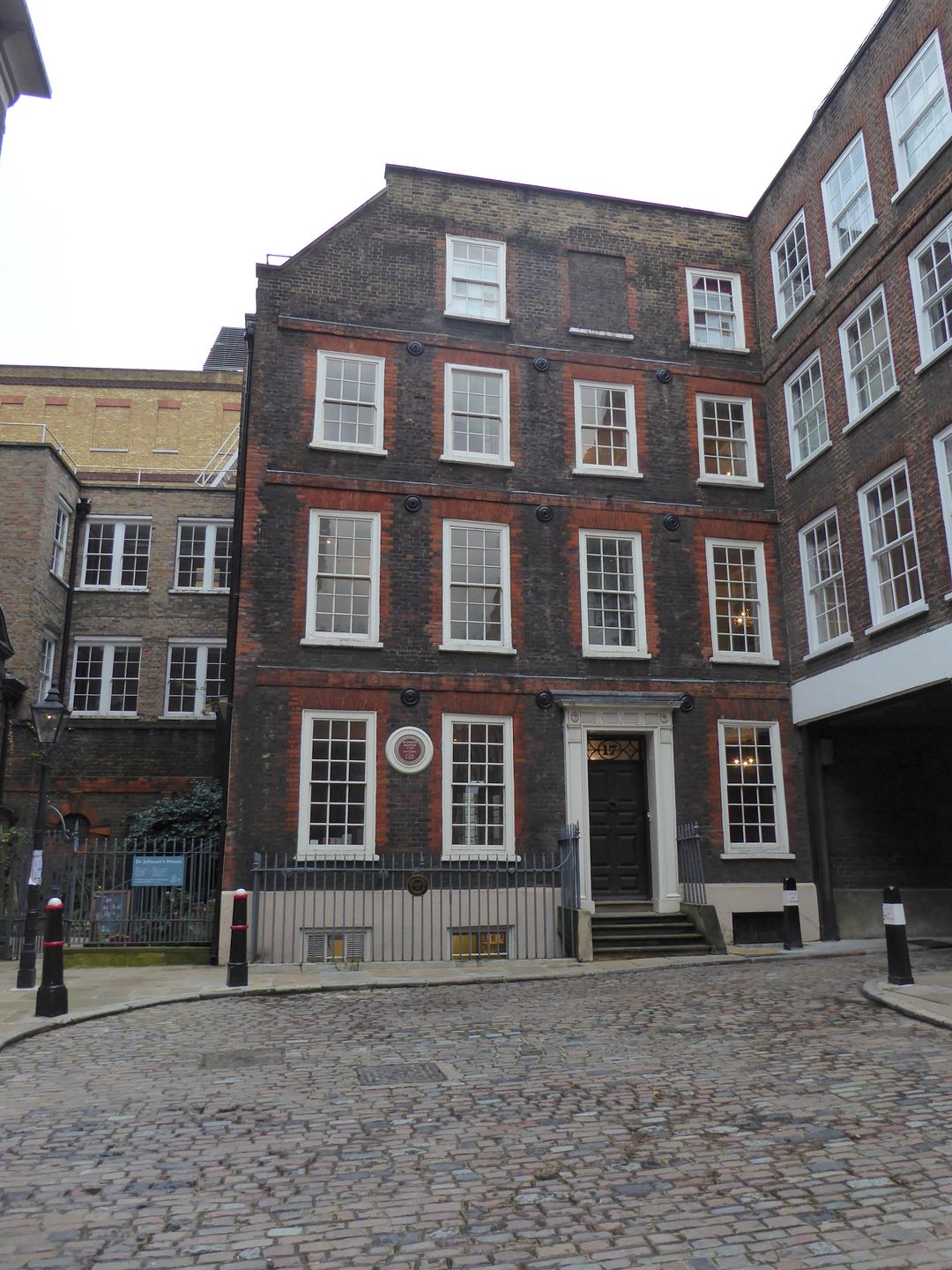
17 Gough Square, the London House where Johnson compiled the Dictionary in a cramped attic. PAUL FARMER, CC BY-SA 2.0, via Wikimedia Commons
Johnson never got rich from the dictionary. He was paid 1,500 guineas for the work, which sounds substantial but was barely enough to cover his living expenses and the cost of his assistants over nine years. He continued writing essays, biographies, and criticism. He became one of the most famous literary figures in England, known as much for his conversation and personality as for his writing. But the dictionary was his monument. It was a structure he built word by word, definition by definition, in a room filled with books and loneliness. Language is a designed system, and Johnson spent nine years drawing the blueprint.
studio / on-this-day / Sep 18