studio / on-this-day / Aug 28
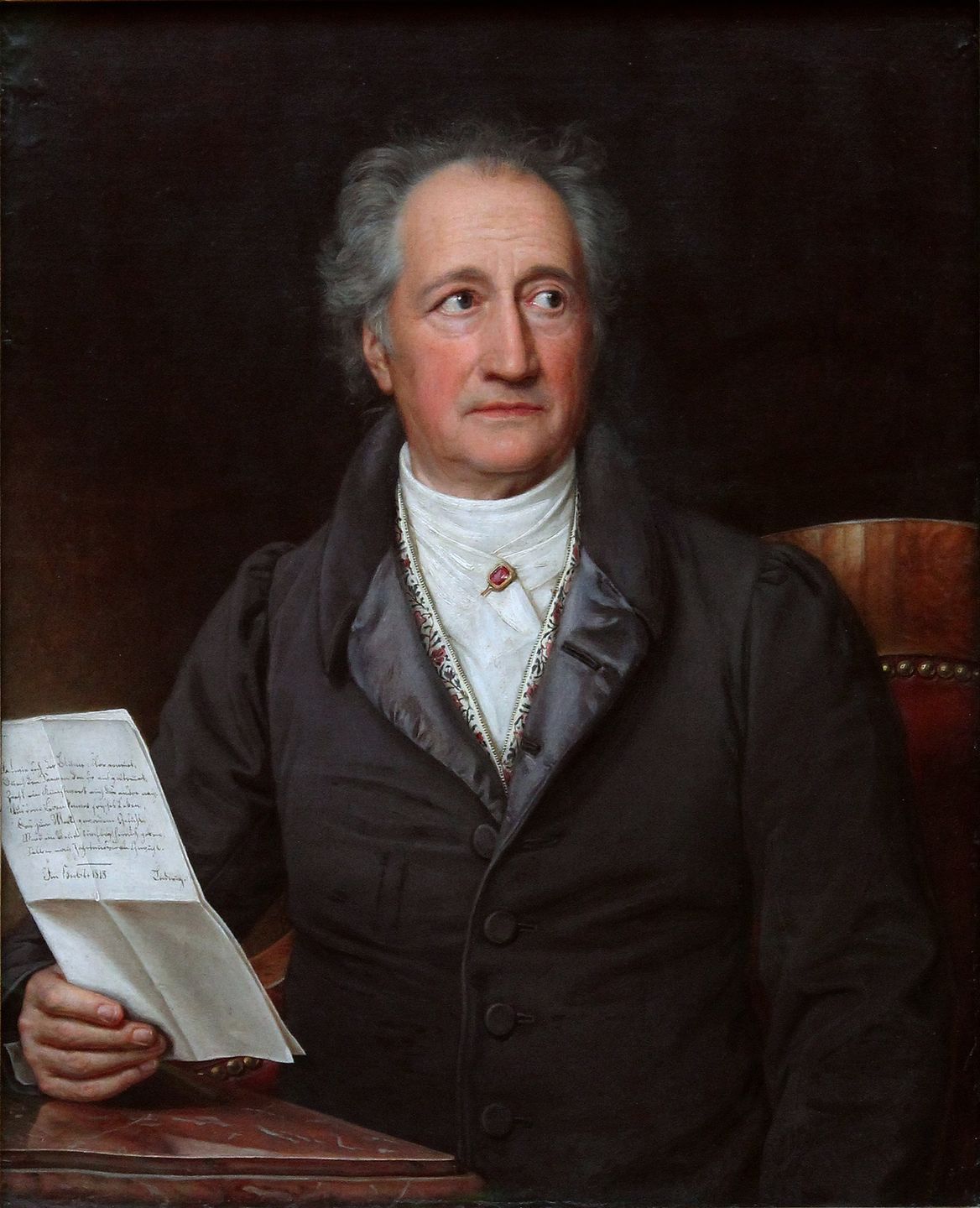
Portrait of Goethe by Joseph Karl Stieler, 1828. Joseph Karl Stieler, Public domain, via Wikimedia Commons
The Poet Who Argued With Newton
On this day in 1749 — Johann Wolfgang von Goethe was born, a poet and scientist who insisted that color was as much feeling as physics.
3 min read
Johann Wolfgang von Goethe was born in Frankfurt on August 28, 1749, and over the next 82 years he would write plays and novels that defined German literature, serve as a government minister in Weimar for decades, conduct serious botanical and geological research, and produce a theory of color that Newton's followers dismissed for a century before designers and perceptual scientists quietly began mining it for insights. He was the last person in Europe of whom it was plausibly said that he knew everything worth knowing. Whether or not that was true, the ambition behind it was real.
His scientific work is the part of Goethe's legacy that most surprises people who know him only as the author of Faust. He spent more than two decades on his "Theory of Colors," published in 1810, which challenged Newton's prism experiments directly. Where Newton had shown that white light splits into a spectrum, Goethe argued that color arises at the boundary between light and darkness, and that the human observer cannot be extracted from the equation. Colors, for Goethe, were not purely physical phenomena but experiences: they carried moral and emotional weight that Newton's optics simply could not account for.
Newton was right about the physics. On the technical question of spectral decomposition, Goethe's objections did not hold. But Goethe was pointing at something else, something that the physics of light does not address: the way color is perceived, the way yellow feels warm and blue feels cool, the way certain combinations create tension and others create rest. His color wheel placed complementary pairs across from each other not because of wavelength relationships but because of how they behaved psychologically together. This is the color theory that Josef Albers would engage with in the twentieth century, that painters and graphic designers have used ever since, and that sits at the foundation of how we talk about color in design today.
His botanical work followed a similar logic. His 1790 essay on the metamorphosis of plants proposed that all plant organs, petals, leaves, sepals, were variations on a single archetypal form. The leaf was the basic unit from which everything else was elaborated. This was wrong as genetics, but it was a genuine attempt to find the generative grammar beneath visible diversity, the design pattern that produced the range of forms. It prefigured the structural thinking that would become central to both biology and design theory a century later.
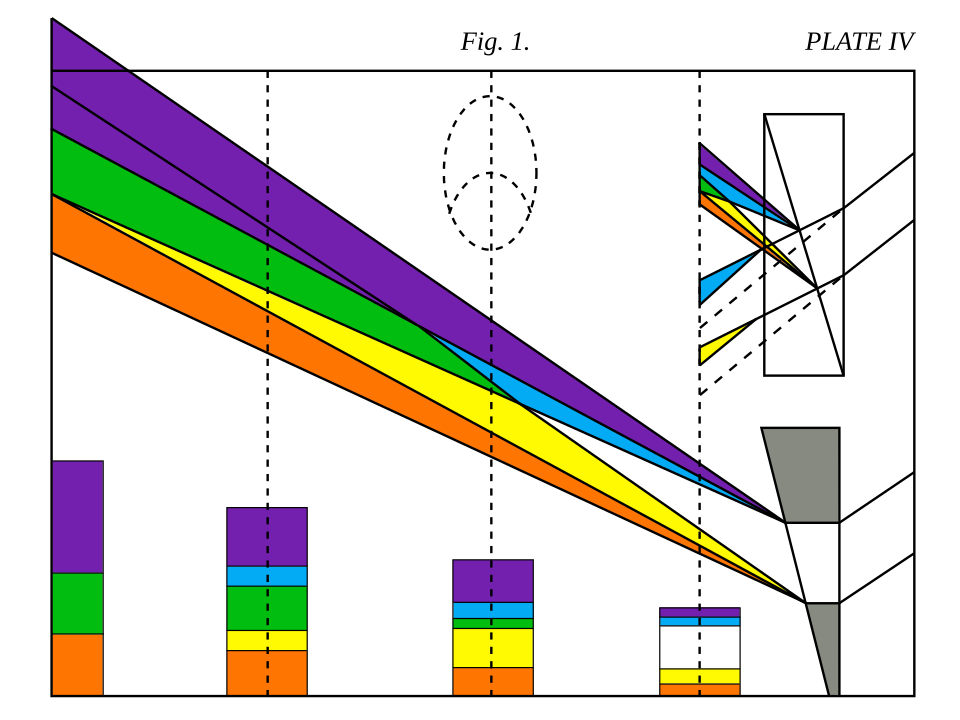
Goethe's light spectrum diagram from his "Theory of Colours" (farbenlehre, 1810) — his challenge to Newton's optics argued that color arises at the boundary between light and darkness and cannot be separated from the human observer's experience. --pbroks13talk?, Public domain, via Wikimedia Commons
Goethe wrote Faust across most of his adult life, completing the second part only weeks before his death in 1832. The play covers alchemy, classical mythology, politics, and the nature of striving. It is, among other things, a portrait of the early modern mind trying to hold together what the specialization of knowledge was beginning to pull apart. The tragedy of Faust is partly that he cannot be satisfied with any single domain of understanding. He has to know everything, feel everything, experience everything, and the cost of that ambition is enormous.
Goethe himself managed the tension better than his character. He was a bureaucrat for most of his working life, administering roads and mines and budgets in a small German duchy, while writing poetry in the margins. His scientific work was conducted with the same care he brought to verse. He believed that looking closely at the world, paying attention to what the eye and mind actually experience rather than what theory predicted they should, was itself a form of knowledge. In an era when natural philosophy was rapidly becoming physics and chemistry, he argued for the irreducible value of the observer's perspective.
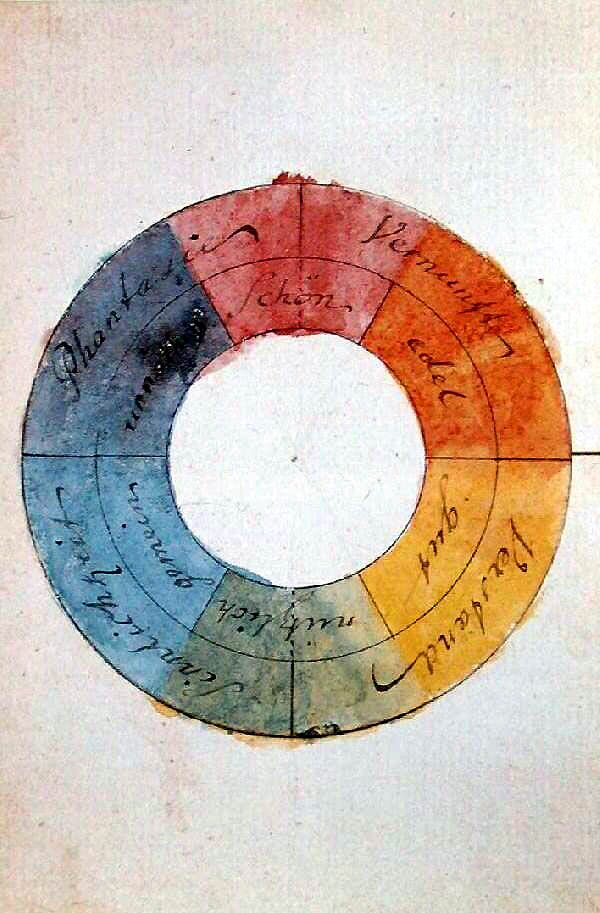
Goethe's own color wheel (farbenkreis, 1809), pairing hues with human temperaments and moods — his attempt to map how color is felt rather than just measured. The original uploader was Luestling at German Wikipedia., Public domain, via Wikimedia Commons
That argument has never fully resolved. The chemists who followed Lavoisier built a science that deliberately excluded the human observer to achieve objectivity. Goethe insisted the observer was the point. Both traditions are alive in contemporary design: one in the precision of material science, one in the study of how color and form feel to the people who encounter them. He was born on a summer morning in Frankfurt, and he never stopped asking what the light looked like.
studio / on-this-day / Aug 28