studio / on-this-day / Aug 18
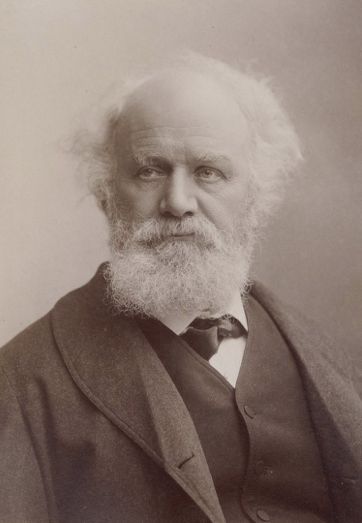
Pierre Jules césar Janssen, the French astronomer who first observed the spectral signature of Helium during a solar eclipse in India on August 18, 1868. Atelier Nadar. Photographe, CC0, via Wikimedia Commons
The Element From the Sun
On this day in 1868 — helium was found in the light of the Sun before anyone had located a trace of it on Earth.
3 min read
On August 18, 1868, French astronomer Pierre Janssen aimed a spectroscope at the sun during a total eclipse in Guntur, India, and saw a bright yellow line in the spectrum that didn't match anything known on Earth. Two months later, English astronomer Norman Lockyer independently observed the same line and concluded it belonged to an element that existed in the sun but had never been found on our planet. He named it helium, after Helios, the Greek god of the sun. For the first time in history, an element was discovered somewhere other than Earth.
Spectroscopy had become a precise tool by the 1860s. Scientists knew that when elements are heated, they emit light at specific wavelengths, creating unique spectral fingerprints. Sodium produces two close yellow lines. Hydrogen produces a red line, a blue line, and others. By analyzing sunlight split through a prism, astronomers could determine what the sun was made of without ever touching it. It was chemistry at a distance, pattern recognition as a form of exploration.
Janssen's observation during the eclipse was significant because the sun's chromosphere, the thin layer just above its visible surface, is usually washed out by the sun's brightness. During an eclipse, when the moon blocks the sun's disk, the chromosphere becomes visible for a few minutes. Janssen used those minutes to capture its spectrum and noticed a line at 587.49 nanometers that couldn't be explained by any known element. He didn't immediately conclude it was new, but he recognized it as unusual.
Lockyer took the next step. He built a spectroscope sensitive enough to observe the sun's chromosphere in daylight, without waiting for an eclipse. When he saw the same mysterious yellow line, he realized it didn't correspond to sodium, despite being close in wavelength. It was something else. He called it the D3 line, naming it after its proximity to the known D1 and D2 sodium lines, and proposed it was evidence of an unknown element. The scientific community was skeptical. Discovering an element in the sun before finding it on Earth seemed backward.
It took 27 years to prove Lockyer right. In 1895, Scottish chemist William Ramsay was heating cleveite, a uranium-bearing mineral, when he noticed an unusual gas being released. He captured it, analyzed its spectrum, and saw the same yellow line Janssen and Lockyer had observed in the sun. Helium wasn't just in the sun. It was here on Earth, trapped in rocks, so chemically inert that it had gone unnoticed. Ramsay had found the second-lightest element in the universe hiding in a mineral sample.

William Ramsay, the Scottish chemist who isolated Helium on Earth in 1895 by heating the mineral cleveite — twenty-seven years after the element was first seen in the sun. Elliott & Fry, Public domain, via Wikimedia Commons
Helium turned out to be strange. It doesn't burn. It doesn't react with anything. It's so light that it escapes Earth's gravity if released into the atmosphere. It only liquefies at temperatures near absolute zero, making it the coldest liquid substance we can produce. These properties made it useful in ways no one anticipated in 1868. Helium became essential for lifting airships, cooling superconducting magnets, and creating controlled environments for scientific experiments.
The discovery of helium also validated a method. If you could analyze light from distant objects, you could understand their composition without physical samples. Spectroscopy became the foundation of astrophysics. Scientists used it to determine the makeup of stars, nebulae, and eventually galaxies billions of light-years away. The same technique that identified helium in the sun would later reveal that the universe is expanding and that most of it is made of elements we still can't directly observe.
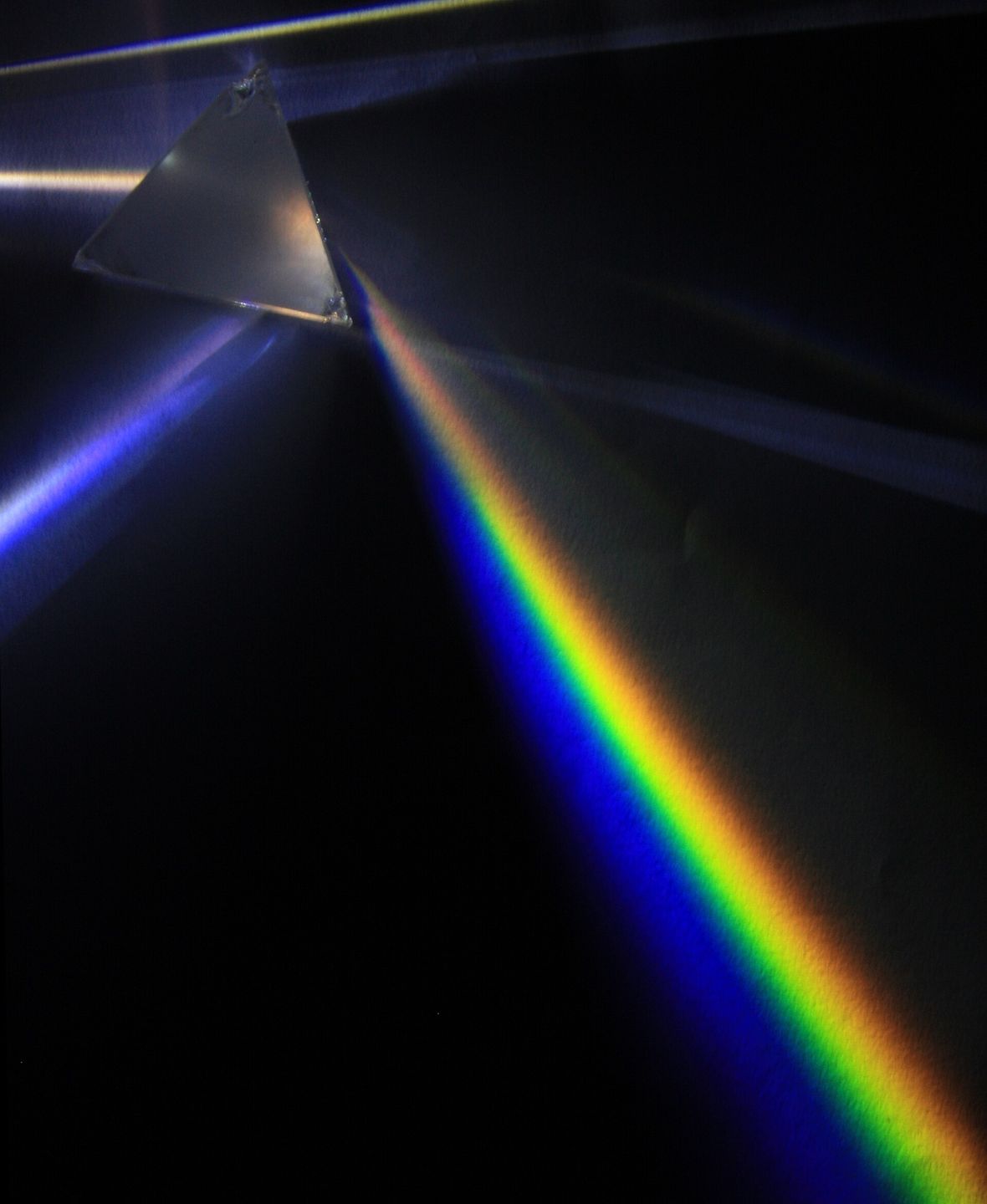
Light dispersion through a glass prism — spectroscopy works by analyzing these spectral lines, each element producing a unique pattern that acts as a chemical fingerprint. D-Kuru, CC BY-SA 3.0 at, via Wikimedia Commons
Helium's story is a reminder that discovery doesn't always follow intuition. Sometimes you find things in the least expected places, using tools designed for entirely different purposes. Janssen and Lockyer weren't looking for a new element. They were trying to understand the sun. The fact that they found something no one on Earth had ever isolated is less about their genius and more about the power of looking carefully at the right kind of data.
We now know helium is the second most abundant element in the universe, created in the first minutes after the Big Bang and continuously produced in the cores of stars through nuclear fusion. It's everywhere out there and almost nowhere down here. The element named after the sun remains, in some sense, still more at home in the sky than on the ground.
studio / on-this-day / Aug 18