studio / on-this-day / Jul 26
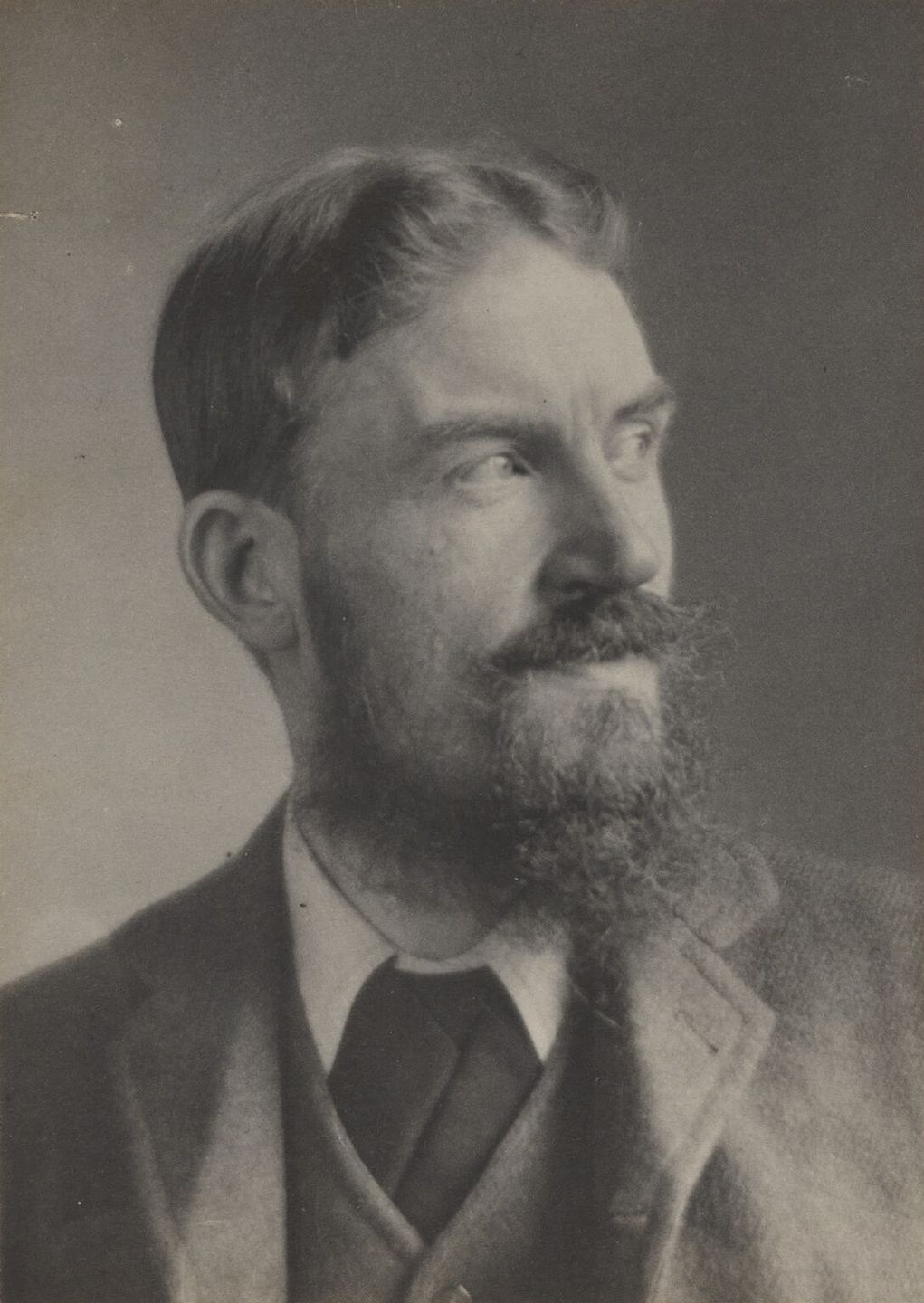
George Bernard Shaw, 1894. Frederick H. Evans, Public domain, via Wikimedia Commons
Theater as Systems Thinking
On this day in 1856 — George Bernard Shaw was born, a playwright and critic who used the stage as a kind of diagram for society.
3 min read
George Bernard Shaw was born in Dublin on July 26, 1856, into a household that barely functioned. His father was an alcoholic grain merchant. His mother was a music teacher who eventually left for London, taking Shaw's sisters with her. Shaw followed at twenty, moving into a shabby boarding house and deciding to become a writer. For nine years, he failed. He wrote five novels. None sold. He survived on his mother's income and whatever freelance work he could find. He was poor, unknown, and relentlessly opinionated.
In 1885, Shaw discovered drama. Not as entertainment but as a tool for dissecting social systems. He attended performances of Henrik Ibsen's plays, which treated the stage as a laboratory for examining marriage, class, and power. Ibsen showed that theater could do more than tell stories. It could interrogate the structures that govern lives. Shaw absorbed this and improved it. He started writing plays designed not to please audiences but to make them uncomfortable, to expose the contradictions in the systems they took for granted.
His first major success came with "Arms and the Man" in 1894, a comedy that mocked romantic notions of war and heroism. It was funny, sharp, and unsentimental. Audiences laughed, but the play also made them question why they believed soldiers were noble and war was glorious. Shaw embedded his arguments in dialogue. Characters debated economics, marriage, religion, and politics. The plays were engines for testing ideas, not just vehicles for plot.
"Pygmalion," written in 1913, became his most famous work. On the surface, it is a comedy about a phonetics professor who transforms a flower girl into someone who can pass as aristocracy by teaching her to speak differently. Beneath that, it is a critique of class systems based on arbitrary markers like accent and manners. The play asks whether changing someone's surface behavior changes who they are, or whether class is so deeply embedded that superficial redesign only exposes the system's absurdity. Shaw gave no clear answer. The play ends ambiguously. Interpretation was left to the audience.
Shaw wrote prefaces to his plays that were longer than the plays themselves. In these essays, he laid out his thinking in explicit terms. He did not trust subtlety. He wanted to be sure the audience understood what the play was interrogating. He wrote about socialism, vegetarianism, women's rights, eugenics, and the failure of conventional morality. Some of his ideas were ahead of their time. Others were deeply problematic. He admired Stalin and Mussolini at various points, believing strong systems could fix broken societies. He was wrong about that, but he was consistent: he believed systems, not individuals, determined outcomes.
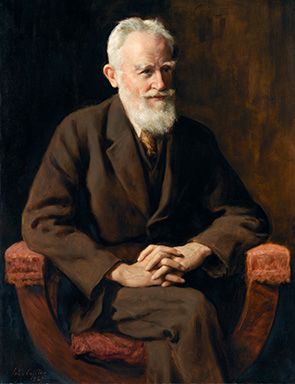
George Bernard Shaw, portrait by john Collier, 1927. John Collier, Public domain, via Wikimedia Commons
Shaw was awarded the Nobel Prize in Literature in 1925. He accepted it reluctantly, calling it a "lifebelt thrown to a swimmer who has already reached the shore." He did not need validation. His plays were already being performed worldwide. He had become famous despite writing works that challenged the very audiences who paid to see them. This was intentional. Shaw believed that art should disturb, not comfort. Entertainment without critique was decoration. He had no interest in decoration.
He lived to be 94, writing until the end. His final years were spent revising earlier works and writing new prefaces. He never softened. He remained convinced that most people were trapped in systems they did not understand and that the role of the playwright was to make those systems visible. Theater was a diagnostic tool, a way to model behavior and expose flaws in the design of society.
Shaw's influence persists in every play that uses dialogue as argument, every work that treats the stage as a place to test ideas rather than just enact plots. He proved that drama could function as applied philosophy, that characters could be systems of belief in collision rather than just people in conflict. His plays are still performed because the systems he dissected remain broken. Class, war, marriage, power: these are not solved problems. They are ongoing design failures.
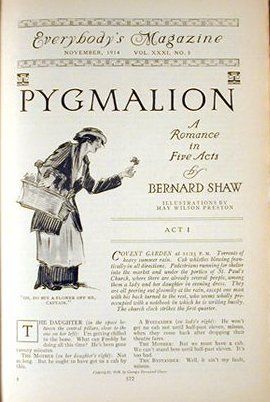
Shaw's "pygmalion" serialized in everybody's Magazine, November 1914. Everybody's Magazine, Public domain, via Wikimedia Commons
He believed change was possible through reason, that if you could show people the absurdity of their beliefs, they would redesign their behavior. History suggests he was optimistic. People resist changing their systems even when the flaws are obvious. But Shaw kept writing as if reason could win. His plays are monuments to that faith. They are blueprints for a better-designed world, written by someone who knew that blueprints alone do not build anything. You still have to convince people to pick up the tools.
studio / on-this-day / Jul 26