studio / on-this-day / Jul 25

The royal Oldham Hospital, where Louise Brown was born on July 25, 1978. David Dixon, CC BY-SA 2.0, via Wikimedia Commons
The First Test Tube Baby
On this day in 1978 — Louise Brown, the first test-tube baby, was born, and human reproduction acquired a new address: the laboratory.
3 min read
Louise Joy Brown was born at 11:47 PM on July 25, 1978, at Oldham General Hospital in England. She weighed five pounds, twelve ounces. She was delivered by caesarean section, not because of complications, but because her birth had to be precisely timed. Doctors, journalists, and camera crews waited. She was the first human born from in vitro fertilization. Conception had taken place in a petri dish. The process that created her was unprecedented. Biology had been redesigned outside the body.
Her parents, Lesley and John Brown, had been trying to conceive for nine years. Lesley's fallopian tubes were blocked, making natural conception impossible. In 1977, they enrolled in an experimental program led by gynecologist Patrick Steptoe and physiologist Robert Edwards. Edwards had been researching human fertilization since the 1960s. Steptoe had developed laparoscopy techniques that allowed eggs to be retrieved from ovaries with minimal surgery. Together, they had been attempting IVF for years, with over 600 failed attempts.
The procedure was straightforward in theory. Extract an egg, fertilize it with sperm in a controlled environment, allow it to divide, then implant the embryo into the uterus. In practice, every step was fragile. Eggs had to be extracted at precisely the right moment. Fertilization required exact conditions of temperature and chemical composition. The embryo had to develop correctly, and the uterus had to be receptive. Hundreds of variables could derail the process. Most did.
On November 10, 1977, Steptoe retrieved an egg from Lesley Brown. Edwards fertilized it with John's sperm. The egg divided into an eight-cell embryo. Two days later, Steptoe implanted it. The embryo attached to the uterine wall. Lesley became pregnant. For nine months, the medical team monitored her closely, keeping the pregnancy secret to avoid public pressure. When Louise was born healthy, they announced the success. The world reacted with equal parts celebration and fear.
Critics called it unnatural. Religious leaders questioned whether scientists were playing God. Ethicists worried about unforeseen consequences. What if the procedure produced abnormalities? What if it led to designer babies, human cloning, the commodification of life itself? The concerns were not baseless. Any time you redesign a fundamental process, you open pathways that were previously closed. Some lead to solutions. Others lead to new problems you did not anticipate.
Louise Brown grew up healthy. She had a normal childhood, went to school, worked as a postal worker, got married, and had children of her own, conceived naturally. She became living proof that IVF could work without catastrophic side effects. Her existence answered the most immediate question: can a child born this way be normal? Yes. But the broader questions remained.
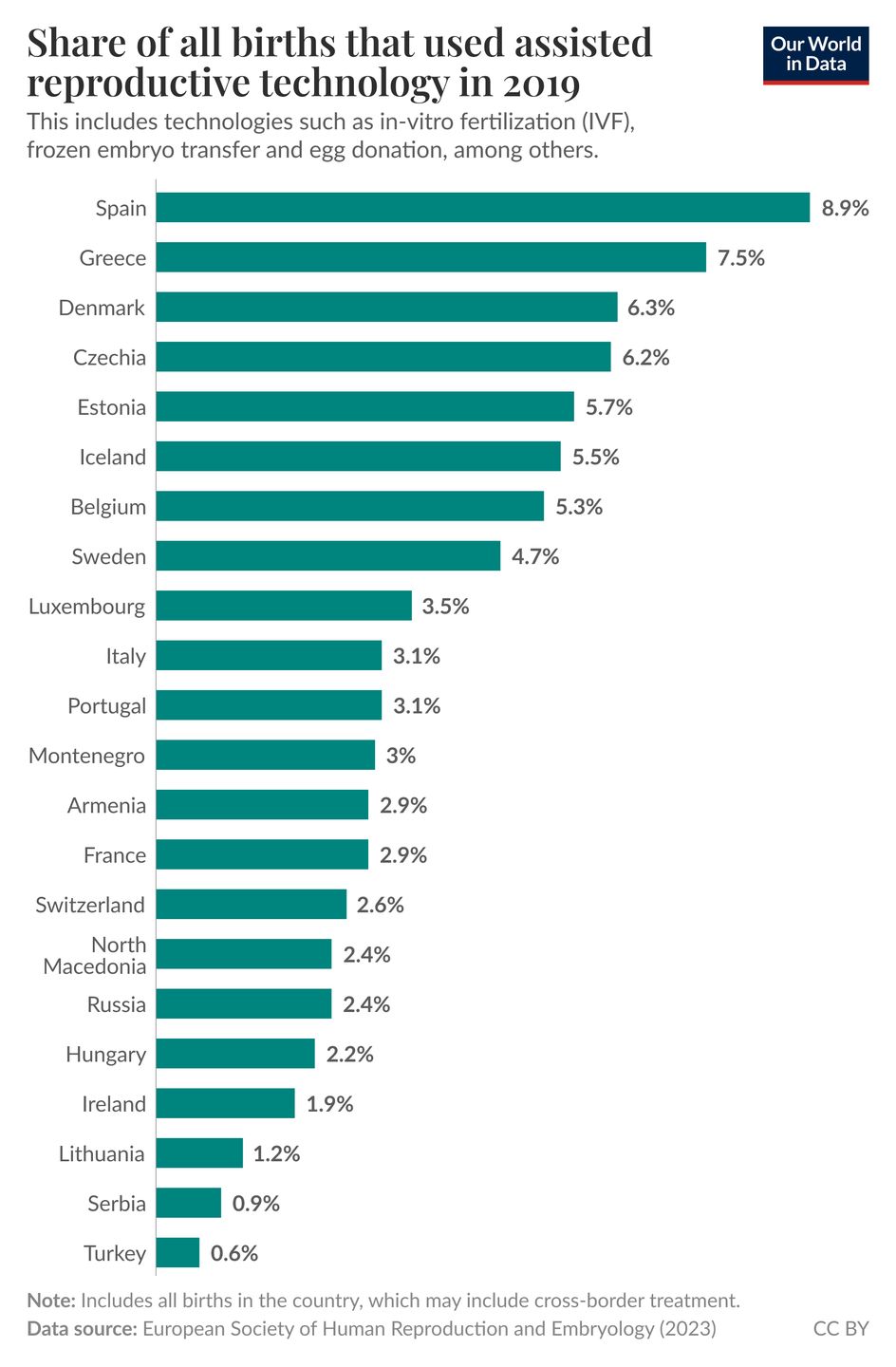
Share of births involving assisted reproductive technologies in Europe. Our World in Data, CC BY 4.0, via Wikimedia Commons
IVF became a routine procedure. Over the next four decades, more than eight million children were born through assisted reproductive technology. The technique improved. Success rates increased. The cost came down, though it remained expensive enough to limit access. Fertility became a service industry. Clinics opened worldwide. Egg freezing, embryo selection, surrogacy, and genetic screening all followed. Each built on the foundation Steptoe and Edwards had established.
Robert Edwards received the Nobel Prize in Physiology or Medicine in 2010. Steptoe had died in 1988, too early to share the honor. The Nobel committee acknowledged that Edwards' work had brought joy to millions of infertile couples, but the award also sparked renewed debate. The Vatican criticized it. Some bioethicists argued that IVF had led to the discarding of millions of embryos, raising questions about when life begins and what moral status an embryo holds. These are design questions as much as ethical ones. When you move a process from the body to the lab, you make it visible, controllable, and subject to judgment.
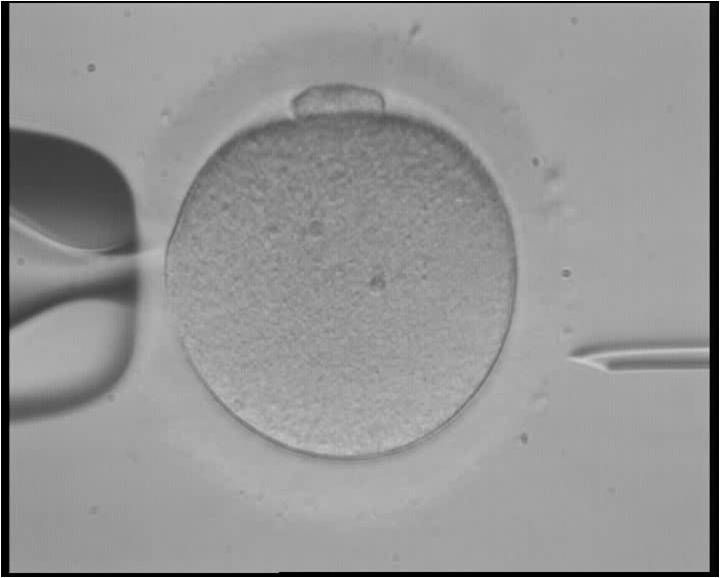
In vitro fertilization performed under a microscope, the procedure that created Louise Brown. Dovidena, CC BY-SA 4.0, via Wikimedia Commons
Louise Brown still gives interviews. She speaks calmly about her origin, describing it as a medical procedure that helped her parents. She does not see herself as unnatural or experimental. She is simply the first. Every technology has a first. Every redesign begins somewhere. Her birth proved that human reproduction could be decoupled from the human body, that conception could happen in glass instead of flesh, and that the result could be an ordinary child.
The question IVF answers is not whether we should redesign biology, but how we redesign it once the tools exist. Infertility is suffering. IVF alleviates it. But it also creates new markets, new inequalities, and new ethical dilemmas. Design always does. You cannot introduce a new capability without reshaping the system around it. Louise Brown was born in a hospital room in England, but her existence changed reproductive medicine everywhere. She was the proof of concept. Everything that followed was iteration.
studio / on-this-day / Jul 25