studio / on-this-day / Jun 29
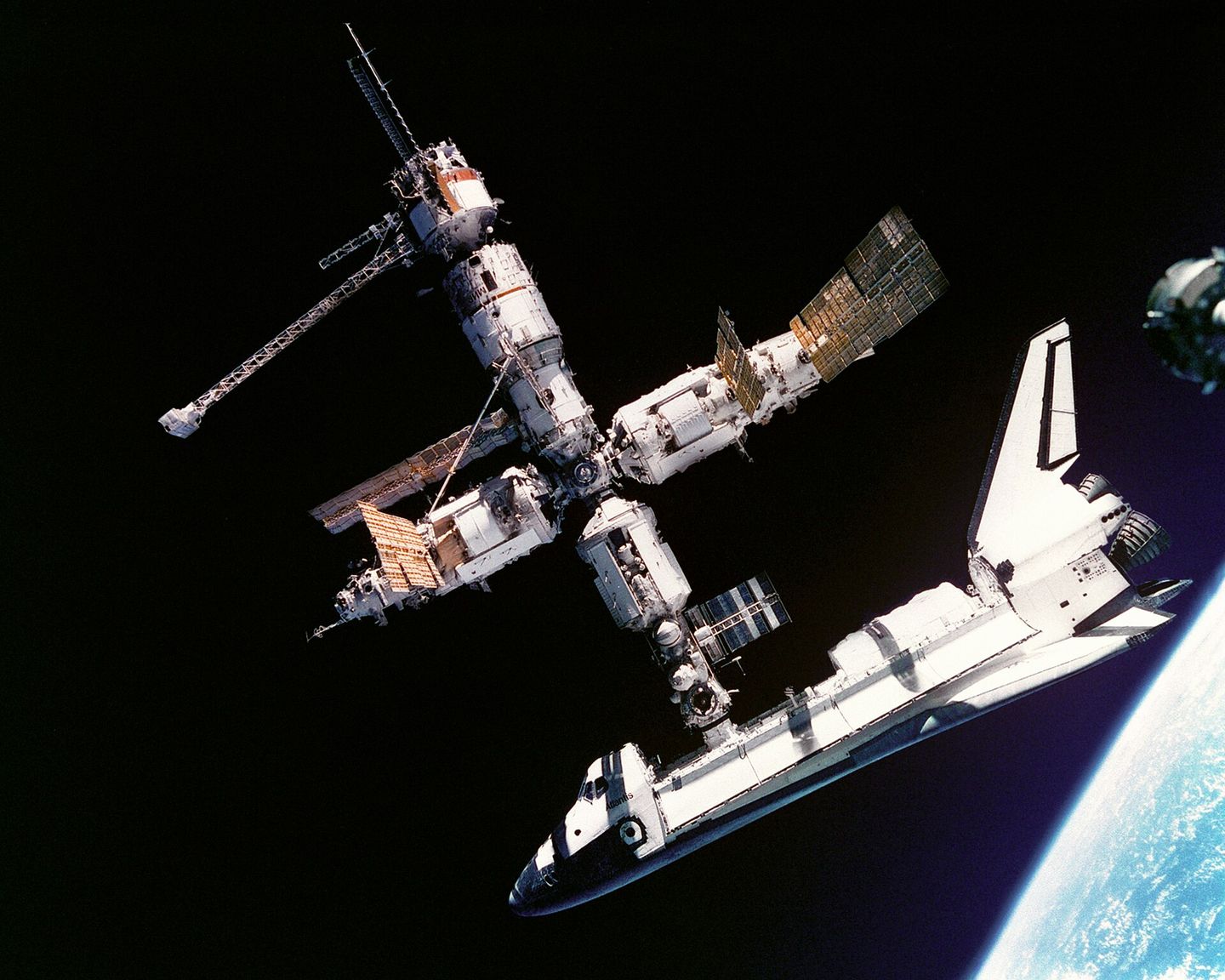
Space Shuttle Atlantis docked to the Russian Space Station Mir during STS-71, June 1995 — the first docking of the two rival Space programs' vehicles. NASA, Public domain, via Wikimedia Commons
When Rivals Docked
On this day in 1995 — the shuttle Atlantis docked with Mir, and two Cold War space programs joined, in orbit, for the first time.
2 min read
On June 29, 1995, at 9:00 AM Eastern Time, the Space Shuttle Atlantis completed a docking maneuver with the Russian space station Mir, 245 miles above the Earth. It was the first time an American spacecraft had docked with a Russian station. The two vehicles, products of rival space programs built during the Cold War, linked together with a custom-built docking module designed to bridge incompatible systems. The connection was mechanical, political, and symbolic. Two nations that had spent decades competing in space were now collaborating in orbit.
The docking was not improvised. It required years of negotiation, engineering, and trust-building. The United States and Russia had different docking standards, different life support systems, different electrical protocols. NASA and Roscosmos engineers worked together to design an interface that could translate between the two systems. The result was a cylindrical module, launched on a previous shuttle mission, that attached to Mir and provided a common interface for Atlantis to dock. The module had to handle pressure differentials, thermal expansion, and the precise alignment of two massive vehicles traveling at 17,500 miles per hour.
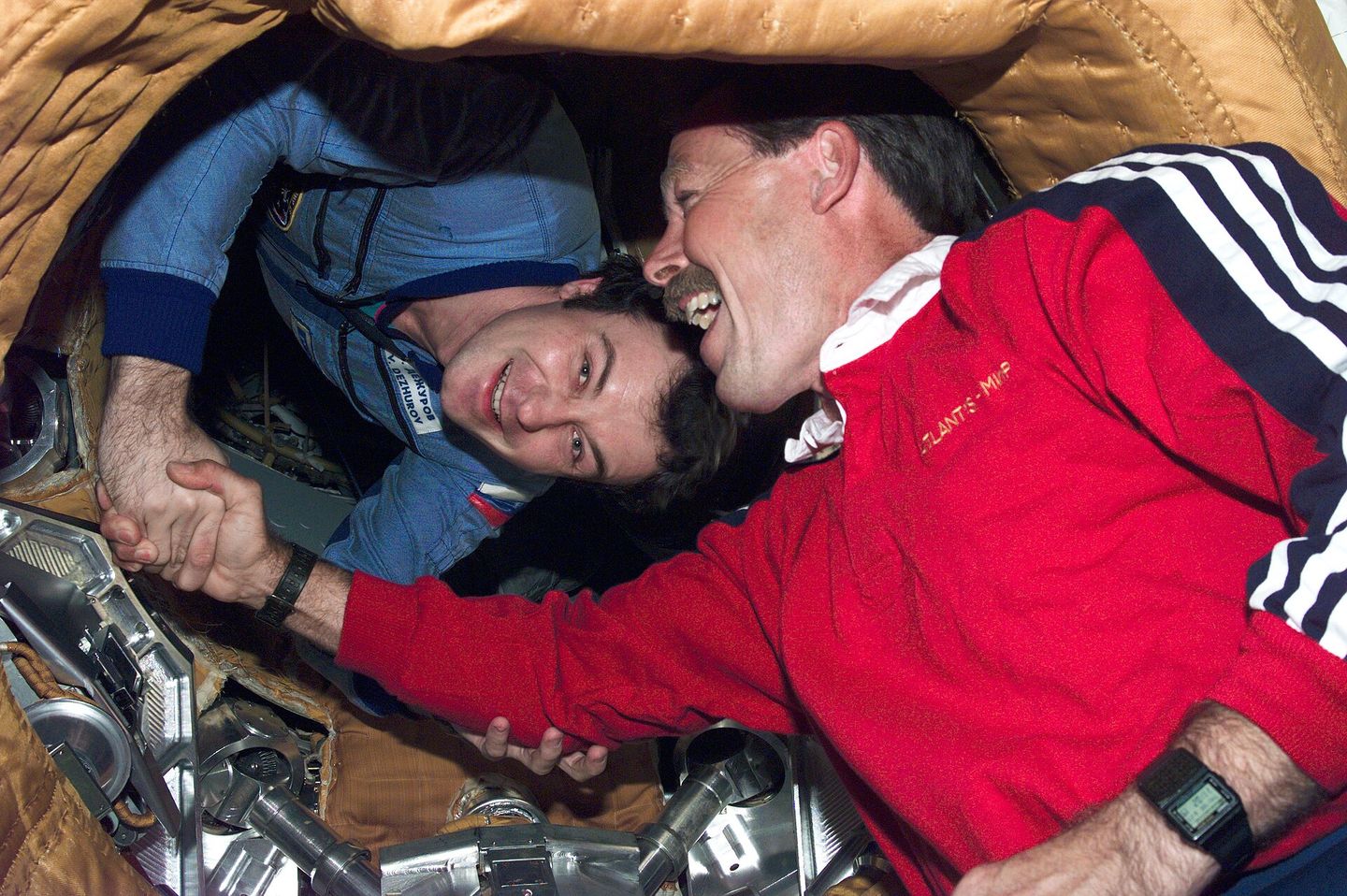
STS-71 Commander Robert "Hoot" Gibson and Mir-18 Commander Vladimir Dezhurov shake hands at the docking hatch — a symbolic moment ending decades of Space race rivalry. NASA, Public domain, via Wikimedia Commons
Commander Robert "Hoot" Gibson piloted Atlantis through the final approach, using thrusters to nudge the 100-ton shuttle into position with millimeter precision. The docking mechanism engaged. Latches locked. Seals inflated. The two spacecraft became one structure, the largest combined mass ever assembled in orbit at the time. When the hatches opened, American astronauts floated into Mir for the first time, greeted by Russian cosmonauts who had been living on the station for months. The handshake in zero gravity was broadcast live.
Atlantis remained docked for five days. The crews exchanged supplies, conducted joint experiments, and transferred astronaut Norman Thagard, who had been living on Mir for three months, back to the shuttle. Thagard had launched on a Russian Soyuz rocket, becoming the first American to travel to space aboard a Russian vehicle. His return on Atlantis marked the end of the first phase of cooperation. More shuttle missions to Mir would follow, setting the stage for the International Space Station, a project that would require the United States, Russia, Europe, Japan, and Canada to collaborate on a scale never attempted before.
The Atlantis-Mir docking was a test of compatibility, not just between machines but between systems of design and operation. NASA and Roscosmos had different approaches to spaceflight. NASA favored reusable shuttles and modular components. Russia relied on expendable rockets and robust, long-duration stations. The cultures were different. The languages were different. The engineering philosophies were different. Making them work together required compromise, translation, and a willingness to accept that there is more than one way to solve a problem.
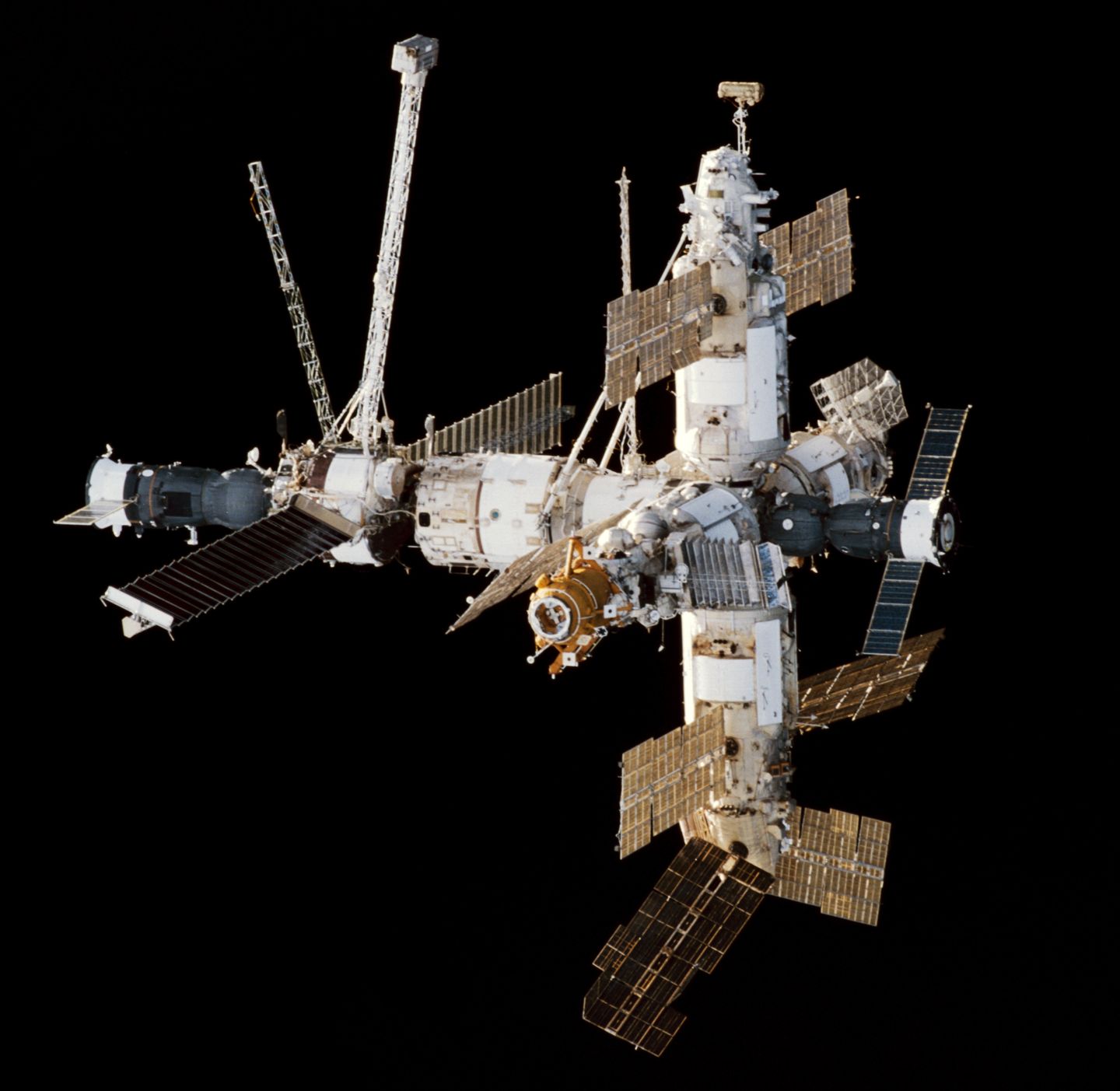
The Russian Space Station Mir, built up module by module over a decade, seen from a visiting Shuttle. NASA, Public domain, via Wikimedia Commons
Mir itself was a marvel of modular design. Launched in 1986, it was built incrementally, with modules added over a decade. By 1995, it had been continuously occupied for nearly nine years, hosting cosmonauts and international visitors in an environment that was cramped, noisy, and prone to malfunctions. It was also functional, adaptable, and resilient. Mir operated until 2001, far beyond its intended lifespan, before being de-orbited in a controlled reentry. The lessons learned from Mir informed the design of the ISS, which remains in operation today, a permanent human presence in orbit, sustained by international cooperation. The handshake in 1995 was the beginning of that permanence.
studio / on-this-day / Jun 29