studio / on-this-day / Jun 28
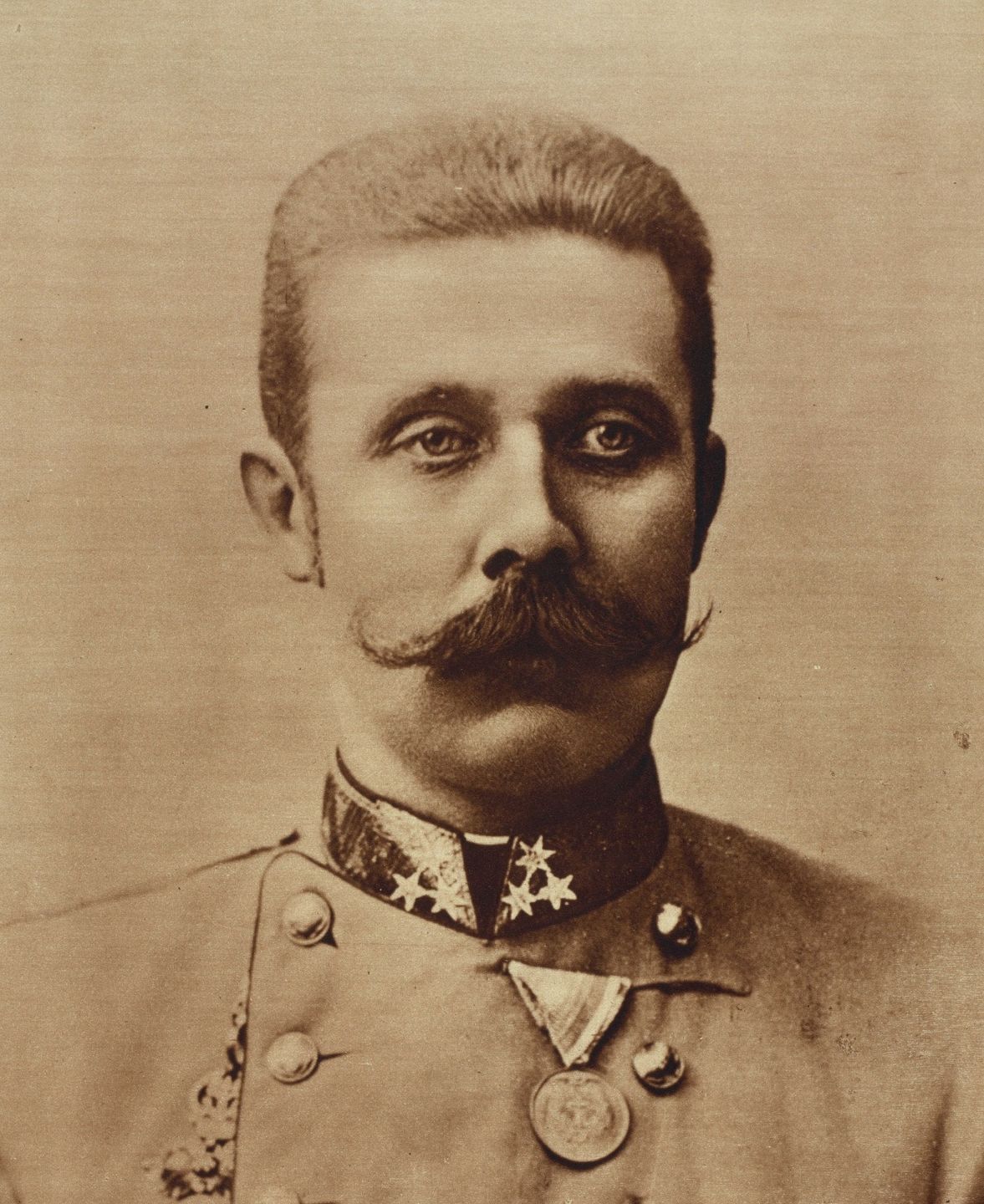
Archduke Franz Ferdinand of Austria, whose assassination in Sarajevo on June 28, 1914 set off the chain of events that led to World War i. Carl Pietzner, Public domain, via Wikimedia Commons
The Shot That Cascaded
On this day in 1914 — Archduke Franz Ferdinand was shot, and a single assassination cascaded through every alliance in Europe into world war.
3 min read
On the morning of June 28, 1914, Archduke Franz Ferdinand of Austria arrived in Sarajevo, the capital of Bosnia, recently annexed by the Austro-Hungarian Empire. He was there for a military inspection, a routine display of imperial authority. The day was also his wedding anniversary. His wife, Sophie, accompanied him despite warnings that the visit was dangerous. Sarajevo was a city of ethnic tensions, a place where Serbian nationalists resented Austrian rule and plotted violence. Security was minimal. The archduke's motorcade route had been published in advance.
At 10:15 AM, as the motorcade passed along the Appel Quay, a member of a nationalist group called the Black Hand threw a grenade at the archduke's car. The driver accelerated, and the grenade exploded under the following vehicle, injuring several officers. Franz Ferdinand was unhurt. He continued to the town hall, where he gave a speech and complained about the attack. After the reception, he insisted on visiting the wounded officers in the hospital. No one thought to change the motorcade route. No one coordinated with the security detail. The cars set off along the same road.
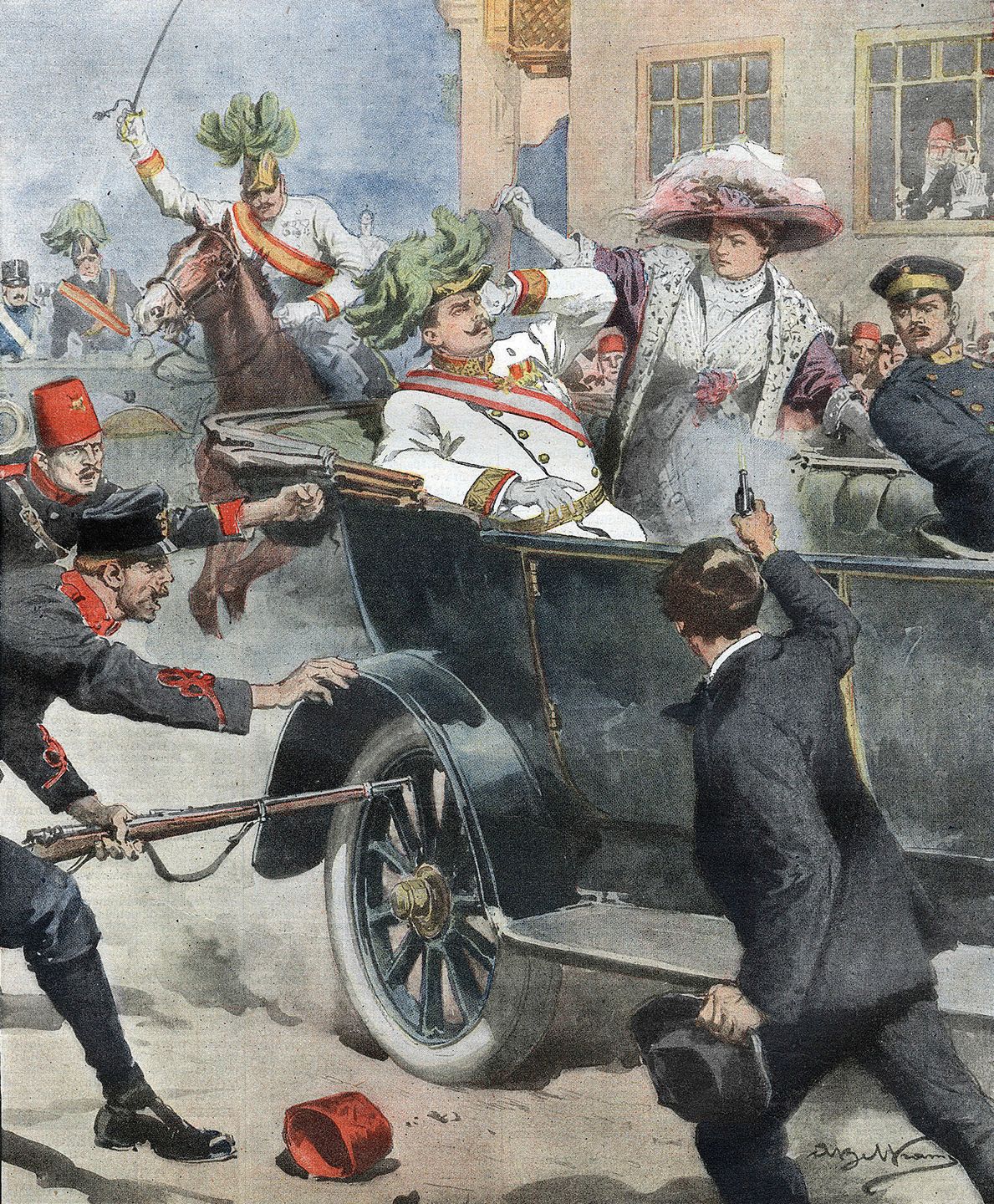
A photograph from Sarajevo, June 28, 1914 — showing events in the immediate aftermath of the assassination that triggered World War i. Achille Beltrame, Public domain, via Wikimedia Commons
The driver of the lead car made a wrong turn onto Franz Joseph Street. When officials realized the mistake, the driver stopped to reverse. The car stalled directly in front of a 19-year-old named Gavrilo Princip, one of the conspirators who had failed earlier in the day. He was standing on the corner, armed with a Browning pistol, having assumed the plot had failed. Suddenly, the target was five feet away. Princip stepped forward and fired twice. One bullet struck Sophie in the abdomen. The other hit Franz Ferdinand in the neck, severing his jugular vein. Both died within minutes.
What followed was not inevitable, but it was structured. Austria-Hungary issued an ultimatum to Serbia, demanding concessions that no sovereign state could accept. Serbia refused. Austria-Hungary declared war on July 28. Russia, allied with Serbia, mobilized its army. Germany, allied with Austria-Hungary, declared war on Russia. France, allied with Russia, mobilized. Germany invaded Belgium to attack France from the north. Britain, committed to Belgian neutrality, declared war on Germany. Within six weeks, the continent was at war. The system of alliances, designed to prevent conflict through mutual deterrence, instead ensured that a local assassination triggered a global catastrophe.
World War I lasted four years, killed an estimated 16 million people, and destroyed four empires. The Austro-Hungarian, Ottoman, Russian, and German empires all collapsed. The map of Europe was redrawn. New nations emerged. Old grievances calcified. The Treaty of Versailles imposed punitive reparations on Germany, creating the economic and political conditions that made the rise of fascism possible. The war that was supposed to end all wars set the stage for an even deadlier one two decades later.
Franz Ferdinand himself was an unlikely martyr. He was not particularly popular. His marriage to Sophie was considered a morganatic union, beneath his station, and she was excluded from most royal ceremonies. He favored reform within the empire, proposing a federalized structure that would grant more autonomy to ethnic minorities. Had he lived and ascended to the throne, he might have prevented the war by restructuring the empire before it fractured. Or he might have failed, and the war would have come anyway. Counterfactuals are cheap. What matters is the chain of events that actually occurred.
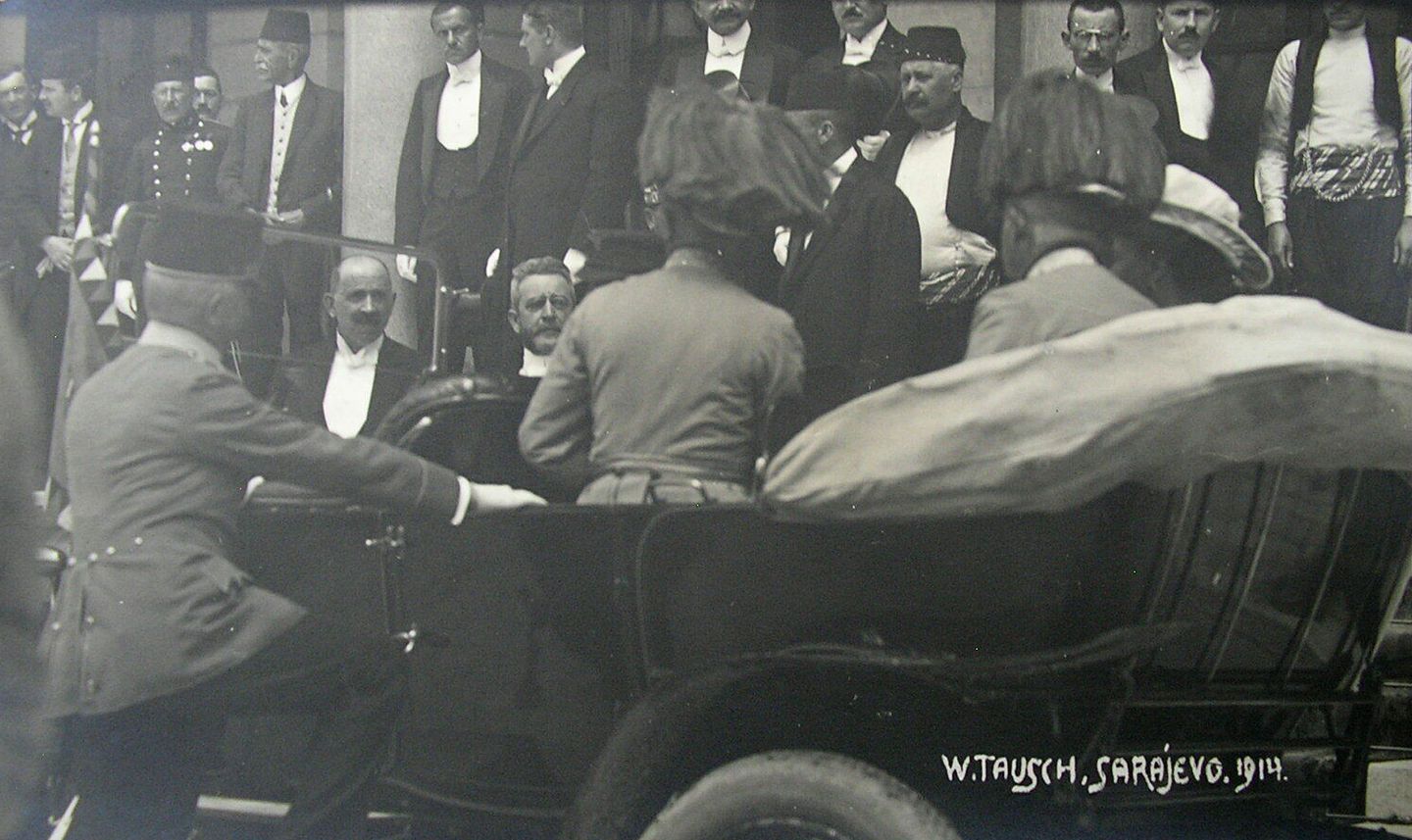
Franz Ferdinand and Sophie leaving the Sarajevo town hall by car, minutes before the wrong turn that placed them in front of Gavrilo Princip. Walter Tausch (1914), Public domain, via Wikimedia Commons
The assassination of Franz Ferdinand is a case study in systems failure. A single point of failure, a wrong turn, a stopped car, a young man with a gun, cascaded through a network of alliances and ultimatums until the entire structure collapsed. The lesson is not that individuals are powerless. Princip made a choice. Franz Ferdinand's driver made a choice. Diplomats and generals made choices. But those choices were constrained by a system that amplified small failures into catastrophic outcomes. Resilient systems have redundancy, flexibility, and mechanisms to absorb shocks. Brittle systems fracture at the first impact. Europe in 1914 was brittle. The shot that killed Franz Ferdinand was just the point where the cracks met.
studio / on-this-day / Jun 28