studio / on-this-day / May 22
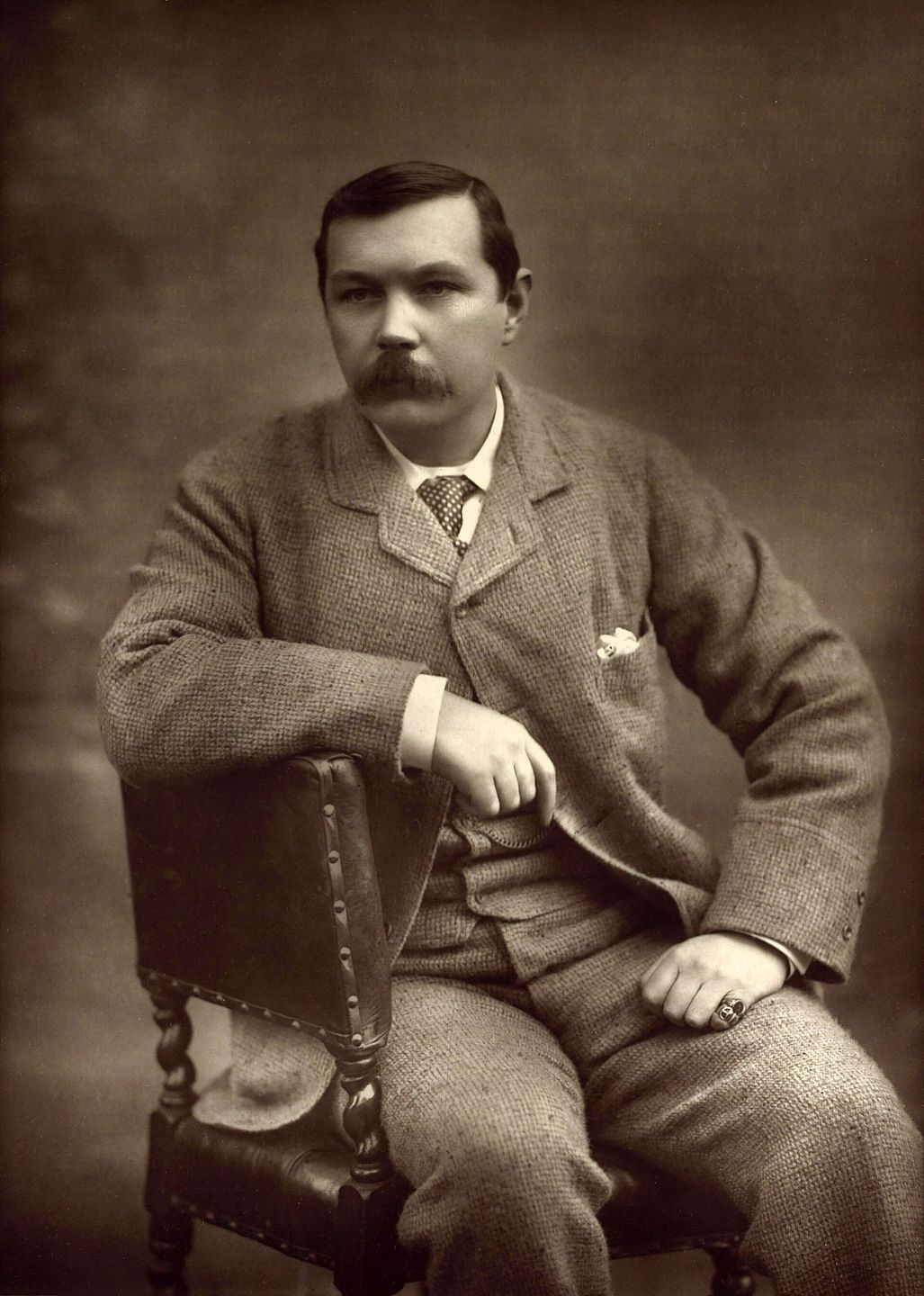
Arthur Conan Doyle photographed by herbert rose barraud, 1893, the year he killed off sherlock Holmes. Herbert Rose Barraud (1845 - c1896), Public domain, via Wikimedia Commons
The Logic Machine
On this day in 1859 — Arthur Conan Doyle was born, and would design Sherlock Holmes, the most famous reasoning engine in fiction.
3 min read
Arthur Conan Doyle was born in Edinburgh on May 22, 1859, into a family of artists and illustrators. His father was a chronic alcoholic who spent much of his later life institutionalized. Doyle went to medical school at the University of Edinburgh, where he studied under Dr. Joseph Bell, a surgeon known for diagnosing patients by observation alone. Bell could deduce a patient's occupation, habits, and recent history from scuff marks on shoes, calluses on hands, and patterns of speech. Doyle watched him work and thought: this would make a hell of a character.
Sherlock Holmes first appeared in A Study in Scarlet in 1887. The novel sold poorly. But Doyle kept writing, and by the 1890s, Holmes had become a phenomenon. The character was not a hero in the traditional sense. He was a system. He processed information, eliminated variables, and arrived at conclusions with mechanical precision. His famous line, "when you have eliminated the impossible, whatever remains, however improbable, must be the truth," is not philosophy. It's an algorithm.
Holmes worked through deduction, a method Doyle borrowed from Bell and formalized into fiction. The detective stories were puzzles with solutions that could, in theory, be worked out by the reader. Doyle laid out clues, red herrings, and logical sequences. The pleasure was not in surprise but in inevitability. Once Holmes explained the solution, it felt obvious. That was the design. The mystery was a locked room, and Holmes was the key that fit.
What made Holmes compelling was not his brilliance but his limitations. He was brilliant in narrow, specific ways. He could identify 140 types of tobacco ash but knew nothing about literature or philosophy. He didn't care that the Earth revolved around the sun because it had no bearing on his work. He was designed for a single purpose: solving problems through observation and reasoning. He was, in that sense, a prototype for artificial intelligence, a mind optimized for pattern recognition and deduction.
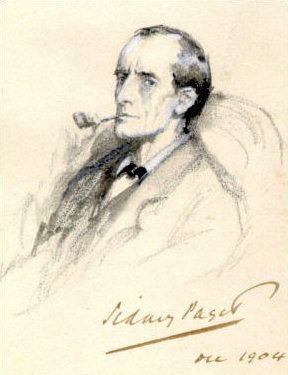
Sidney Paget's iconic illustration of sherlock Holmes, published in the strand magazine, 1891. Sidney Paget, Public domain, via Wikimedia Commons
Doyle eventually grew to hate the character. Holmes was too popular, too demanding. In 1893, Doyle killed him off by throwing him over Reichenbach Falls in a struggle with his nemesis, Professor Moriarty. The public was outraged. People wore black armbands. Doyle received death threats. He tried to move on, writing historical novels and spiritualist tracts, but the pressure to bring Holmes back was relentless. In 1903, he relented and wrote The Hound of the Baskervilles, set before Holmes's death. In 1905, he resurrected him fully. Holmes had escaped the falls. Of course he had.
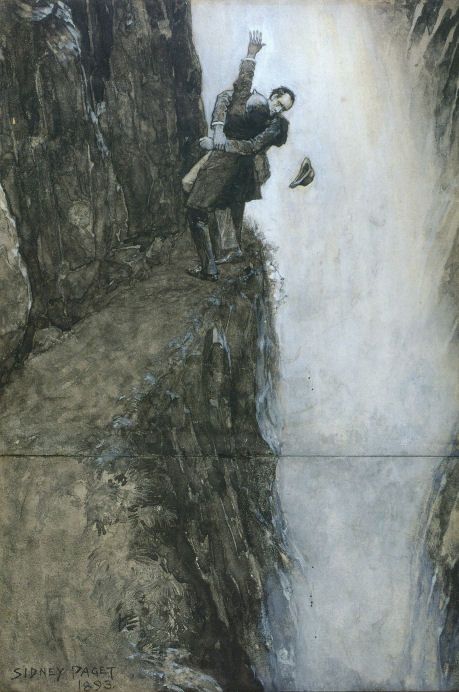
Sidney Paget's illustration of Holmes and Moriarty at the Reichenbach Falls, where Doyle tried to kill the detective off in 1893. Sidney Paget, Public domain, via Wikimedia Commons
Doyle wrote 56 short stories and four novels featuring Holmes. The character became more famous than his creator. He was adapted into plays, films, radio dramas, and television series. He became a template. Every detective who solves crimes through logic rather than luck owes something to Holmes. Every procedural that breaks down evidence into steps is following the structure Doyle built.
Doyle himself was a strange counterpoint to his creation. He believed in spiritualism, attended séances, and spent years trying to prove that fairies were real. He was gullible in ways Holmes never would have been. It's a reminder that creating a rigorous system doesn't require embodying it. You can design logic without being logical. You can build a reasoning engine even if your own mind works differently.
Sherlock Holmes endures because the method endures. Observation, hypothesis, elimination, conclusion. It's the same process scientists use, the same process engineers use, the same process anyone uses when trying to solve a problem with incomplete information. Doyle didn't invent deduction, but he turned it into entertainment. He made thinking feel like action. That was the real trick. The logic was always the point.
studio / on-this-day / May 22