studio / on-this-day / Apr 28
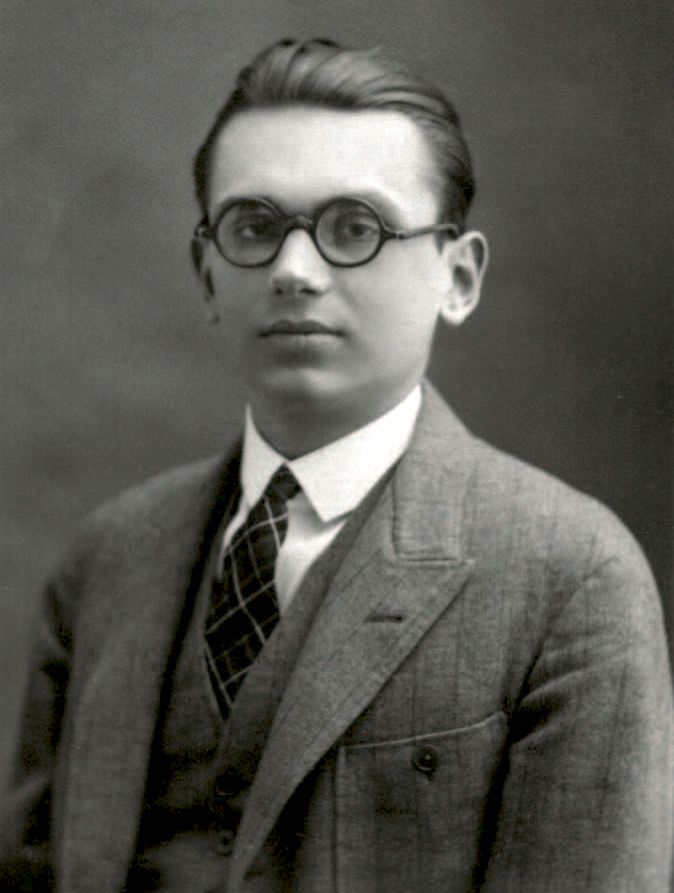
Kurt gödel as a student in 1925, six years before he would publish the incompleteness theorems at age 25. he was a member of the Vienna Circle, whose dream of a complete logical foundation for all knowledge his work would destroy. Public domain, via Wikimedia Commons
The Limits of Proof
On this day in 1906 — Kurt Gödel was born, and would prove that any logical system rich enough to be useful holds truths it can never prove.
3 min read
Kurt Gödel was born on April 28, 1906, in Brünn, Austria-Hungary, now Brno, Czech Republic. He was a sickly child, anxious and hypochondriacal, convinced he had a weak heart. He studied mathematics and philosophy at the University of Vienna and joined the Vienna Circle, a group of philosophers and scientists trying to build a rigorous foundation for all knowledge using logic and mathematics. Their project was ambitious: reduce every true statement to a proof, formalize all reasoning, eliminate ambiguity. Gödel destroyed that ambition at age 25.
In 1931, Gödel published a paper titled "On Formally Undecidable Propositions of Principia Mathematica and Related Systems." The title is dry. The implications are not. Gödel proved that in any sufficiently complex logical system, there exist statements that are true but cannot be proven within the system. Worse, no such system can prove its own consistency. If mathematics is consistent, it cannot prove it is consistent. If it proves it is consistent, it is lying. This is the first incompleteness theorem, and it shattered the dream of a complete, self-contained mathematical framework.
The proof works by turning logic on itself. Gödel assigned a unique number to every mathematical symbol, expression, and proof, a system now called Gödel numbering. Using these numbers, he constructed a statement that essentially says, "This statement cannot be proven." If the statement is false, it can be proven, which means the system proves false things, so it is inconsistent. If the statement is true, it cannot be proven, which means the system is incomplete. Either way, the system fails. It is a logical trap with no escape.
What Gödel showed is that mathematics has limits. Not practical limits, not limits of human intelligence, but structural limits. There are truths that sit outside the reach of any proof system you can construct. You can expand the system, add more axioms, make it more powerful, but new unprovable truths will always emerge. The boundary between what can be proven and what cannot is not a temporary obstacle. It is built into the nature of formal systems.
This has direct consequences for computation. Alan Turing, building on Gödel's work, proved that there is no general algorithm to determine whether an arbitrary program will halt or run forever. This is the halting problem, and it is undecidable. You cannot write a program that reliably predicts the behavior of all other programs. The best you can do is run the program and see what happens. Formal verification, automated testing, static analysis, these are all valuable tools, but they cannot eliminate uncertainty. Some bugs are provably undetectable until runtime.
Gödel's work also clarifies what it means to design a system. Any set of rules, any protocol, any specification, is a formal system. If the system is sufficiently complex, it will contain edge cases, ambiguities, and contradictions that cannot be resolved by the rules themselves. You need external judgment, human intervention, or an appeal to a higher-level system. This is why legal codes have courts. Why software has maintainers. Why protocols have governance processes. The rules alone are never enough. Interpretation is part of the system, not a failure of it.
Gödel himself became increasingly paranoid later in life. He believed people were trying to poison him and would only eat food prepared by his wife. When she became ill and was hospitalized, he stopped eating. He died of starvation in 1978, weighing 65 pounds. His mind, which had uncovered the limits of logical systems, could not escape the illogic of his own fears. There is something fitting in that. The man who proved that reason has boundaries spent his final years unable to reason his way out of delusion.
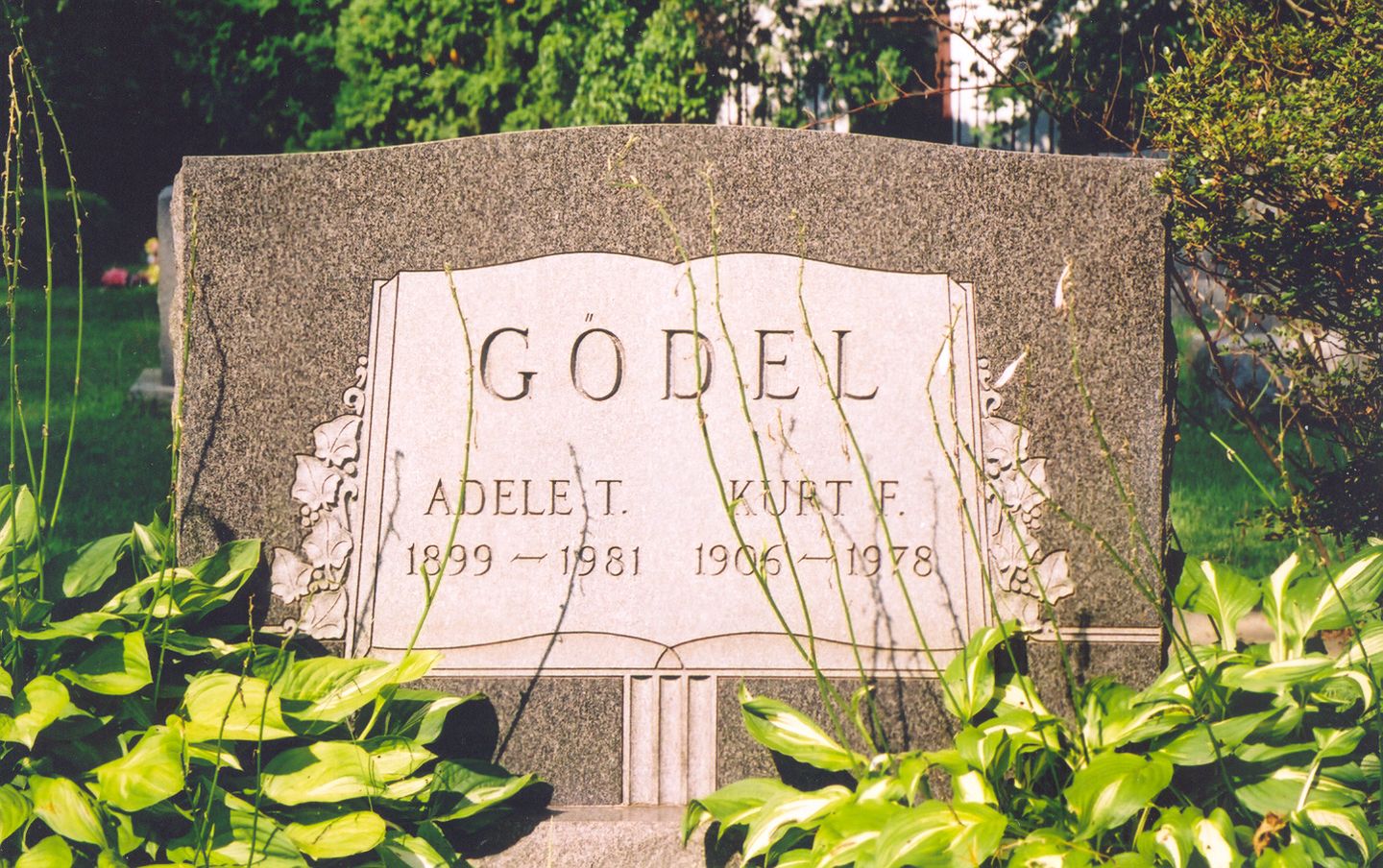
Gödel's grave at princeton cemetery, new jersey, where he settled after fleeing Europe to join the institute for advanced study. He died in 1978, weighing 65 pounds, after refusing food while his wife was hospitalized. Antonio G Colombo, Public domain, via Wikimedia Commons
What remains is the theorem. It is not a negative result, despite how it sounds. It is a clarification. It tells you what to expect from formal systems and what not to demand of them. You cannot build a system that answers every question, proves every truth, or eliminates all uncertainty. You can build systems that are useful, reliable, and robust within limits. The limits are real, and they are not going away. Gödel proved it. That is the proof.
studio / on-this-day / Apr 28