studio / on-this-day / Mar 17
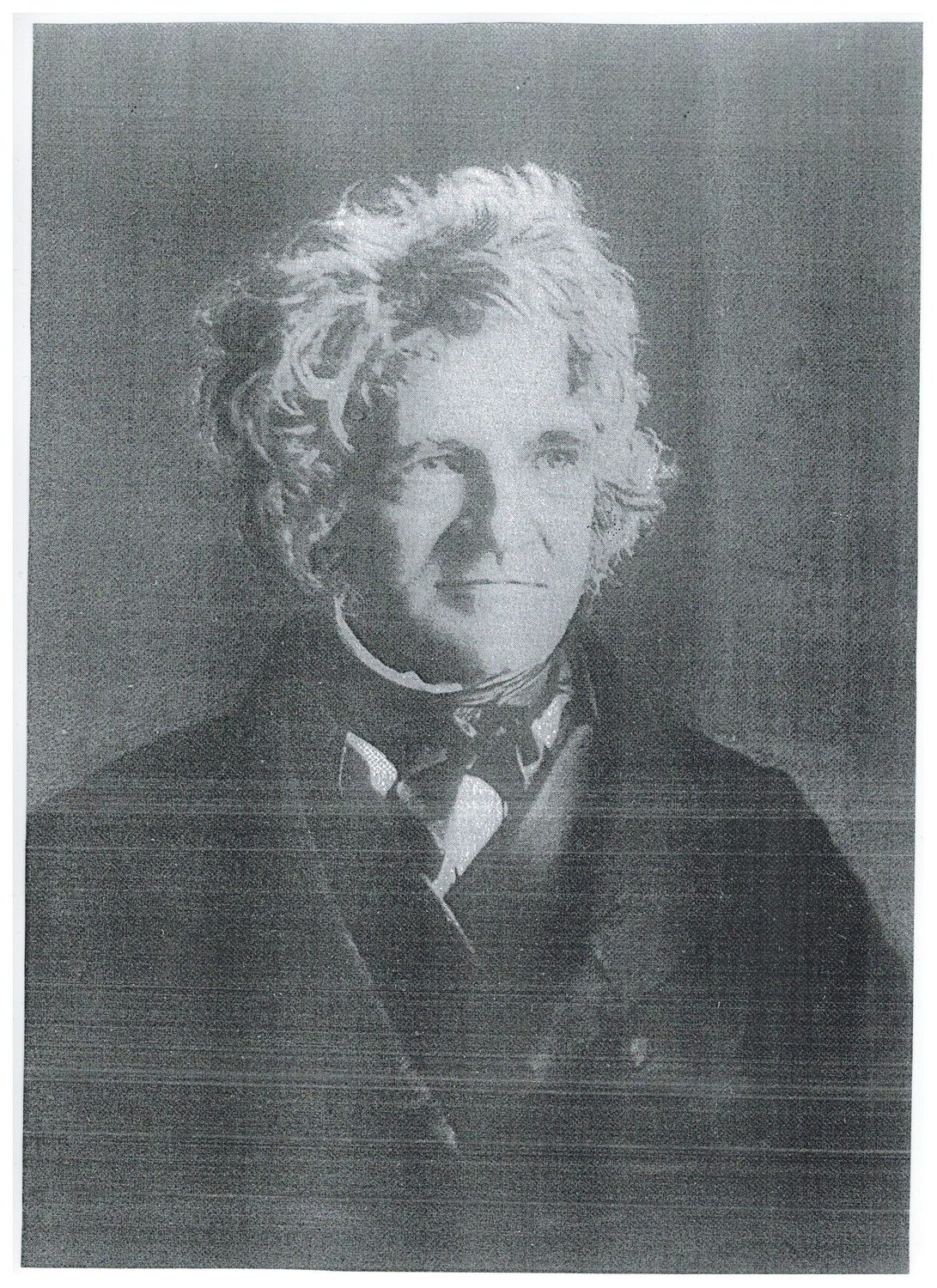
Friedrich Bessel, the astronomer who made the first reliable measurement of a star's distance. Dioskorides, CC BY-SA 4.0, via Wikimedia Commons
The Distance to Everything
On this day in 1846 — Friedrich Bessel died, the man who first measured the distance to a star and put a hard number on the emptiness.
3 min read
For most of human history, the stars were points of light at an unknown distance. They could have been holes in a celestial sphere a few miles up, or they could have been impossibly far away. No one knew, because no one had a way to measure. The problem wasn't telescopes or mathematics. It was perspective. To measure distance, you need to observe something from two different positions and calculate the angle between them. The technique is called parallax, and it works fine for objects a few miles away. But the stars are so far away that even viewing them from opposite sides of Earth's orbit produces an angle too small to detect with the naked eye.
Friedrich Wilhelm Bessel understood this. Born in 1784 in Minden, Prussia, he trained as an accountant and taught himself astronomy from books. By age twenty, he had calculated the orbit of Halley's Comet using historical observations. By thirty, he was director of the Königsberg Observatory, where he would spend the rest of his career. He had a gift for precision. He cataloged the positions of over 50,000 stars and developed mathematical tools still used today to describe wave functions and planetary motion. But his most famous achievement was figuring out how far away the stars actually are.
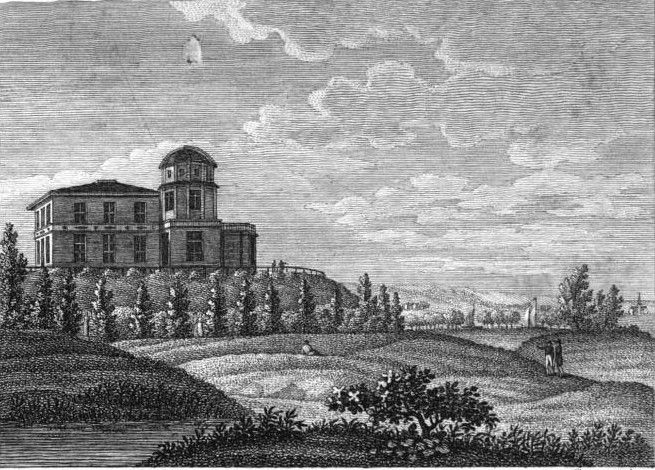
The königsberg Observatory around 1829, where Bessel made his measurements. Public domain, via Wikimedia Commons
The method was simple in principle. Observe a star from one side of Earth's orbit around the sun. Six months later, observe it again from the opposite side. If the star shifts position relative to more distant background stars, that shift, however tiny, can be used to calculate the distance through triangulation. The challenge was finding a star close enough to produce a measurable shift, and building instruments sensitive enough to detect it. Bessel spent years refining his telescope and selecting his target: 61 Cygni, a faint binary star in the constellation Cygnus.
In 1838, after months of careful observation, Bessel announced his result. The parallax angle was 0.314 arcseconds, roughly the width of a dime viewed from two miles away. That translated to a distance of about 10.3 light-years, or roughly 60 trillion miles. It was the first time anyone had measured the distance to a star. The universe, which had been an abstraction, suddenly had scale. The stars were not nearby. They were unimaginably distant, and the space between them was vast beyond comprehension.
What Bessel proved was less about 61 Cygni specifically and more about method. He showed that the stars were accessible to measurement, that the cosmos operated according to rules we could deduce from careful observation. His work gave astronomy a foundation. Before Bessel, the field was mostly descriptive: cataloging positions, tracking motions, noting cycles. After Bessel, it became quantitative. Distances could be calculated, luminosities inferred, masses estimated. The sky stopped being a backdrop and became a laboratory.
Bessel died on March 17, 1846, at the age of 61. By then, his parallax measurement had been confirmed by other astronomers and extended to additional stars. His mathematical contributions, particularly the Bessel functions that describe wave phenomena, had applications far beyond astronomy. Engineers today use them to model heat transfer, signal processing, and electromagnetic fields. The tools he developed to study stars turned out to be useful for understanding almost anything that vibrates or radiates.
The legacy of Bessel's work is not just the numbers he calculated, but the mindset he brought to the problem. Precision matters. Small angles carry information. The impossible can be measured if you build the right instrument and wait for the right moment. Every telescope launched into space, every distance measurement made by parallax, every astronomical catalog that lists stellar coordinates owes something to the methods Bessel refined in Königsberg. He took the stars out of mythology and put them into geometry. The universe has felt closer ever since.
There is a conceptual link between what Bessel did in 1838 and what Robert Goddard would do nearly a century later with liquid-fueled rockets. Both men proved that the unreachable could be reached, not through speculation, but through engineering and patience. Bessel's telescope gave us the distances. Goddard's rockets gave us the means to travel them. The space between is just math and thrust.
studio / on-this-day / Mar 17