studio / on-this-day / Mar 13
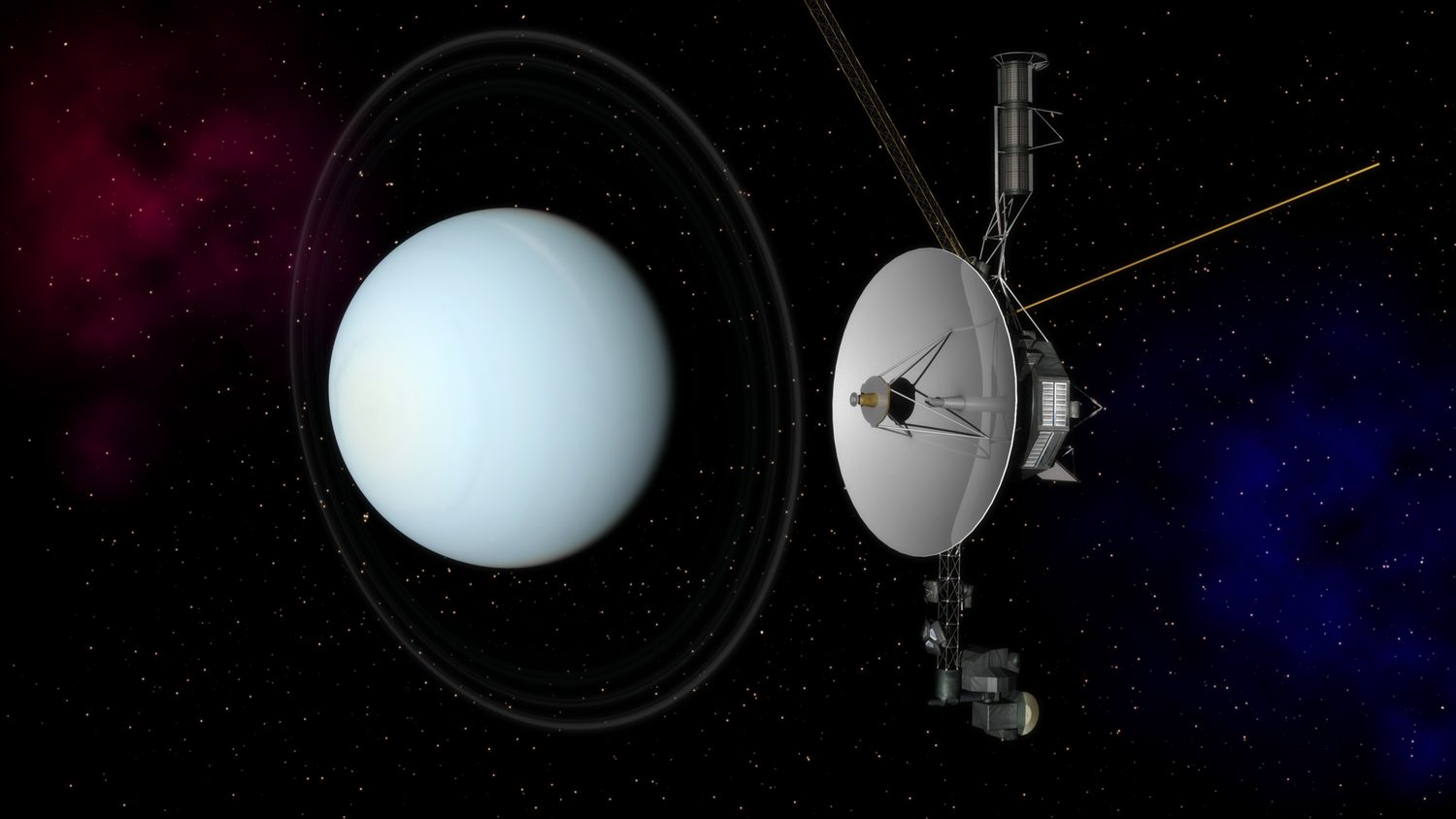
Uranus, the first planet discovered with a telescope, found by Herschel in 1781. Kevin M. Gill, CC BY 2.0, via Wikimedia Commons
Amateur Optics, Professional Discovery
On this day in 1781 — William Herschel found Uranus with a telescope he had built himself, the first new planet discovered in recorded history.
3 min read
William Herschel discovered Uranus on March 13, 1781, from the backyard of his house in Bath, England. He was not a professional astronomer. He was a musician and composer who ground telescope mirrors as a hobby. He had built his own seven-foot reflecting telescope because he could not afford to buy one of comparable quality. On that night, he was conducting a systematic survey of the sky, cataloging stars, when he noticed an object that did not look like the others. It appeared as a small disk rather than a point of light. He thought it might be a comet. It was a planet.
Herschel's discovery doubled the known size of the solar system. Mercury, Venus, Earth, Mars, Jupiter, and Saturn had been known since antiquity. They were the wanderers, visible to the naked eye. Uranus was different. It required a telescope to see and had been observed before but always mistaken for a star. Herschel recognized it as something else because his telescope was better and because he was looking carefully. He measured its motion over several nights, calculated its orbit, and concluded it was too distant and too slow to be a comet. Within months, other astronomers confirmed his findings. The solar system had a seventh planet.
Herschel wanted to name the planet Georgium Sidus, "George's Star," after King George III. The name did not stick. French astronomers refused to honor the British monarch and called it Herschel instead. Eventually, the astronomical community settled on Uranus, continuing the tradition of naming planets after Roman gods. Herschel's preferred name became a footnote, but the discovery made him famous. King George appointed him Court Astronomer, gave him a salary, and funded the construction of even larger telescopes. Herschel quit music and became a full-time astronomer.
The telescope Herschel used was a Newtonian reflector with a mirror he had cast and polished himself. Making telescope mirrors was labor-intensive. It required melting and casting metal alloys, grinding them to precise curvatures, and polishing them to optical smoothness. Herschel made hundreds of mirrors, experimenting with different compositions and techniques. He built telescopes of increasing size, eventually constructing a 40-foot instrument with a mirror four feet in diameter. It was the largest telescope in the world for 50 years, though it was difficult to use and spent much of its life as a curiosity.
Herschel's discovery was not luck. It was the result of systematic observation. He conducted multiple surveys of the entire visible sky, cataloging the positions and apparent brightness of thousands of stars. He was looking for patterns, anomalies, anything that did not fit existing models. The survey approach was methodical and time-consuming. It required patience, clear nights, and obsessive record-keeping. Herschel found Uranus because he was looking at parts of the sky most astronomers ignored.
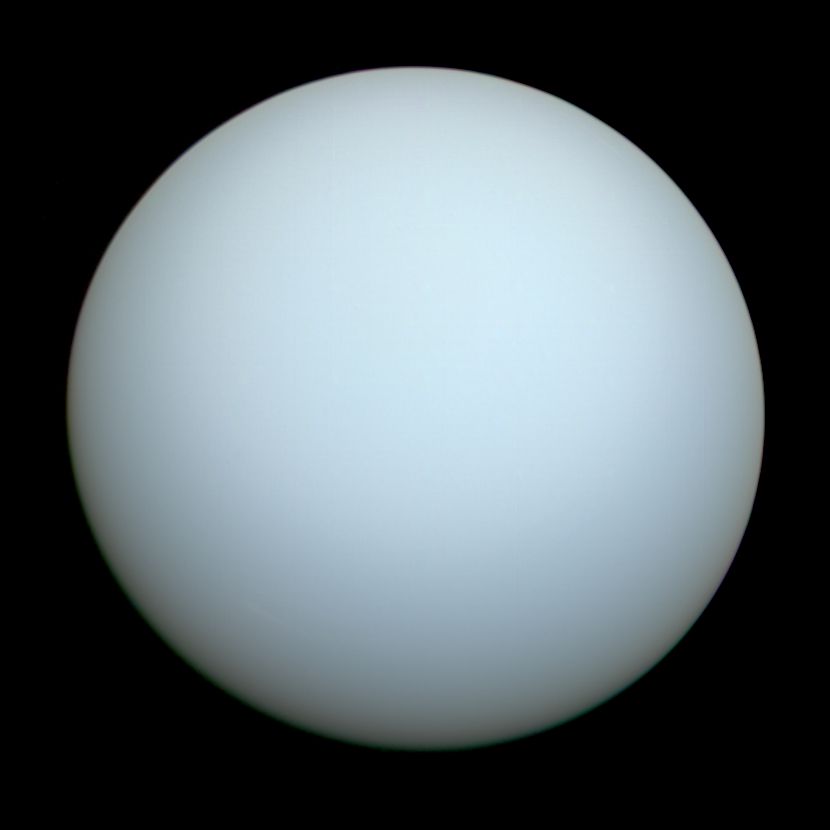
Uranus photographed by voyager 2, the planet Herschel discovered from his backyard in Bath. Ardenau4, CC0, via Wikimedia Commons
After discovering Uranus, Herschel went on to discover two of its moons, Titania and Oberon, and two moons of Saturn. He cataloged over 2,500 nebulae and star clusters, many of which are still identified by his catalog numbers. He was the first to realize that some nebulae are galaxies, distant collections of stars far beyond the Milky Way. He proposed that the Milky Way itself has a structure, a disk of stars with the Sun located off-center. His work laid the groundwork for modern cosmology.
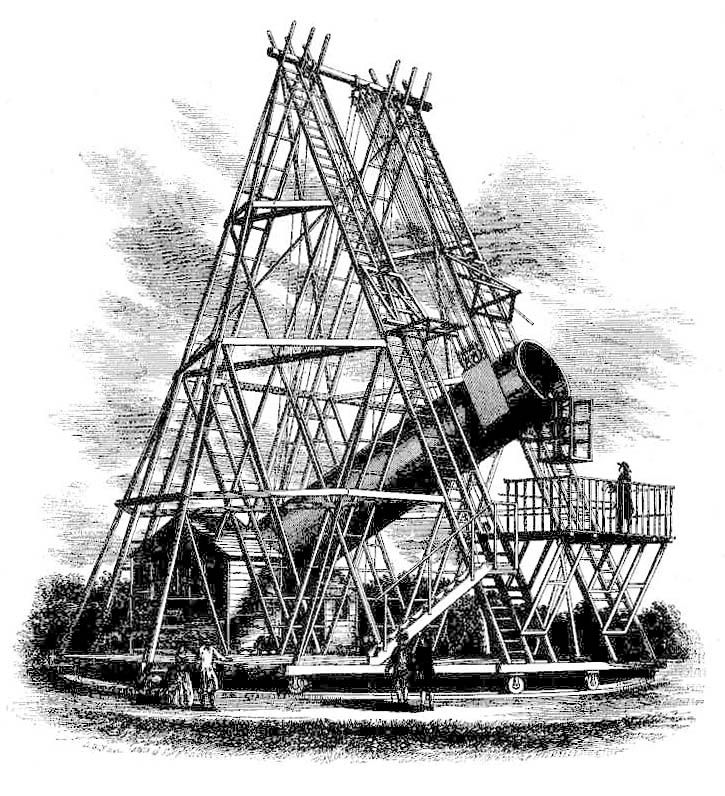
Herschel's 40-foot telescope, the largest in the world for fifty years, built with a four-foot mirror he cast himself. Public domain, via Wikimedia Commons
Herschel's story is a reminder that major discoveries often come from outside established institutions. He was not trained as an astronomer. He did not have access to university resources or professional equipment. What he had was curiosity, technical skill, and the willingness to spend thousands of hours grinding mirrors and staring at the sky. The tools he needed did not exist, so he built them. The data he needed was not published, so he collected it himself. The planet was always there. He just had to look.
studio / on-this-day / Mar 13