studio / on-this-day / Feb 9
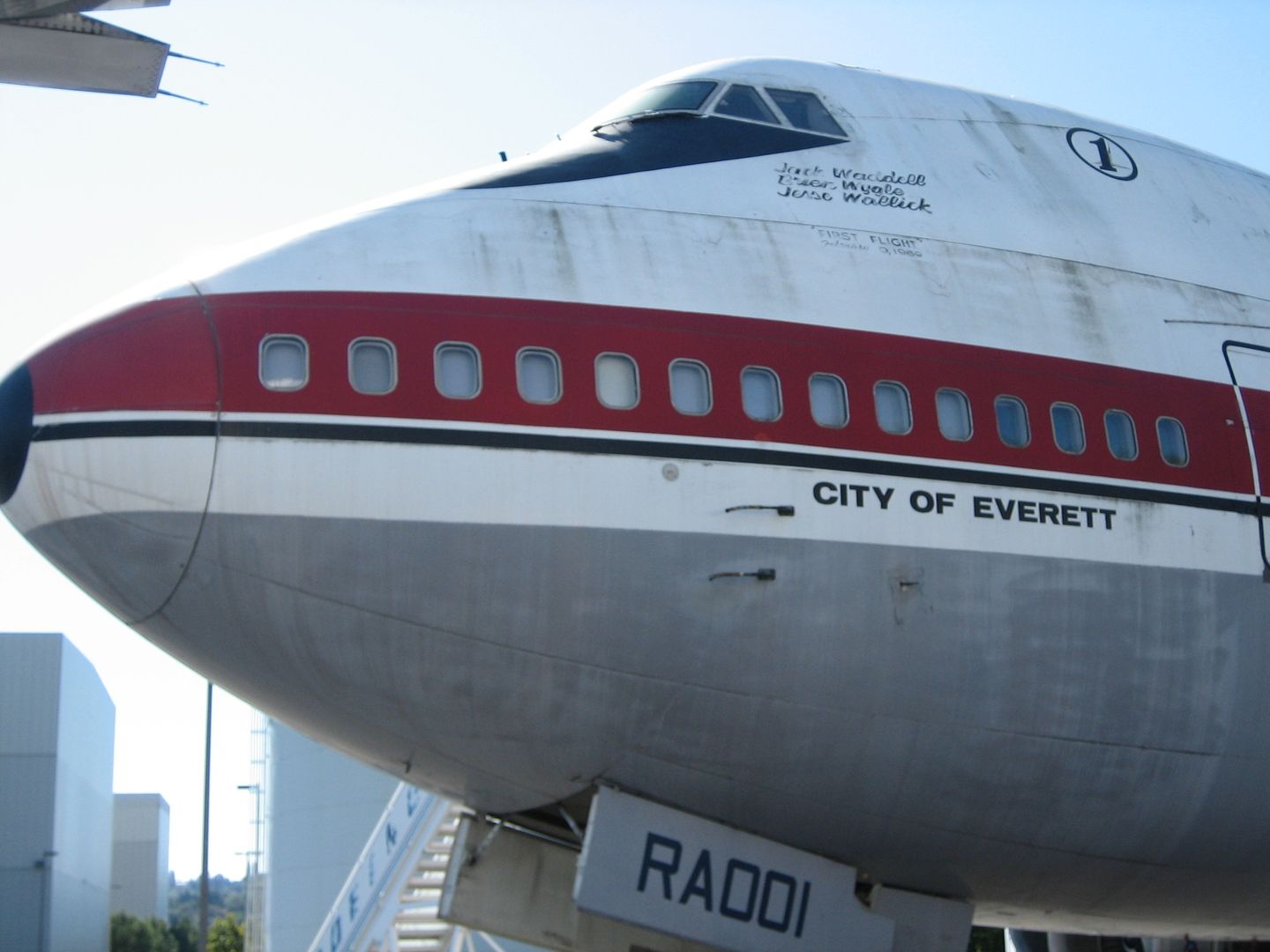
The Boeing 747 prototype, city of Everett, which made its maiden flight on February 9, 1969, from Paine Field in Everett, Washington. Fawcett5, Public domain, via Wikimedia Commons
Design at Impossible Scale
On this day in 1969 — the Boeing 747 lifted off for the first time, an aircraft so large it seemed to be arguing with physics.
3 min read
The Boeing 747 took off from Paine Field in Everett, Washington, on February 9, 1969, at 11:34 AM. Test pilot Jack Waddell lifted the nose, and 710,000 pounds of aluminum, fuel, and ambition became airborne. The aircraft climbed to 15,000 feet, flew for 75 minutes, and landed without incident. It was the first flight of a machine that would redefine what commercial aviation could do, and it almost bankrupted the company that built it.
Juan Trippe, the founder of Pan Am, wanted an airplane that could carry twice as many passengers as anything flying at the time. The existing long-range jets, like the Boeing 707 and Douglas DC-8, seated around 200. Trippe envisioned 400 or more. He wanted to cut the cost per seat mile in half and make international travel affordable for the middle class. He told Boeing to build it. Boeing said yes, even though they had no idea if it was possible.
The engineering challenges were massive. A plane that size would need engines that didn't exist. Wings strong enough to support the weight without being too heavy to fly. A fuselage wide enough for two aisles, which had never been done on a commercial jet. And it all had to be built in 28 months, because Pan Am had already ordered 25 of them and expected delivery by 1970.
Boeing built a new factory to assemble the 747, the largest building by volume in the world at the time. Pratt & Whitney developed the JT9D turbofan engine, the first high-bypass turbofan powerful enough for commercial aviation. The design team created the distinctive hump at the front of the fuselage to house the cockpit, making the rest of the upper deck available for cargo or passengers. The hump was originally intended to allow the nose to open for freight loading, under the assumption that the 747 would eventually be replaced by supersonic jets and relegated to cargo duty. That never happened.
The 747 entered service in January 1970. It could carry 366 passengers in a typical three-class configuration, or up to 550 in an all-economy layout. It could fly nonstop from New York to Tokyo. It was quieter than earlier jets, more fuel-efficient per passenger, and it turned long-distance air travel into something resembling mass transit. Ticket prices dropped. Routes expanded. The world got smaller.
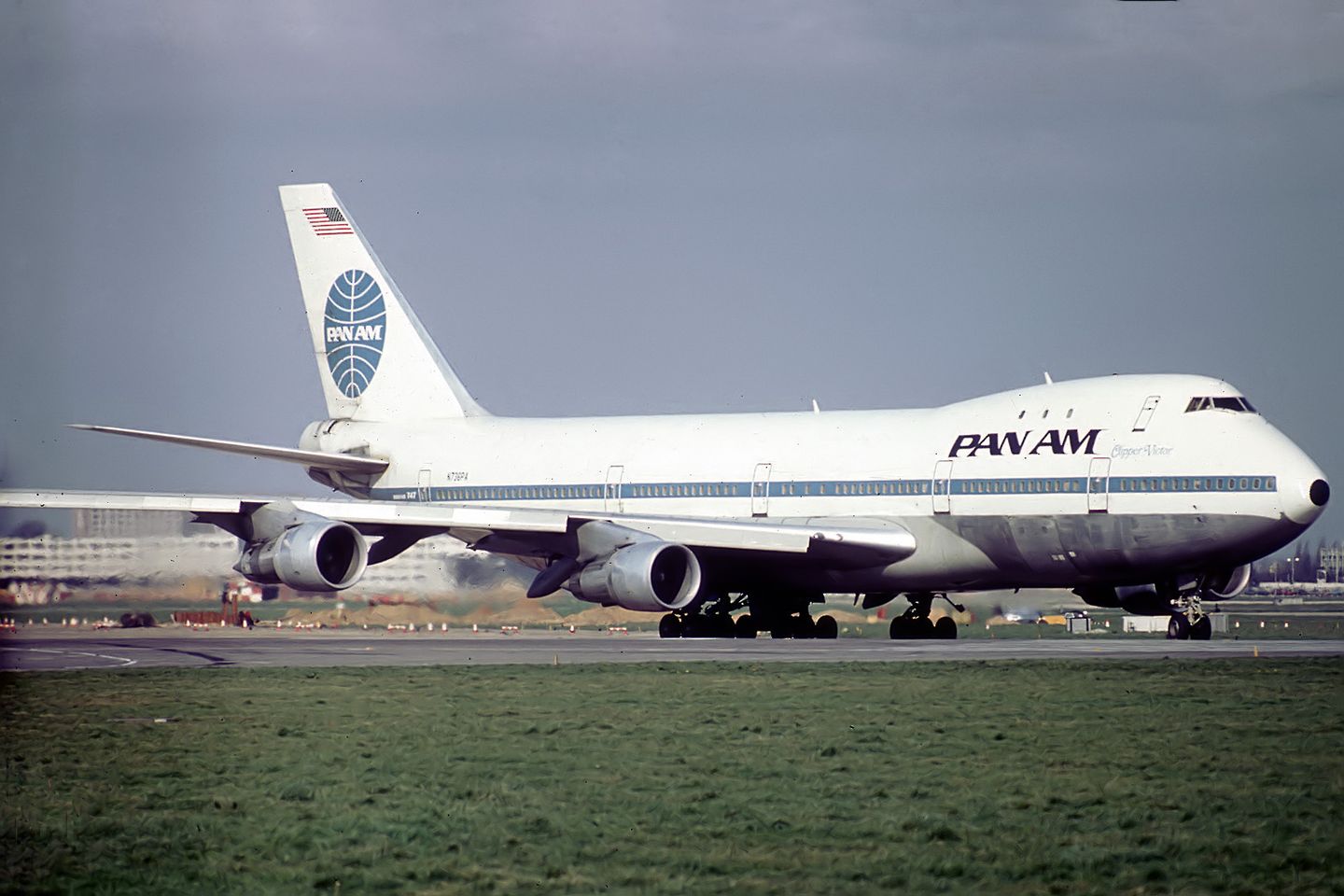
Pan AM's Boeing 747-121 "Clipper Victor" at London Heathrow. Juan Trippe's Pan AM ordered 25 of the jets before Boeing knew it could build them, and flew the type's first commercial service in 1970. Paul Seymour, CC BY-SA 4.0, via Wikimedia Commons
The airplane was so expensive to develop that Boeing nearly went bankrupt in the early 1970s. Employment in Seattle dropped from 100,000 to 38,000. A billboard near the airport read: "Will the last person leaving Seattle turn out the lights?" But the 747 sold. Airlines around the world ordered them. The production run lasted 54 years. The last one rolled off the assembly line in 2023, after 1,574 units were built. No other wide-body jet has come close to that number.
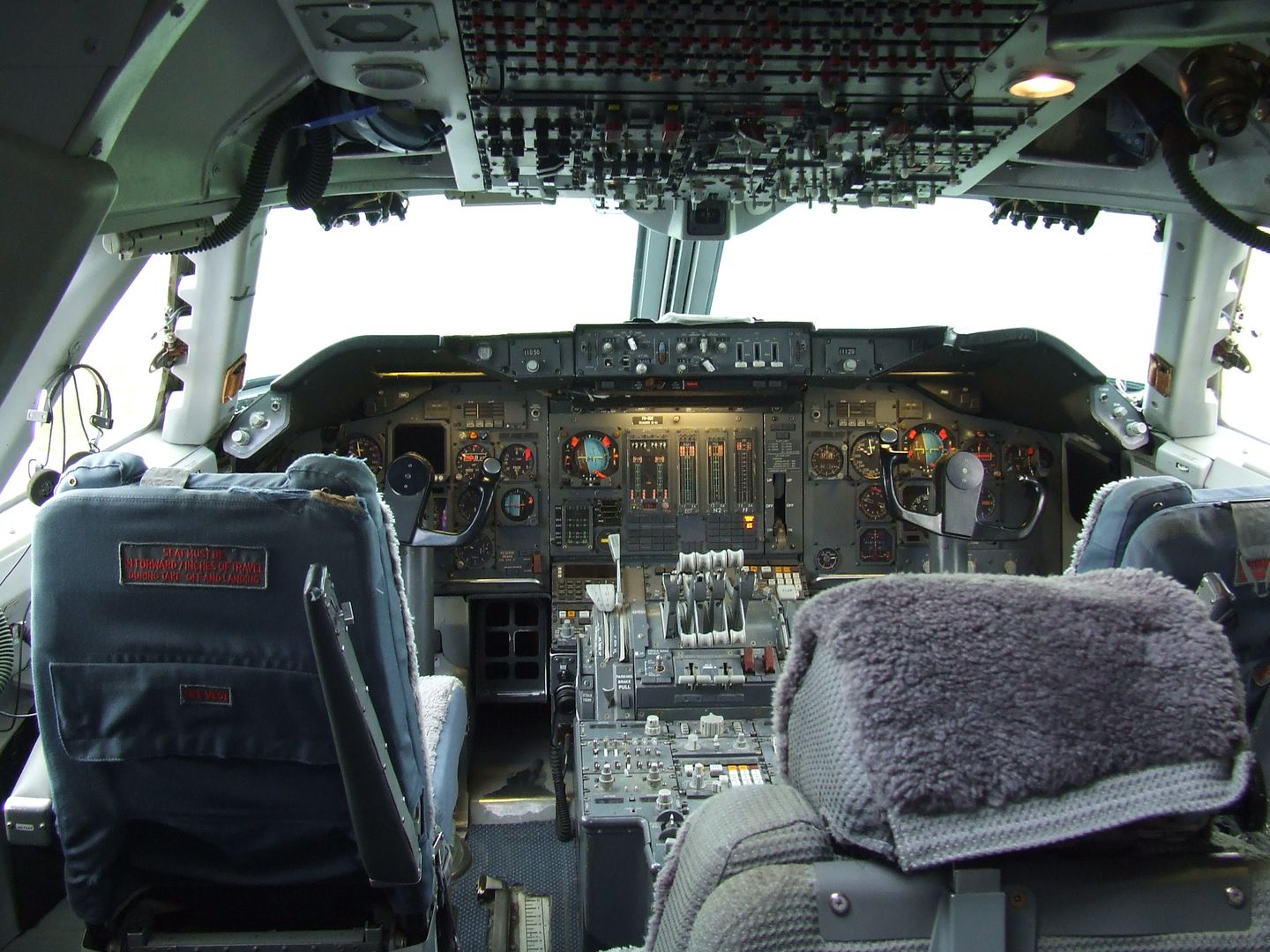
Cockpit of a Boeing 747-200 at the Aviodrome aviation museum in Lelystad, Netherlands, showing the flight engineer station and instrument panel that became the nerve center of the world's most iconic commercial jet. Felix Stember, CC BY-SA 3.0, via Wikimedia Commons
The 747's design became iconic in a way few machines ever do. The bulging forehead. The four engines slung under swept wings. The sheer size. It appeared in movies, on album covers, in dreams of travel. It became the default image of what a jet airplane looks like, even though most people who flew on one never sat on the upper deck. The main cabin, the one everyone knows, is enormous and oddly ordinary. Two aisles. Ten seats across. Overhead bins. It's a room that happens to be six miles above the ocean, moving at 570 miles per hour.
What the 747 proved is that scale is a design parameter you can choose to push. Boeing didn't build a slightly bigger plane. They built one twice the size of anything flying and bet the entire company on it working. The risk was existential. The reward was a machine that moved more people farther and cheaper than ever before, for half a century. That's not just engineering. That's conviction expressed in aluminum and thrust.
studio / on-this-day / Feb 9