studio / on-this-day / Feb 28
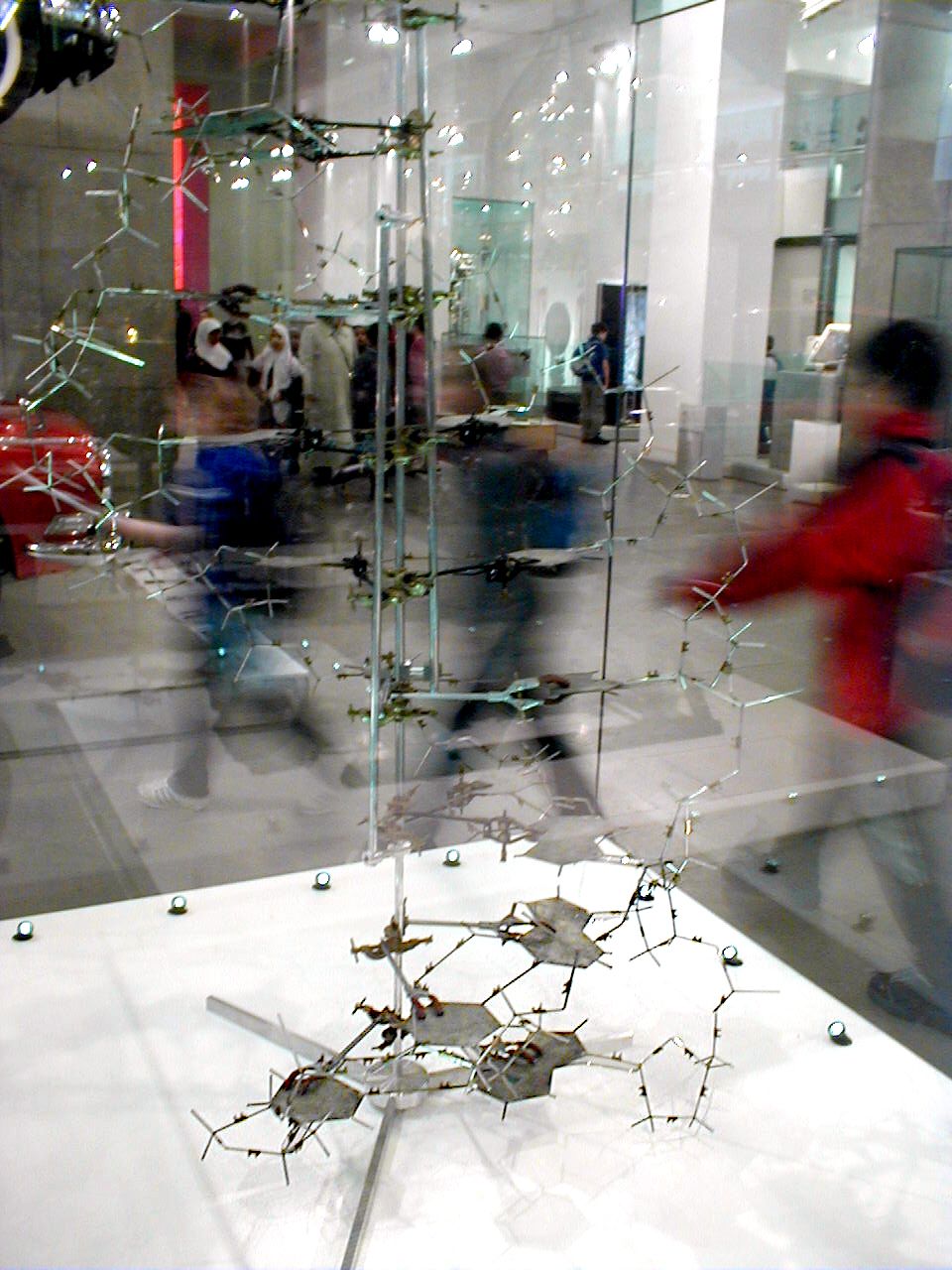
The original Watson-Crick DNA molecular model from 1953, now held at the science museum in London. On February 28, 1953, Watson and Crick walked into the Eagle Pub in Cambridge and announced they had discovered the secret of life. User:Alkivar, Public domain, via Wikimedia Commons
The Double Helix
On this day in 1953 — Watson and Crick worked out the double helix, and life turned out to store its instructions in an elegant twisted ladder.
3 min read
On February 28, 1953, James Watson and Francis Crick walked into the Eagle Pub in Cambridge, England, and announced that they had discovered the secret of life. They had determined the structure of deoxyribonucleic acid, DNA, the molecule that carries genetic information in living organisms. The structure was a double helix, two intertwined spirals held together by pairs of chemical bases. It was elegant, simple, and immediately suggested how genetic information could be copied and transmitted.
Watson was 24, an American biologist working on a postdoctoral fellowship. Crick was 36, a British physicist who had turned to biology. They worked at the Cavendish Laboratory in Cambridge, building models of molecular structures based on experimental data produced by others. They did not conduct the experiments themselves. They interpreted the results.
The critical data came from Rosalind Franklin, a chemist working at King's College London. Franklin was an expert in X-ray crystallography, a technique that involved firing X-rays at crystallized molecules and analyzing the diffraction patterns to infer structure. In 1952, she produced a particularly clear image of DNA, known as Photo 51. The image showed a distinctive X-shaped pattern, a signature of a helical structure.
Franklin's colleague, Maurice Wilkins, showed Photo 51 to Watson without her knowledge or permission. Watson saw the image and immediately recognized its significance. He and Crick used the data, along with chemical rules about base pairing discovered by biochemist Erwin Chargaff, to build a physical model of DNA. The model consisted of two sugar-phosphate backbones twisted into a helix, with pairs of bases (adenine with thymine, guanine with cytosine) forming the rungs of the ladder.
The structure explained how DNA could replicate. The two strands could separate, and each could serve as a template for constructing a new complementary strand. This was the mechanism of heredity at the molecular level. Watson and Crick published their findings in the journal Nature on April 25, 1953, in a paper less than a page long. The final sentence was a masterpiece of understatement: "It has not escaped our notice that the specific pairing we have postulated immediately suggests a possible copying mechanism for the genetic material."
Rosalind Franklin's contribution was acknowledged in a separate paper published alongside Watson and Crick's, but her role was downplayed. She died of ovarian cancer in 1958 at the age of 37, possibly due to prolonged exposure to X-rays. In 1962, Watson, Crick, and Wilkins were awarded the Nobel Prize in Physiology or Medicine for the discovery. Franklin was not included. Nobel Prizes are not awarded posthumously, and there is no evidence that the committee would have recognized her contribution even if she had been alive.
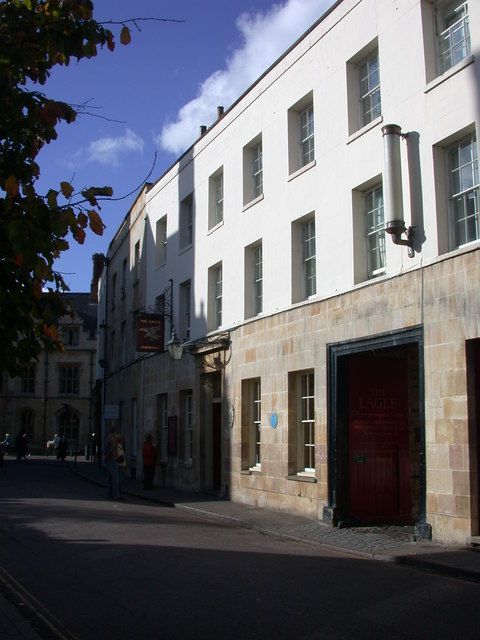
The Eagle Pub on Bene't Street in Cambridge, where Watson and Crick announced on February 28, 1953 that they had found the secret of life. Keith Edkins, CC BY-SA 2.0, via Wikimedia Commons
The discovery of DNA's structure was a turning point in biology. It provided a physical basis for genetics, explained how traits are inherited, and opened the door to molecular biology as a discipline. Within decades, scientists were manipulating DNA directly, sequencing genomes, cloning organisms, and engineering new life forms. The Human Genome Project, completed in 2003, mapped all 3 billion base pairs in human DNA. CRISPR technology, developed in the 2010s, allows for precise editing of genetic sequences.
The double helix is now one of the most recognizable symbols in science, appearing in logos, textbooks, and popular culture. It represents the idea that life is, at its core, information encoded in a physical structure. DNA is a language written in four letters (A, T, G, C), a code that specifies proteins, which in turn build and operate cells, which form tissues, organs, and organisms. It is a design system, one that predates human civilization by billions of years.
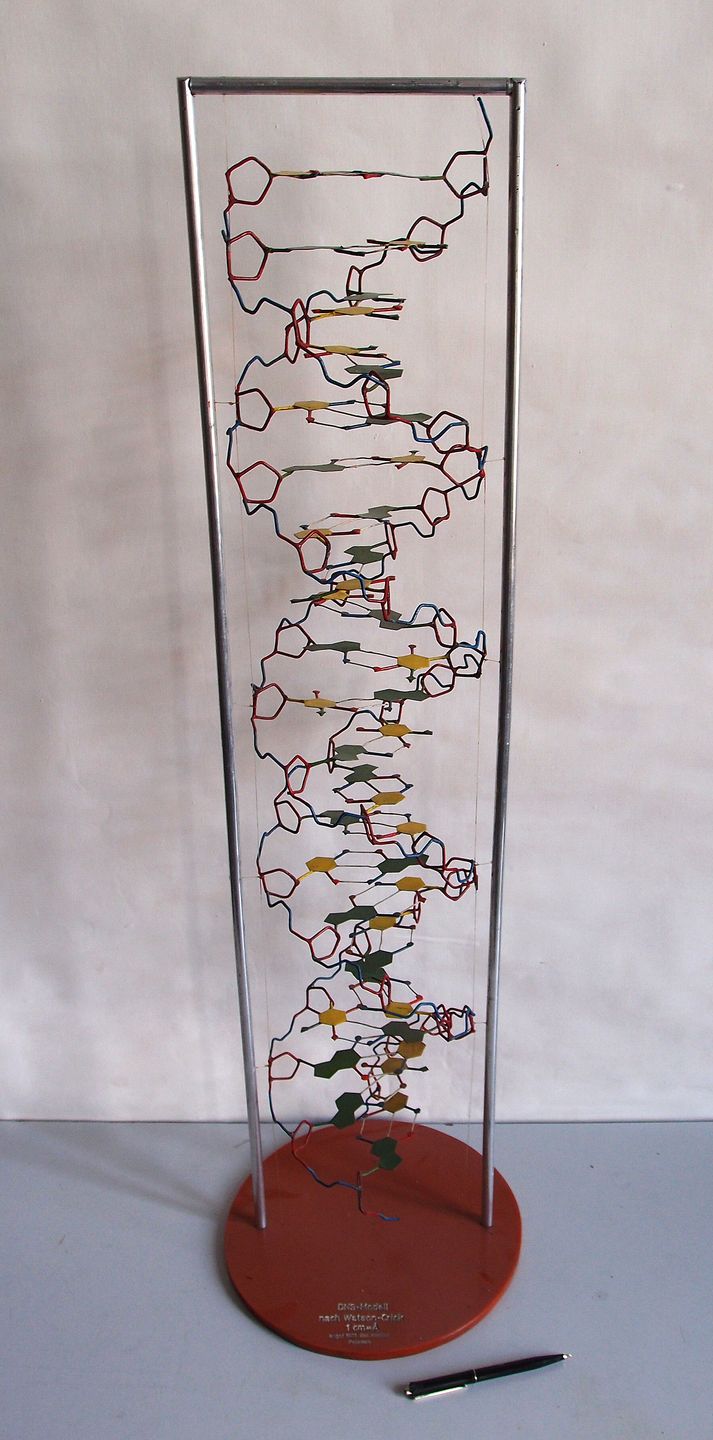
A model of the DNA double helix according to the Watson-Crick model — two complementary strands twisted together, with base pairs (adenine-thymine and guanine-cytosine) forming the rungs of the molecular ladder. David Ludwig, CC BY-SA 3.0, via Wikimedia Commons
Watson and Crick's discovery was not just about finding the shape of a molecule. It was about revealing the architecture of inheritance, the mechanism by which complexity is transmitted across generations. The elegance of the double helix lies in its simplicity. Two strands, complementary and intertwined, capable of separating and replicating with extraordinary fidelity. It is a structure that encodes its own reproduction, a blueprint that is also a machine. On February 28, 1953, the secret of life was not discovered so much as it was read, decoded from the patterns hidden in an X-ray photograph. Biology became a language, and we learned to read it.
studio / on-this-day / Feb 28