studio / on-this-day / Feb 25
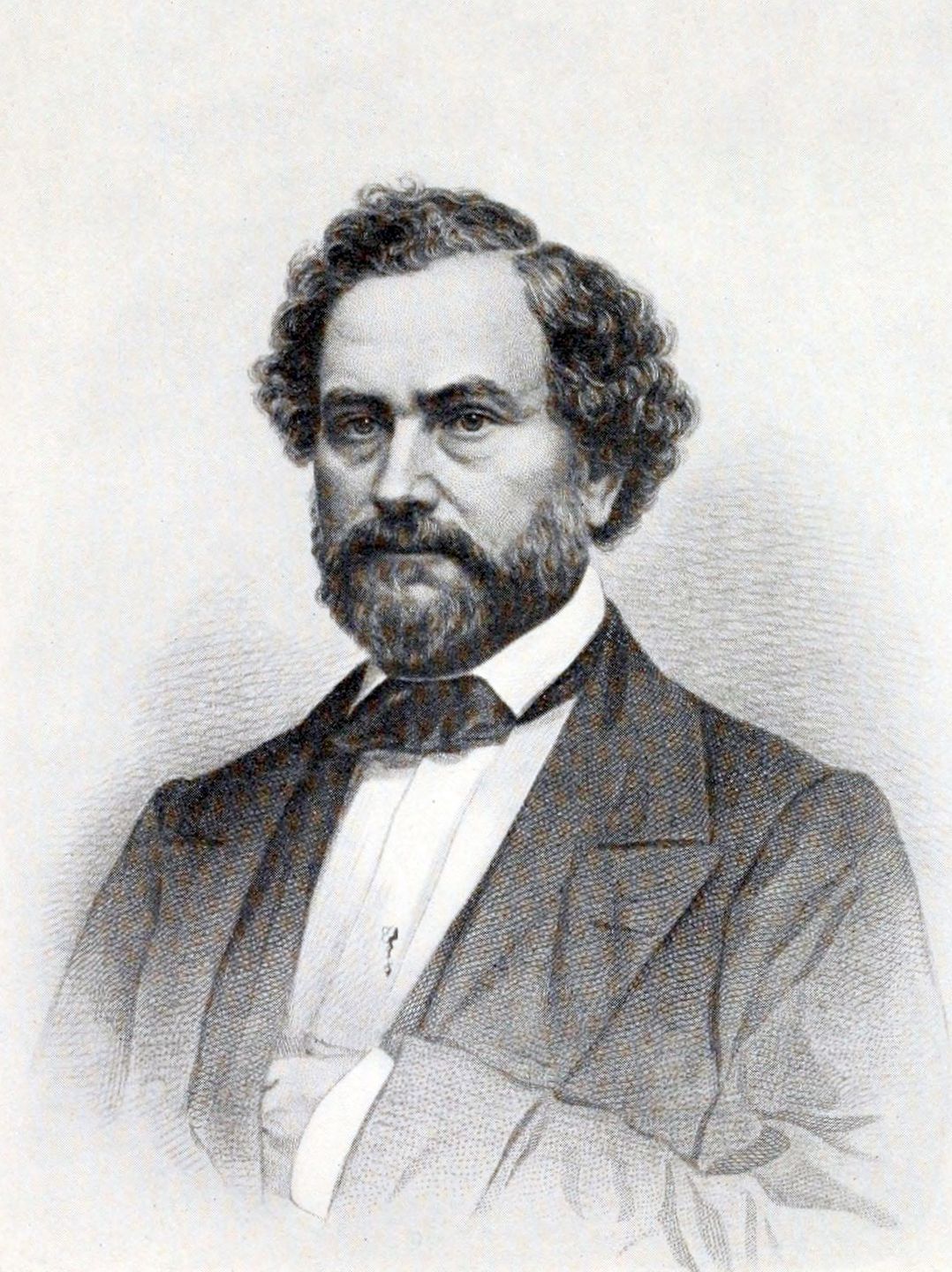
Samuel Colt, photographed by Mathew Brady in 1857, the inventor who received U.S. Patent no. 9430x for his "revolving gun" on February 25, 1836, and went on to pioneer interchangeable parts Manufacturing. Smith, Henry Wright, b. 1828, engraver; after a photo by Mathew Brady, Public domain, via Wikimedia Commons
The Geometry of Conflict
On this day in 1836 — Samuel Colt patented the revolver, a piece of mechanical cleverness that changed the arithmetic of a fight.
3 min read
On February 25, 1836, Samuel Colt received U.S. Patent No. 138 (later renumbered 9430X) for a "revolving gun." It was not the first firearm with a rotating cylinder, but it was the first practical, reliable design that could be mass-produced. The revolver changed warfare, law enforcement, and the American frontier. It also made Colt very rich.
Colt was 21 when he received the patent. He had been obsessed with firearms since childhood and had spent years refining his design. The key innovation was a mechanism that automatically rotated the cylinder and locked it in place when the hammer was cocked. Earlier revolving firearms required the shooter to manually align the chamber with the barrel, a slow and imprecise process. Colt's design was mechanical, repeatable, and fast. A trained shooter could fire six rounds in quick succession without reloading.
The revolver was a multiplier. Before Colt, most firearms were single-shot weapons. A soldier or civilian carried a musket, a rifle, or a pistol that required reloading after each discharge. The process involved powder, wadding, and a ball, and it took time. In combat, that time could be fatal. Colt's revolver held six shots in a rotating cylinder. It gave one person the firepower of six. It changed the calculus of violence.
Colt initially struggled to commercialize his invention. He founded the Patent Arms Manufacturing Company in Paterson, New Jersey, in 1836, but sales were slow. The U.S. military was not interested. Civilians found the weapons expensive. The company went bankrupt in 1842. Colt lost control of his patents and spent the next few years promoting other inventions, including underwater mines and telegraph cable.
The Mexican-American War changed everything. In 1846, Captain Samuel Walker of the Texas Rangers contacted Colt. Walker had used Colt's revolvers in combat and wanted a more powerful version for mounted troops. Colt designed the Walker Colt, a massive .44 caliber revolver that became the most powerful handgun in the world at the time. The U.S. government ordered 1,000 units. Colt was back in business.
He reopened his factory in Hartford, Connecticut, and began refining his manufacturing processes. Colt was not just an inventor. He was a pioneer of industrial production. He implemented interchangeable parts, a concept that was revolutionary in the 1850s. Most firearms were handmade by skilled gunsmiths, with each part custom-fitted to a specific weapon. Colt's factory used precision machinery to produce standardized components that could be assembled by less skilled workers. This reduced costs, increased production speed, and made repairs easier. A broken part could be swapped out rather than hand-crafted.
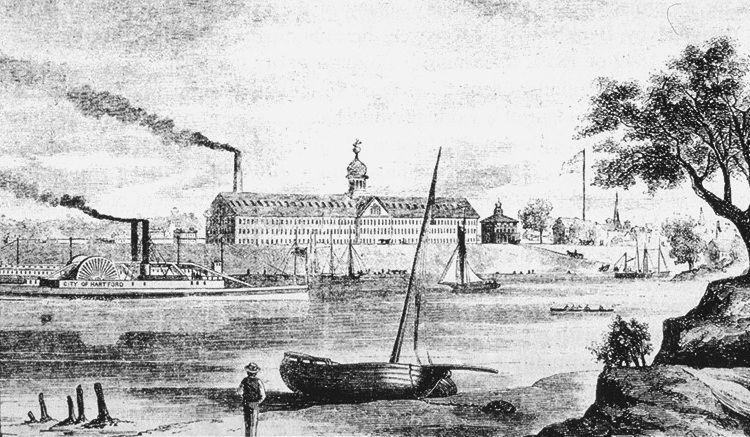
Colt's Armory in Hartford, Connecticut, shown in 1857, where precision machinery and interchangeable parts turned firearm-making into industrial mass production. Public domain, via Wikimedia Commons
The revolver became a symbol of American expansion. It was carried by settlers, soldiers, lawmen, and outlaws. It was used in the Civil War, the Indian Wars, and countless personal conflicts. The phrase "God made men, but Samuel Colt made them equal" captured the weapon's leveling effect. A small person could match a large one. A single individual could hold off multiple attackers. The revolver democratized violence.
Colt died in 1862 at the age of 47, one of the wealthiest men in America. His factory continued producing firearms for decades. The Colt Single Action Army, introduced in 1873, became the most iconic revolver in history, known as the "Peacemaker." It was the weapon of choice for lawmen and gunfighters in the American West.
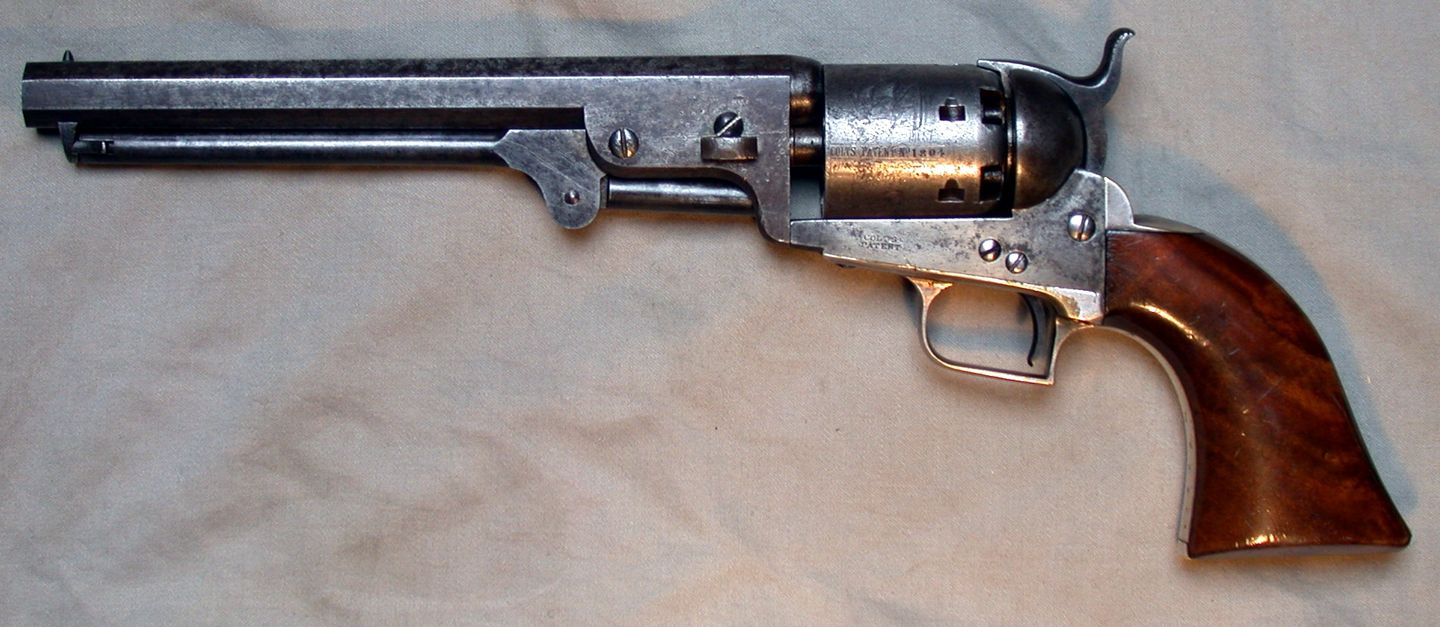
A Colt Navy Model 1851 revolver, one of the early percussion revolvers that made Samuel Colt's mechanical design famous across America and Europe. The Colt Navy was produced from 1850 to 1873. Hmaag, CC BY-SA 3.0, via Wikimedia Commons
The revolver is a design object. It is a machine optimized for a specific task: delivering projectiles accurately and repeatedly with minimal delay. Its rotating cylinder is an elegant solution to a mechanical problem. Its grip, balance, and trigger pull are the result of iterative refinement. It is also a tool of destruction, responsible for countless deaths over nearly two centuries.
Colt's innovation was not just a weapon. It was a system for manufacturing precision machines at scale. The interchangeable parts he pioneered would influence the production of everything from sewing machines to automobiles. The revolver itself remains in use today, largely unchanged in principle from the design Colt patented in 1836. It is a reminder that some solutions are so effective, so precisely matched to their purpose, that they endure for generations. The geometry of conflict changed on February 25, 1836. One trigger, six chambers, and the mechanical certainty that each would fire in turn.
studio / on-this-day / Feb 25