studio / on-this-day / Dec 7
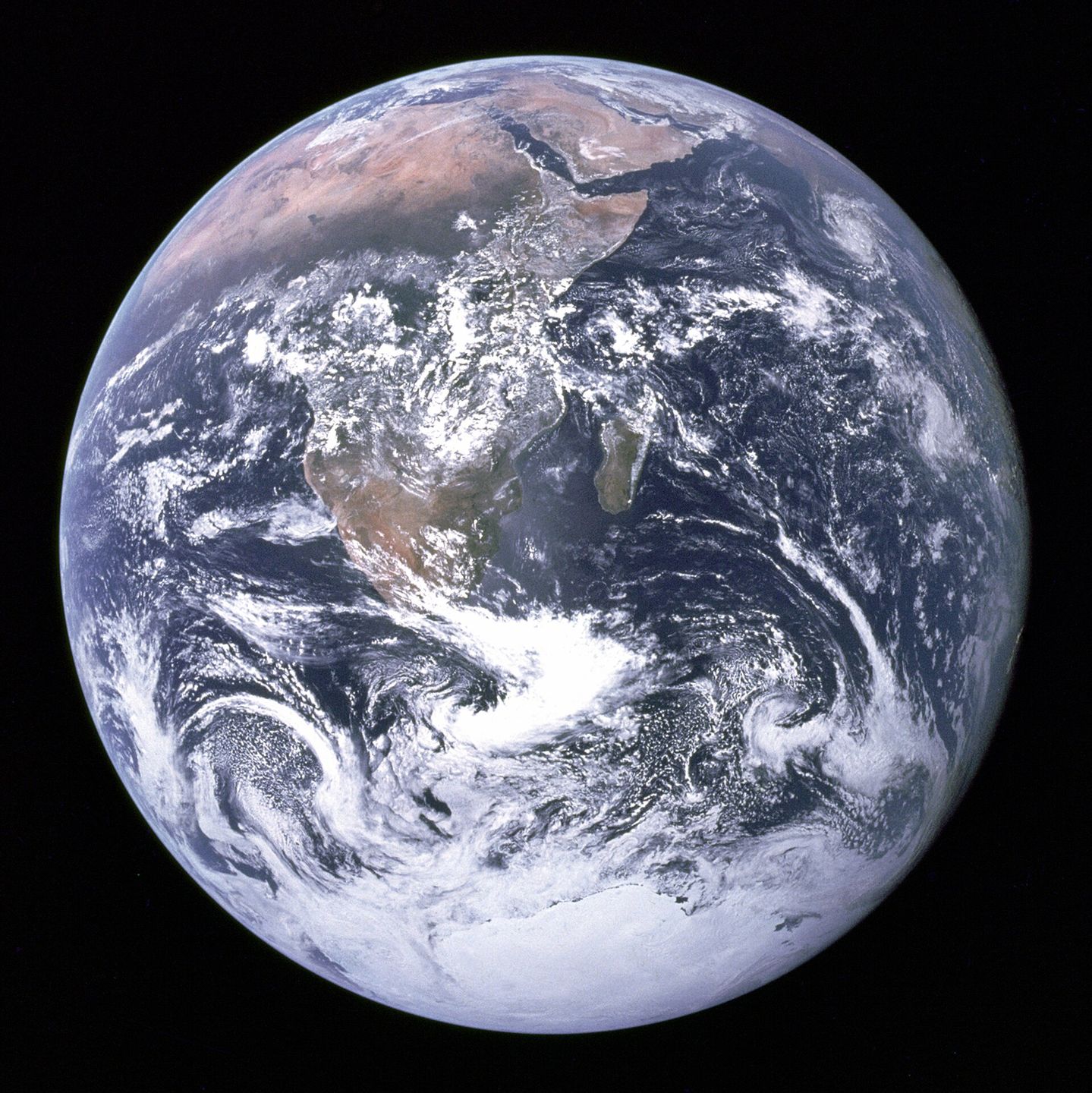
The Blue Marble, December 7, 1972. NASA/Apollo 17 crew; taken by either Harrison Schmitt or Ron Evans, Public domain, via Wikimedia Commons
The Blue Marble
On this day in 1972 — the crew of Apollo 17 shot the Blue Marble, which became the most reproduced photograph in history.
3 min read
On December 7, 1972, at 5:39 a.m. EST, the crew of Apollo 17 was five hours and six minutes into their journey to the Moon, traveling at roughly 28,000 kilometers per hour, when one of them looked back. Through a window in the command module, 29,000 kilometers from Earth, they saw the planet fully illuminated by the Sun. Africa was visible. Madagascar. Antarctica. Swirling white clouds over blue oceans. The astronauts grabbed a Hasselblad camera fitted with an 80mm lens and captured a single frame. The image, later cataloged as AS17-148-22727, became known as "The Blue Marble." It is the most widely distributed photograph in human history.
No one knows for certain who pressed the shutter. The crew consisted of Eugene Cernan, Ronald Evans, and Harrison Schmitt. NASA credits the entire crew. The image was one of several taken during the outbound leg of the mission, but this particular frame stood out. Earth appeared as a perfect sphere, hanging in the blackness of space, with no landmass dominating the composition. It was the first photograph to show Earth fully lit from the perspective of human eyes. Earlier missions had captured partial views, crescents, or distant shots. This was the whole planet, centered, sharp, and impossibly beautiful.
The photograph's impact was immediate and unexpected. NASA released it to the public, and it spread everywhere: newspapers, magazines, textbooks, posters, album covers. It became an icon of the environmental movement. The first Earth Day had been celebrated in 1970, two years earlier, but "The Blue Marble" gave the movement a visual anchor. Here was undeniable evidence that Earth is finite, fragile, and isolated. There are no borders visible from space. No nations. Just water, land, clouds, and life clinging to a small rock in an indifferent void.
What makes the image powerful is its perspective. For all of human history, people looked at the horizon. They saw land extending outward, oceans stretching to the edge of vision, skies arching above. The world felt vast and inexhaustible. "The Blue Marble" flipped that perspective. Suddenly, Earth was small. Contained. Bounded. Astronauts returning from space missions often describe a profound psychological shift called the "overview effect," a cognitive reorientation that occurs when you see the planet as a whole. The photograph allowed people who would never leave the ground to experience a version of that shift.
The image also became a symbol of technological achievement. Humans built machines capable of leaving Earth, traveling a quarter-million miles through vacuum, landing on another world, and returning safely. The photograph was proof of that capability. But it also highlighted the paradox of the Apollo program: all that effort, all that engineering, all those resources spent to go somewhere else, and the most valuable thing we brought back was a picture of home.
In the decades since, "The Blue Marble" has been reproduced billions of times. It appears on flags, logos, and conference materials. It's been referenced in art, literature, and film. Variations exist. In 2002, NASA released an updated composite image assembled from satellite data, also called "Blue Marble." That version shows Earth in even higher resolution, stitched together from multiple passes of the Terra satellite. But the original 1972 photograph retains a unique status. It was taken by human hands, from a human vantage point, during a human journey. It's not a simulation or a composite. It's a snapshot.
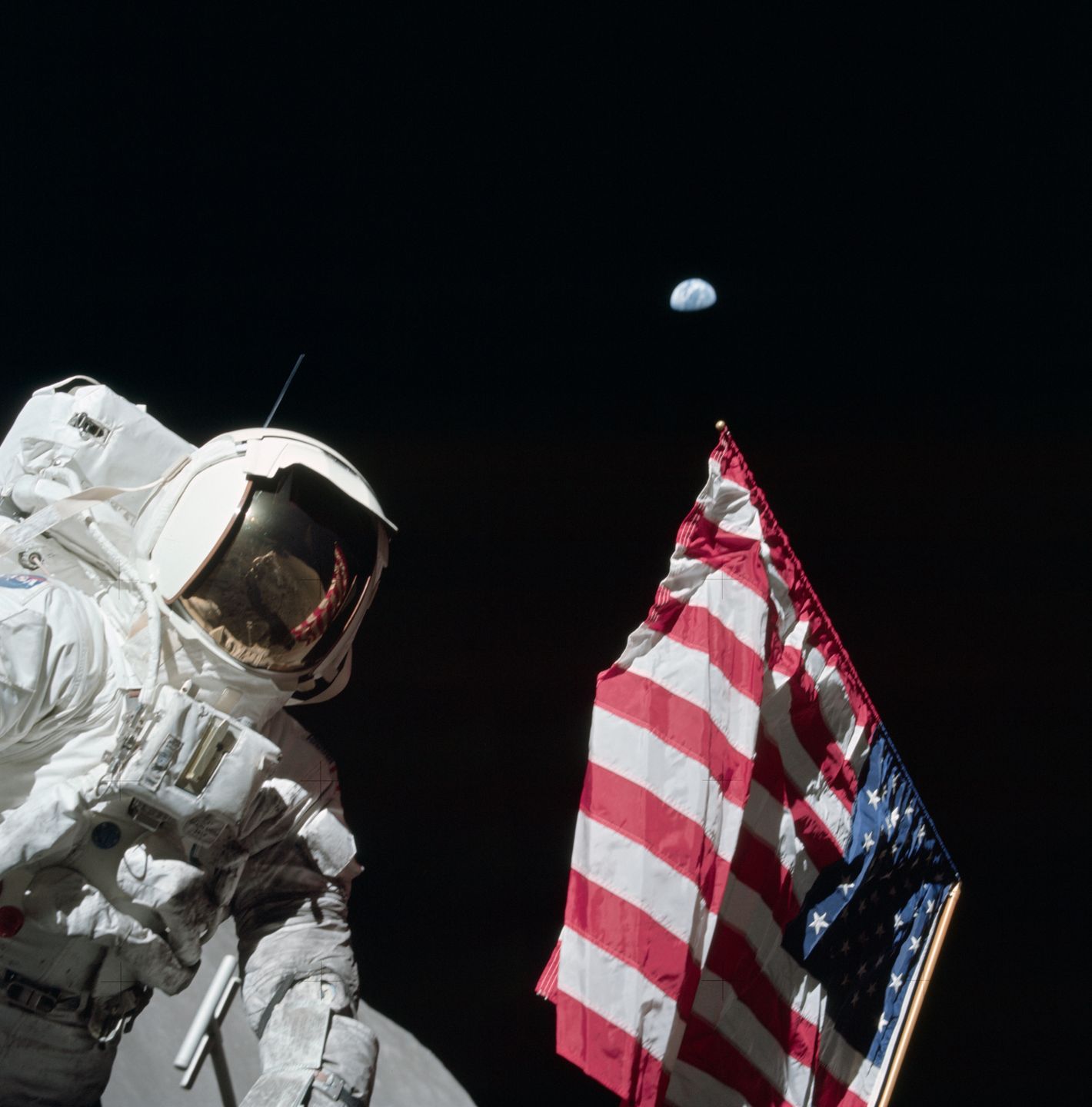
Harrison Schmitt with the flag during Apollo 17, Earth hanging in the sky above. NASA/Eugene Cernan, Public domain, via Wikimedia Commons
The photograph's legacy is also political. It emerged during the Cold War, a period when national borders and ideological divisions defined global politics. "The Blue Marble" implicitly argued for a planetary perspective, a viewpoint that transcended nationalism. It's no accident that it became a rallying image for environmentalism, international cooperation, and space advocacy. The image suggests that if you go far enough away, the things that divide us disappear. What remains is the thing we share: a single, fragile, beautiful world.
Apollo 17 was the last crewed mission to the Moon. No human has traveled beyond low Earth orbit since December 1972. That photograph, taken casually during a routine leg of the journey, remains one of the mission's most enduring contributions. The astronauts went to the Moon. But what they showed us was Earth. And we've been looking at it differently ever since.
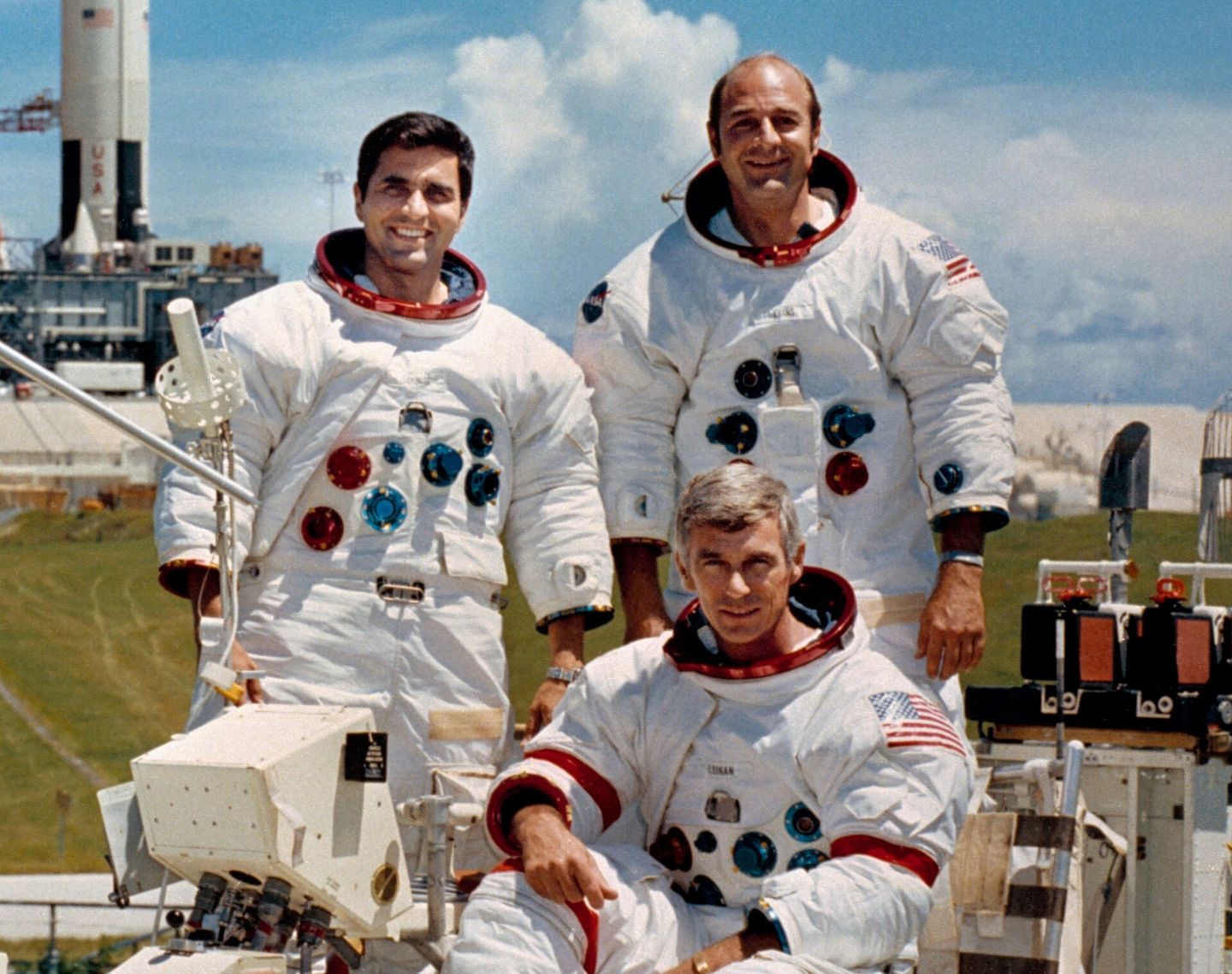
Apollo 17 prime crew: Cernan, Evans, and Schmitt. NASA, Public domain, via Wikimedia Commons
studio / on-this-day / Dec 7