studio / on-this-day / Dec 15
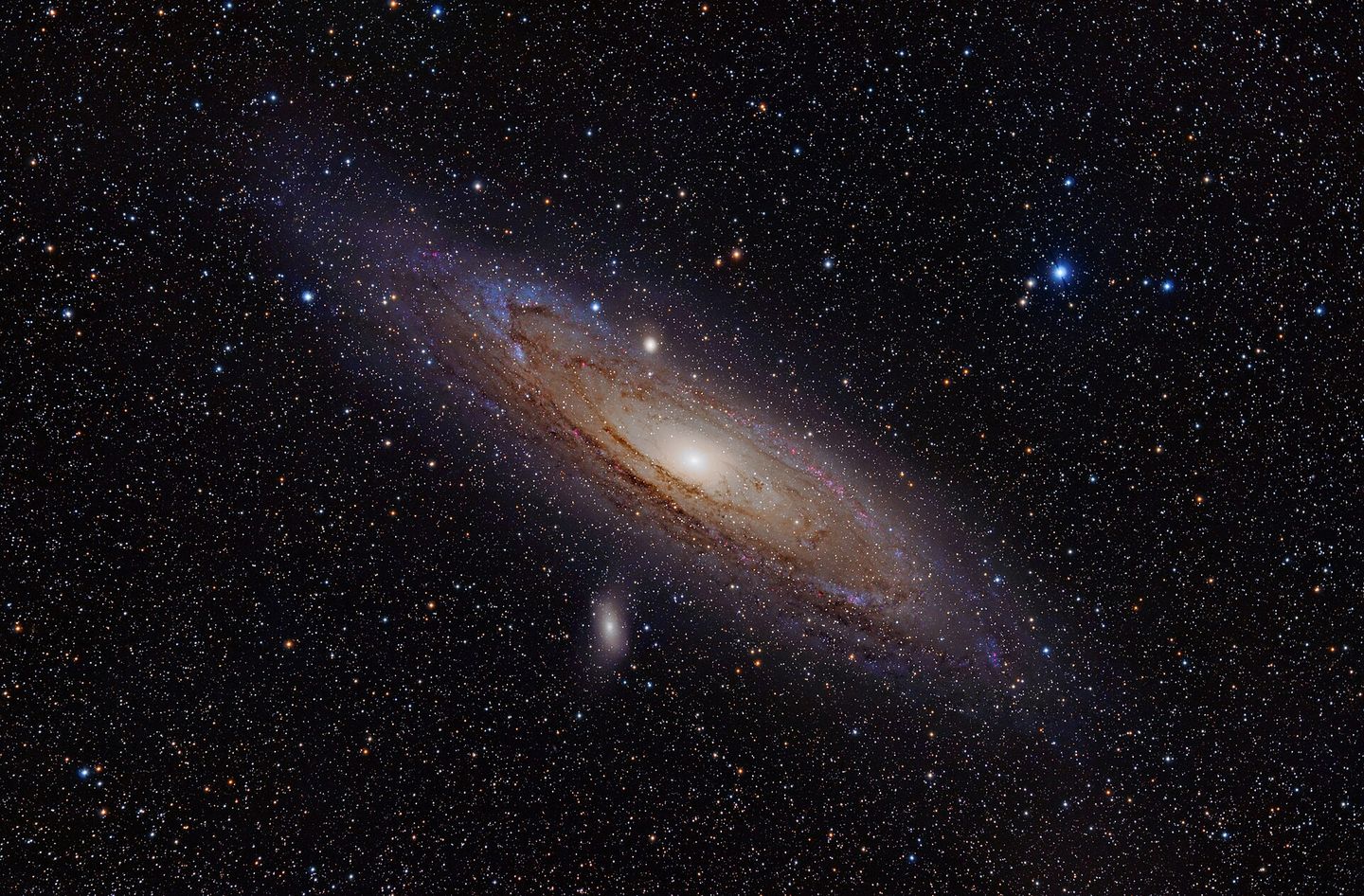
The Andromeda Galaxy (m31), 2.5 million light-years from Earth. Adam Evans, CC BY 2.0, via Wikimedia Commons
The First Look at Andromeda
On this day in 1612 — Simon Marius became the first to study the Andromeda galaxy through a telescope.
3 min read
On December 15, 1612, German astronomer Simon Marius pointed his telescope at a faint, hazy patch of light in the constellation Andromeda. What he saw, he later described as resembling "the light of a candle shining through horn." The object had been known to naked-eye observers for centuries, cataloged by Persian astronomer Abd al-Rahman al-Sufi in 964 as a "small cloud." But Marius was the first to observe it through a telescope, magnifying its structure and revealing that it was not a star or a nebula in the Milky Way, but something different. He had no way of knowing that he was looking at an entire galaxy, a massive island of hundreds of billions of stars located 2.5 million light-years away, the closest major galaxy to our own.
Marius was a contemporary of Galileo and, like Galileo, used one of the newly invented refracting telescopes to study the night sky. The telescope, developed in the Netherlands around 1608, was a revolutionary tool. For the first time, humans could see celestial objects in detail beyond what the naked eye could resolve. Marius observed Jupiter and its four largest moons around the same time as Galileo, though Galileo published first and received the credit. Marius also observed the phases of Venus, the structure of the Milky Way, and various nebulae. His observations were meticulous, but his reputation suffered because he did not publish his findings quickly, and Galileo accused him of plagiarism.
What Marius saw when he looked at Andromeda was a fuzzy, oval-shaped glow. He could not resolve individual stars within it. The telescope's magnification wasn't strong enough. For the next three centuries, astronomers debated what these "spiral nebulae," as they came to be called, actually were. Some believed they were clouds of gas within the Milky Way. Others speculated they might be distant star systems. The debate wasn't settled until 1924, when Edwin Hubble used the 100-inch Hooker Telescope at Mount Wilson to resolve individual stars in Andromeda and measure their distances. He proved that Andromeda was far outside the Milky Way, a separate galaxy entirely. The universe, which had been thought to consist of a single galaxy, suddenly expanded to contain billions of them.
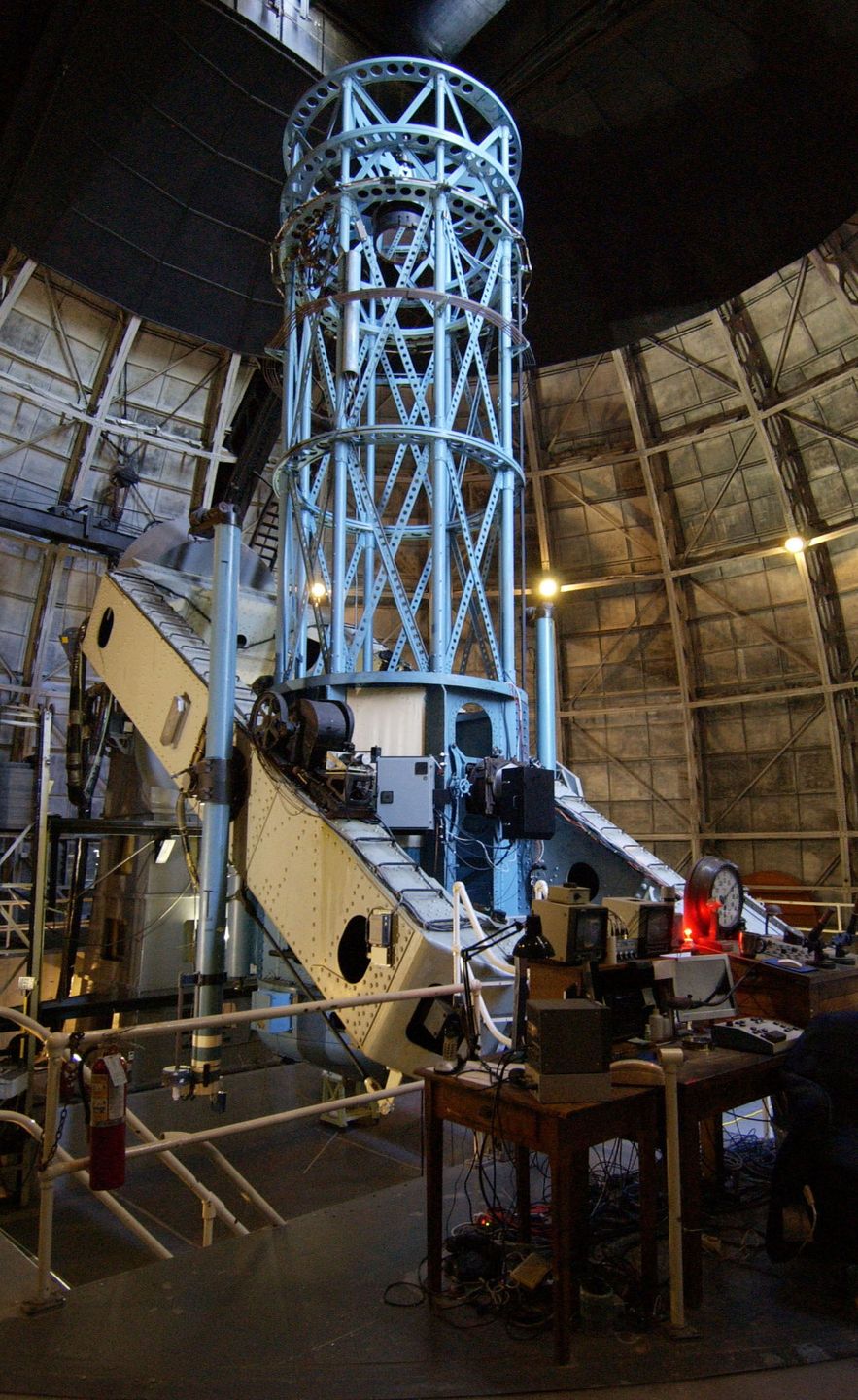
The 100-inch Hooker Telescope at Mount Wilson, where Edwin Hubble resolved Andromeda's stars in 1924. Ken Spencer, CC BY-SA 3.0, via Wikimedia Commons
Andromeda, formally designated Messier 31 or M31, is the nearest large galaxy to the Milky Way. It contains roughly one trillion stars, more than twice as many as the Milky Way. It spans 220,000 light-years in diameter and is visible to the naked eye as a faint smudge in dark skies. But even though humans had seen it for over a thousand years, they didn't understand what it was until the 20th century. Marius's 1612 observation was a step toward that understanding. He couldn't explain what he was seeing, but he documented it. He described its appearance, its location, and its uniqueness compared to other objects in the sky.
The Andromeda Galaxy is also notable because it is moving toward the Milky Way at about 110 kilometers per second. In roughly 4.5 billion years, the two galaxies will collide and merge into a single, larger galaxy that astronomers have nicknamed "Milkomeda." The collision won't destroy the stars themselves. Space is so vast that individual stars will pass through each other's galaxies without colliding. But the gravitational interaction will reshape both galaxies, likely forming a giant elliptical galaxy. The Sun and its planets will likely survive the event, though their position in the new galaxy will be different. By then, the Sun will be nearing the end of its life, expanding into a red giant and consuming the inner planets. But Andromeda will still be there, no longer a separate galaxy but part of the same structure as the Milky Way.
What makes Marius's observation significant is not that he discovered Andromeda. Ancient astronomers had seen it long before. But he was the first to look at it with magnification, to see it as more than a point of light. He turned a tool designed for navigation and warfare toward the heavens and used it to study objects no one had ever seen in detail. The telescope didn't just make distant objects larger. It made them knowable. It turned questions into observations. It transformed astronomy from a cataloging exercise into an investigative science.
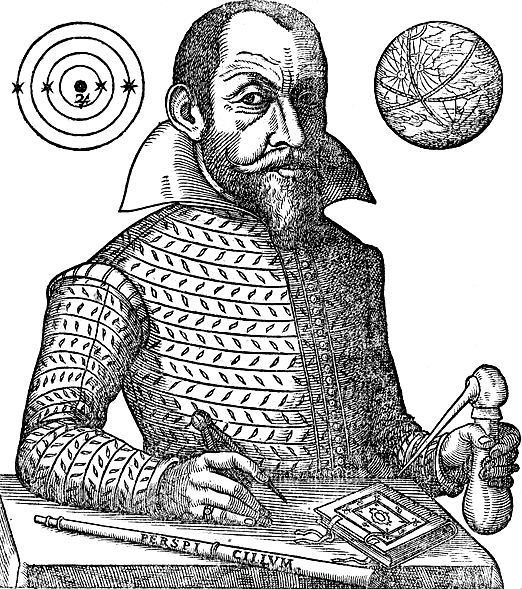
Simon Marius (1573–1624), German astronomer. Artist unidentified, Public domain, via Wikimedia Commons
Marius died in 1624, largely forgotten. Galileo overshadowed him. But his observations were accurate, and his contributions to early telescopic astronomy were real. He named Jupiter's four largest moons Io, Europa, Ganymede, and Callisto, names still used today, though credit for their discovery went to Galileo. He observed sunspots, planetary motion, and the structure of the Milky Way. And on December 15, 1612, he looked through a small refracting telescope at a faint patch of light in Andromeda and saw something no one had ever seen before: the first magnified view of another galaxy. He didn't know that's what it was. But he looked. And looking was enough.
studio / on-this-day / Dec 15