studio / on-this-day / Nov 28
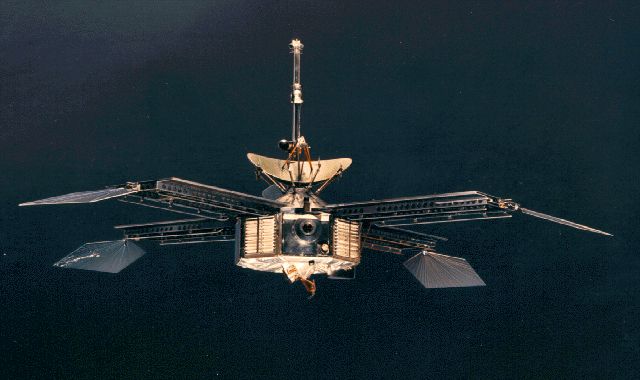
Mariner 4 spacecraft during assembly, 1964. NASA, Public domain, via Wikimedia Commons
Postcards from Mars
On this day in 1964 — Mariner 4 set off for Mars, and its twenty-two grainy photographs would erase a century of fantasies about the planet.
2 min read
Mariner 4 launched from Cape Kennedy on November 28, 1964, aboard an Atlas-Agena rocket. It was the size of a small car, weighed 575 pounds, and carried a single television camera along with scientific instruments to measure cosmic radiation, magnetic fields, and solar wind. The mission objective was simple: fly past Mars, take pictures, send them back. It took seven and a half months to cover the 325 million miles. On July 14, 1965, Mariner 4 passed within 6,118 miles of the Martian surface and captured 22 photographs, each transmitted back to Earth one pixel at a time over eight hours. The images were grainy, low-resolution, and devastating to decades of hopeful speculation.
Before Mariner 4, Mars was a canvas for imagination. Astronomers had observed what they thought were canals, interpreted as evidence of intelligent life or at least liquid water. Science fiction had filled Mars with civilizations, ancient cities, and dying races. Percival Lowell had drawn elaborate maps of Martian waterways. The planet was a neighbor, a possibility, a place where life might exist or have existed. Mariner 4's images showed craters. Lots of them. Mars looked like the Moon, dead and airless, with a thin atmosphere and no obvious signs of water or vegetation. The dream of a living Mars collapsed in 22 frames.
The data transmission was a feat of engineering. Each image was divided into 200 lines of 200 pixels, with each pixel encoded as one of 64 shades of gray. The signal traveled at the speed of light but took over four hours to reach Earth from Mars. NASA engineers couldn't wait for the full digital reconstruction. They converted the incoming data by hand, coloring in a grid with pastels based on the numeric values. The first image of Mars seen by human eyes was drawn with crayons on graph paper. It showed a cratered, barren surface. No canals. No cities. Just geology.
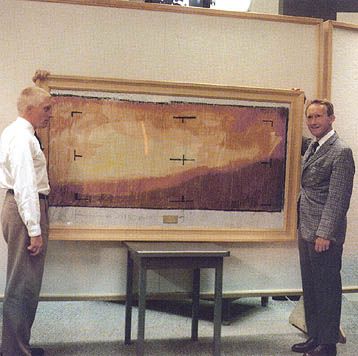
The first picture of Mars seen by human eyes — hand-colored with pastels on a numbered grid while engineers waited for the digital reconstruction. NASA, Public domain, via Wikimedia Commons
Mariner 4's success proved that interplanetary missions were viable. It demonstrated that spacecraft could navigate across millions of miles, survive the journey, execute complex operations autonomously, and send back usable data. The mission established design patterns that would be used for decades: solar panels for power, a high-gain antenna for communication, a tape recorder for storing data, redundant systems for reliability. Every Mars mission since has built on what Mariner 4 validated. The infrastructure of planetary exploration was prototyped on that first successful flyby.
The 22 images covered less than one percent of Mars's surface, but they redefined the planet. Mars was not Earth-like. It was hostile, cratered, ancient. Later missions would discover polar ice caps, dry riverbeds, and evidence that water once flowed there. But Mariner 4's first look was bleak. It killed the romantic vision of Mars and replaced it with something harder and more interesting: a planet with a history, one that could be studied rather than imagined. The canals were optical illusions. The civilizations were fiction. What remained was real, which turned out to be enough.
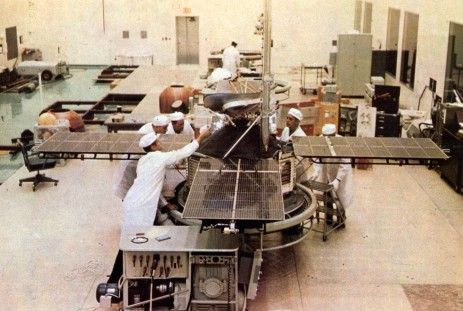
Engineers checking the Mariner 4 spacecraft before its launch — the mission that sent back the first close-up photographs of Mars. NASA, Public domain, via Wikimedia Commons
studio / on-this-day / Nov 28