studio / on-this-day / Oct 29
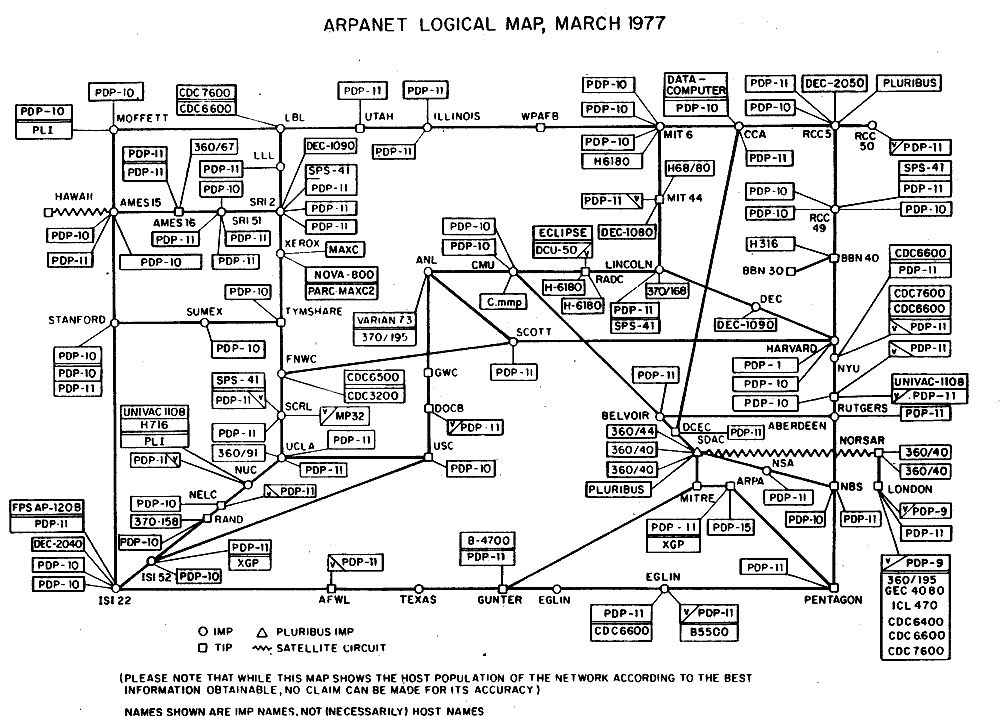
ARPANET logical map, March 1977. ARPANET, Public domain, via Wikimedia Commons
Lo
On this day in 1969 — the first message crossed the ARPANET and the system crashed after two letters, leaving only lo.
3 min read
On October 29, 1969, at 10:30 p.m., a graduate student named Charley Kline sat at a computer terminal at UCLA and tried to log into a computer at Stanford Research Institute, 400 miles away. He typed "login." The system crashed after the first two letters. The first message ever sent over the ARPANET, the predecessor to the internet, was "lo." It was an accident, but it was also the beginning of networked computing.
ARPANET was a research project funded by the U.S. Department of Defense's Advanced Research Projects Agency. The goal was to create a resilient communication network that could survive partial outages, including a nuclear attack. The network used a new technique called packet switching, which broke messages into small chunks, sent them independently through the network, and reassembled them at the destination. This was radically different from traditional telephone networks, which required a dedicated circuit between two points.
The system worked, barely. Kline tried again after the crash. This time, the full word "login" went through. The connection was established. Two computers, hundreds of miles apart, were communicating in real time without a dedicated phone line. This was the proof of concept. If it worked between two nodes, it could work between dozens, then hundreds, then thousands.
The early ARPANET was small. By the end of 1969, it connected only four universities: UCLA, Stanford, UC Santa Barbara, and the University of Utah. The computers were expensive mainframes, and the connections were leased telephone lines running at 50 kilobits per second, roughly the speed of a 1990s dial-up modem. The network existed for research, not commerce or communication. Email had not been invented yet. There were no websites, no browsers, no search engines. The network was infrastructure without applications.
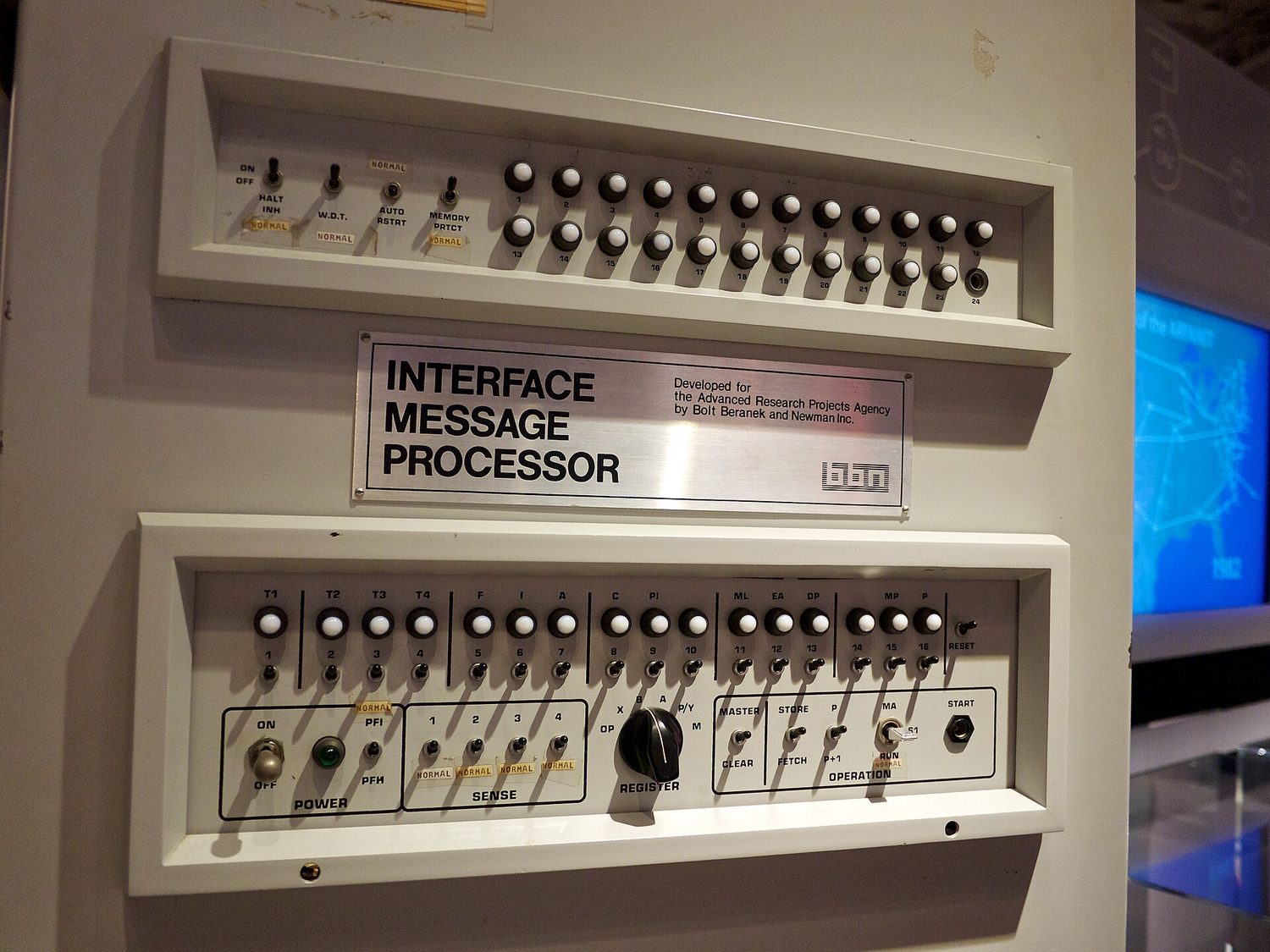
An Interface Message Processor, the early ARPANET's router. Don DeBold from San Jose, CA, USA, CC BY 2.0, via Wikimedia Commons
What made ARPANET significant was not what it could do in 1969 but what it made possible later. The protocols developed for ARPANET, particularly TCP/IP, became the foundation for the internet. Packet switching became the standard way to move data across networks. The idea that networks should be decentralized and resilient, with no single point of failure, shaped how the internet was designed. The assumption that the network itself should be dumb and the intelligence should live at the edges, in the computers and devices connected to it, became a core principle of internet architecture.
The first message, "lo," is often mythologized as prophetic. Lo and behold. The beginning of something new. But it was not planned. It was a bug. The system was not ready. The message was incomplete. And yet, in that incompleteness, there is something fitting. The internet has always been unfinished. It has grown through iteration, adaptation, and improvisation. No one designed it all at once. It emerged from a series of small decisions, experiments, and accidents.
By the mid-1970s, ARPANET had expanded to dozens of nodes. Researchers developed new applications: email, file transfer, remote login. The network became useful, not just experimental. In 1983, ARPANET switched to the TCP/IP protocol, which allowed different networks to interconnect. This was the moment when "the internet" as a concept became real. It was no longer a single network but a network of networks.
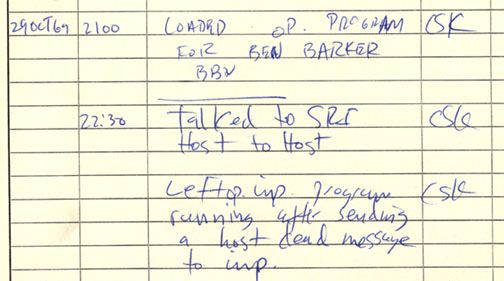
The UCLA IMP log book entry for October 29, 1969, noting the first host-to-host Message — "talked to sri host to host." Charles S. Kline, Public domain, via Wikimedia Commons
ARPANET was officially decommissioned in 1990, by which time the internet had grown far beyond its original purpose. The network that was designed to survive a nuclear war became the infrastructure for global commerce, communication, and culture. The first message, "lo," transmitted at 50 kilobits per second over a leased phone line, was the seed of a system that now moves exabytes of data every day. It started with a crash. And it kept going.
studio / on-this-day / Oct 29