studio / on-this-day / Oct 20
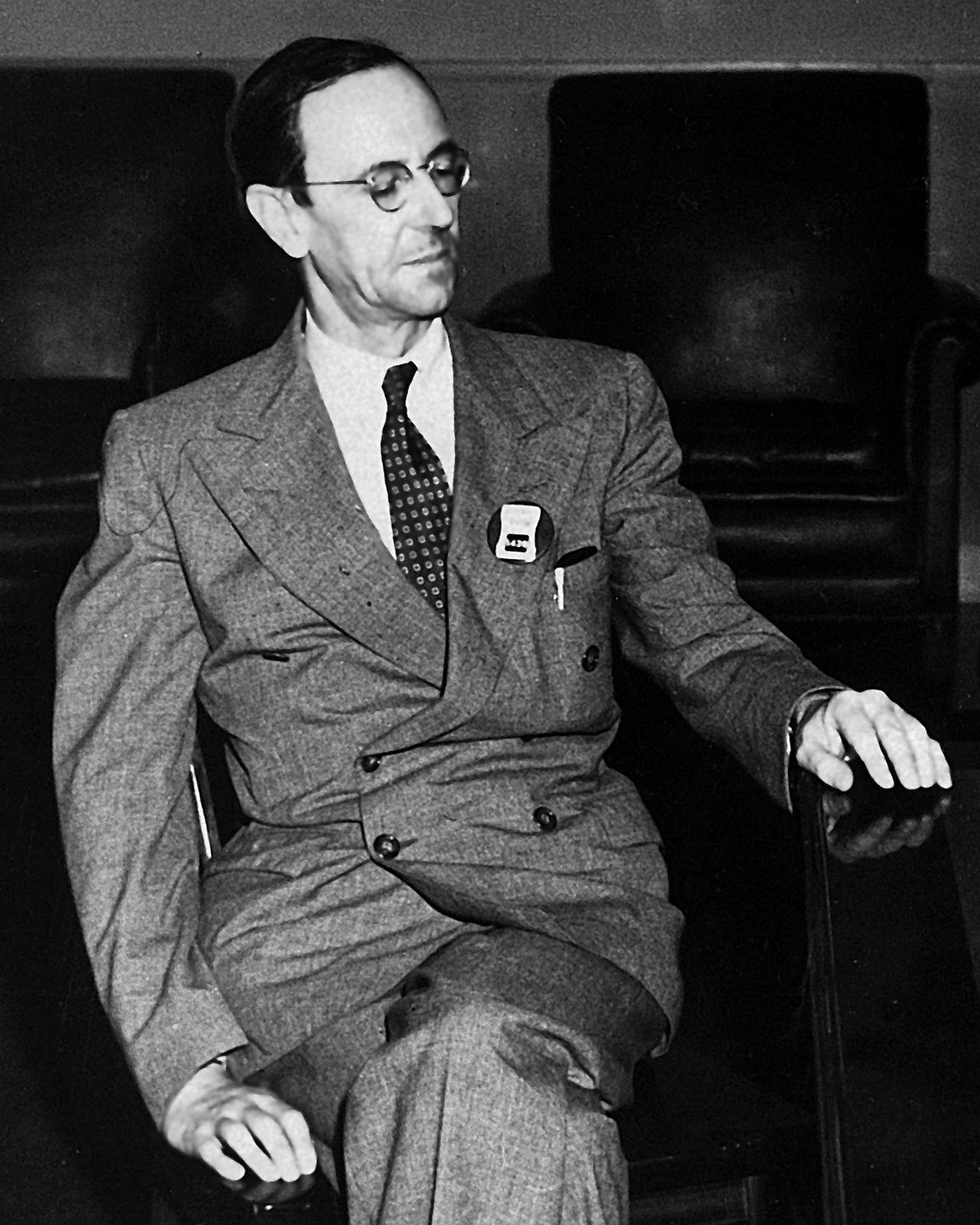
James Chadwick, discoverer of the neutron. Los Alamos National Laboratory, Attribution, via Wikimedia Commons
The Missing Piece of Matter
On this day in 1891 — James Chadwick was born, and would discover the neutron and complete the modern picture of the atom.
3 min read
James Chadwick was born on October 20, 1891, in Bollington, England. He would grow up to find the missing piece of the atom, the neutral particle that had eluded physicists for decades. The neutron was not flashy. It carried no charge, interacted weakly with other matter, and was nearly impossible to detect. But without it, the atomic nucleus made no sense, and neither did most of chemistry.
By the early 1930s, physicists knew atoms had nuclei containing protons, positively charged particles discovered by Ernest Rutherford. But the math did not add up. A helium nucleus, for example, had twice the mass it should have if it contained only protons. Something else had to be in there, something with mass but no charge. Rutherford had speculated about such a particle in 1920, calling it a neutron, but no one could prove it existed.
The challenge was detection. Charged particles leave tracks in cloud chambers and interact with electromagnetic fields. Neutrons do neither. They pass through matter almost invisibly. You cannot see them directly. You can only infer their presence by what they knock loose when they collide with other nuclei. Chadwick understood this. He designed experiments not to observe neutrons but to observe their effects.
In 1932, working at the Cavendish Laboratory in Cambridge, Chadwick bombarded beryllium with alpha particles. The beryllium emitted radiation that had no charge but could knock protons out of paraffin wax with surprising energy. Other researchers had seen this radiation and misinterpreted it as high-energy gamma rays. Chadwick ran the numbers. Gamma rays could not transfer that much momentum to protons. But a particle with roughly the same mass as a proton could. He had found the neutron.
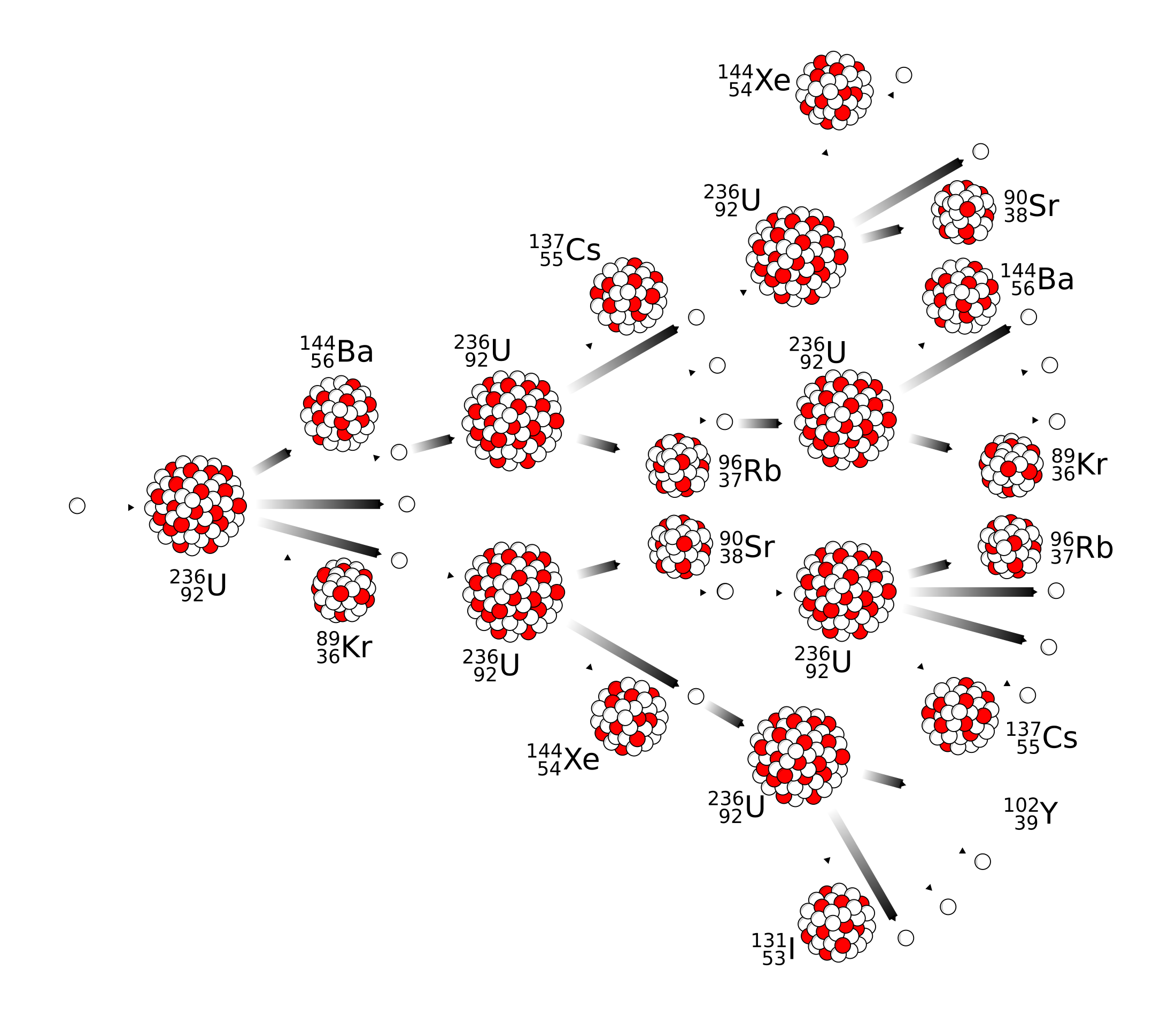
Diagram of a nuclear fission chain reaction — the neutron that Chadwick discovered is central to nuclear Physics. MikeRun, CC BY-SA 4.0, via Wikimedia Commons
The discovery was elegant in its simplicity. Chadwick did not build massive new equipment or develop radically new techniques. He used existing tools and paid attention to details others had overlooked. He published his findings in a paper that was only a few pages long. Within months, the scientific community accepted the neutron as real. Chadwick won the Nobel Prize in Physics three years later.
The neutron changed everything. It explained why atomic nuclei were stable despite containing multiple positively charged protons that should repel each other. Neutrons acted as nuclear glue, adding mass and mediating the strong force that held the nucleus together. It also explained isotopes, atoms of the same element with different masses. Same number of protons, different number of neutrons. Chemistry finally had a complete structural model.
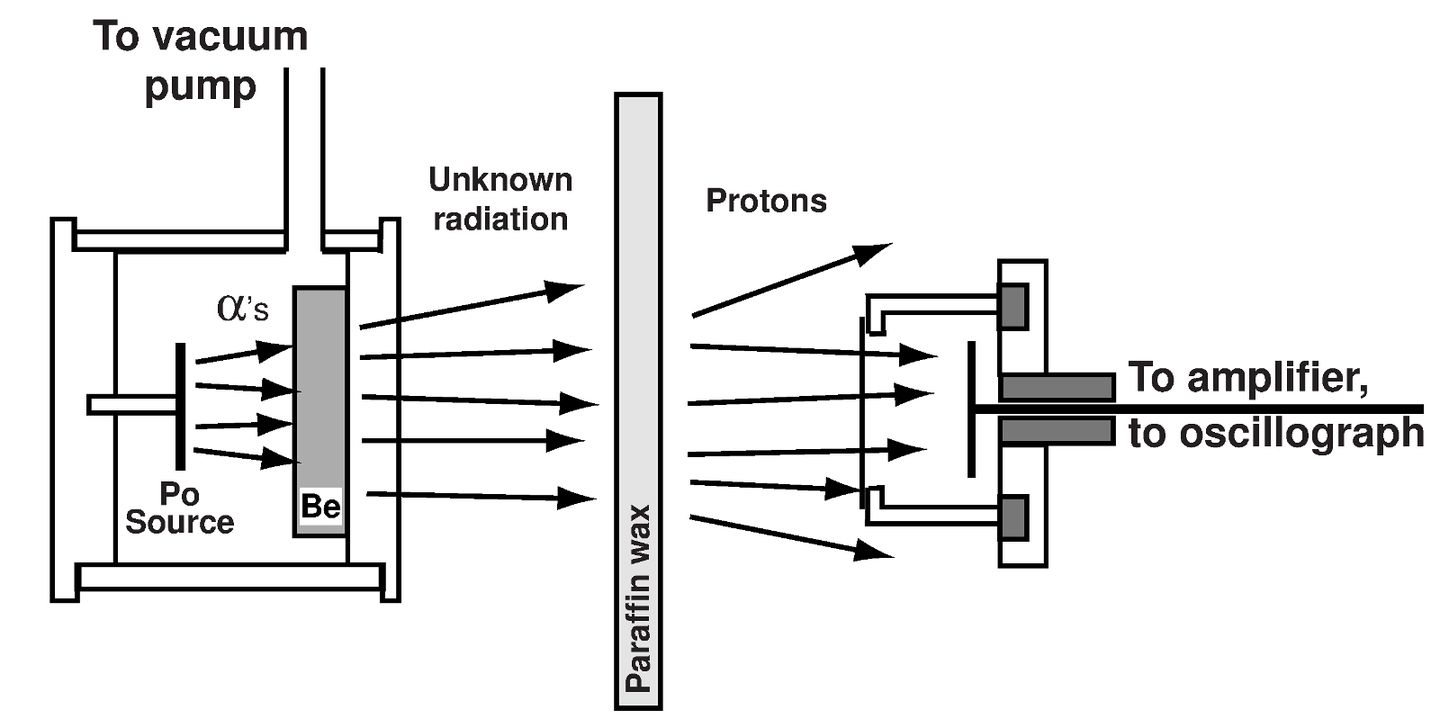
Diagram of Chadwick's 1932 setup: alpha particles strike beryllium, emitting neutrons that knock protons from paraffin wax. Bdushaw, CC BY-SA 4.0, via Wikimedia Commons
But the neutron also unlocked something darker. Because neutrons have no charge, they can penetrate atomic nuclei without being repelled. That makes them ideal for triggering nuclear fission. When a neutron strikes a heavy nucleus like uranium-235, it can split the atom, releasing energy and more neutrons, which can split more atoms in a chain reaction. This is the principle behind both nuclear reactors and nuclear weapons. Chadwick discovered the neutron in 1932. The first nuclear bomb was tested in 1945, just 13 years later.
Chadwick understood the implications. During World War II, he worked on the Manhattan Project, helping to design the atomic bomb. He later expressed ambivalence about the work, recognizing both its necessity in wartime and its horrifying consequences. The neutron, like many discoveries in physics, was morally neutral. It could generate electricity or level cities. The design was indifferent to its use.
Today, neutrons are everywhere in physics and engineering. Nuclear reactors rely on neutron moderation to control fission. Neutron scattering is used to study the structure of materials at the atomic level. Medical treatments use neutron beams to destroy cancer cells. The particle Chadwick discovered is now a standard tool in a dozen fields. It completed the model of the atom and, in doing so, gave humanity access to the nucleus itself.
studio / on-this-day / Oct 20