studio / on-this-day / Jan 12
An artist's rendering of Deep Impact's probe striking comet Tempel 1. NASA, public domain, via Wikimedia Commons
Hitting a Comet on Purpose
On this day in 2005 — NASA launched Deep Impact, a mission to fire a probe into a comet and read what came flying out.
3 min read
On January 12, 2005, a Delta II rocket lifted off from Cape Canaveral carrying one of the strangest missions NASA had ever attempted. The plan was not to orbit a comet, or fly past it, or gently sample its surface. The plan was to hit it. Deep Impact was built to fire a projectile into a comet at tens of thousands of miles an hour and watch what came out.
Comets are among the oldest things in the solar system, frozen leftovers from the cloud of dust and ice that formed the planets four and a half billion years ago. Studying them is like reading the solar system's first draft. But there is a problem. A comet's surface is weathered, baked by the Sun and coated in a dark crust. The pristine material, the stuff that actually dates to the beginning, is locked underneath. You cannot learn what a comet is made of by looking at its skin. You have to break it open.
So the mission carried two spacecraft in one. There was a flyby craft, loaded with cameras and instruments, and there was an impactor: a 370-kilogram slug built largely of copper. The copper was deliberate. When the impactor hit, its own vaporized material would show up in the instruments, and the engineers wanted something that could not be confused with anything a comet might actually contain. They were designing the crash to be readable.
The target was comet Tempel 1, a lumpy body about the size of a small city, tumbling through space at enormous speed. On July 4, 2005, the impactor separated from the flyby craft and steered itself into the comet's path, using its own camera and autonomous navigation to correct its aim in the final hours. Hitting it has been compared to standing on one speeding bullet, firing a second, and having a third bullet film the collision. The impactor struck at about 23,000 miles per hour.
The flash was brighter than anyone predicted. From a safe distance the flyby craft watched a plume of debris fan out into space, and telescopes on Earth and in orbit, Hubble among them, turned to watch too. The excavated material told a surprising story. Tempel 1 was fluffier and dustier than expected, less a solid dirty snowball than a loosely packed pile of fine powder held together by almost nothing. Beneath the crust were water ice and organic compounds, the raw ingredients of chemistry, preserved since the birth of the planets.
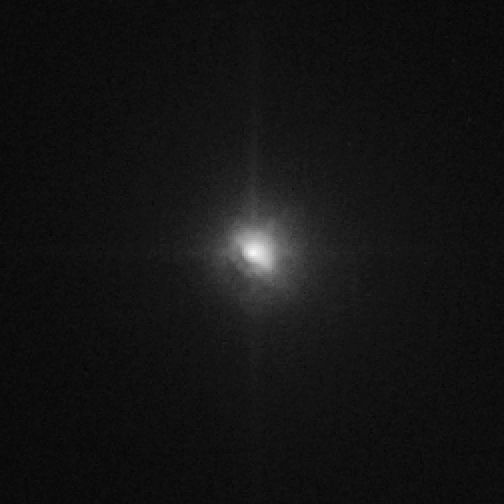
Hubble's view of comet Tempel 1 brightening just after the Impact, July 4, 2005. NASA / ESA, public domain, via Wikimedia Commons
It was the first time humans had ever deliberately reached into a comet. The mission did not just observe; it intervened, changing the thing it was studying in order to see inside it. That is a different kind of science, closer to an experiment than an expedition. Just as Project Diana had bounced radar off the Moon to measure a distance no one could reach, Deep Impact struck a comet to read a page no one could turn.
The flyby craft survived and kept working. NASA repurposed it under a new name, EPOXI, and sent it on to a second comet, Hartley 2, which it visited in 2010. Contact was finally lost in 2013, the spacecraft drifting silent through the solar system it had helped explain. But the data outlived the mission.
What Deep Impact confirmed matters beyond comets. The ice and organic molecules buried inside bodies like Tempel 1 are the same ingredients that may have been delivered to a young Earth by comet impacts, seeding the oceans and perhaps the chemistry that became life. To understand a comet's interior is to look at a version of our own beginning. Deep Impact answered that question the only way it could: not by watching, but by hitting something and paying very close attention to what came out.
studio / on-this-day / Jan 12