studio / on-this-day / Jun 9
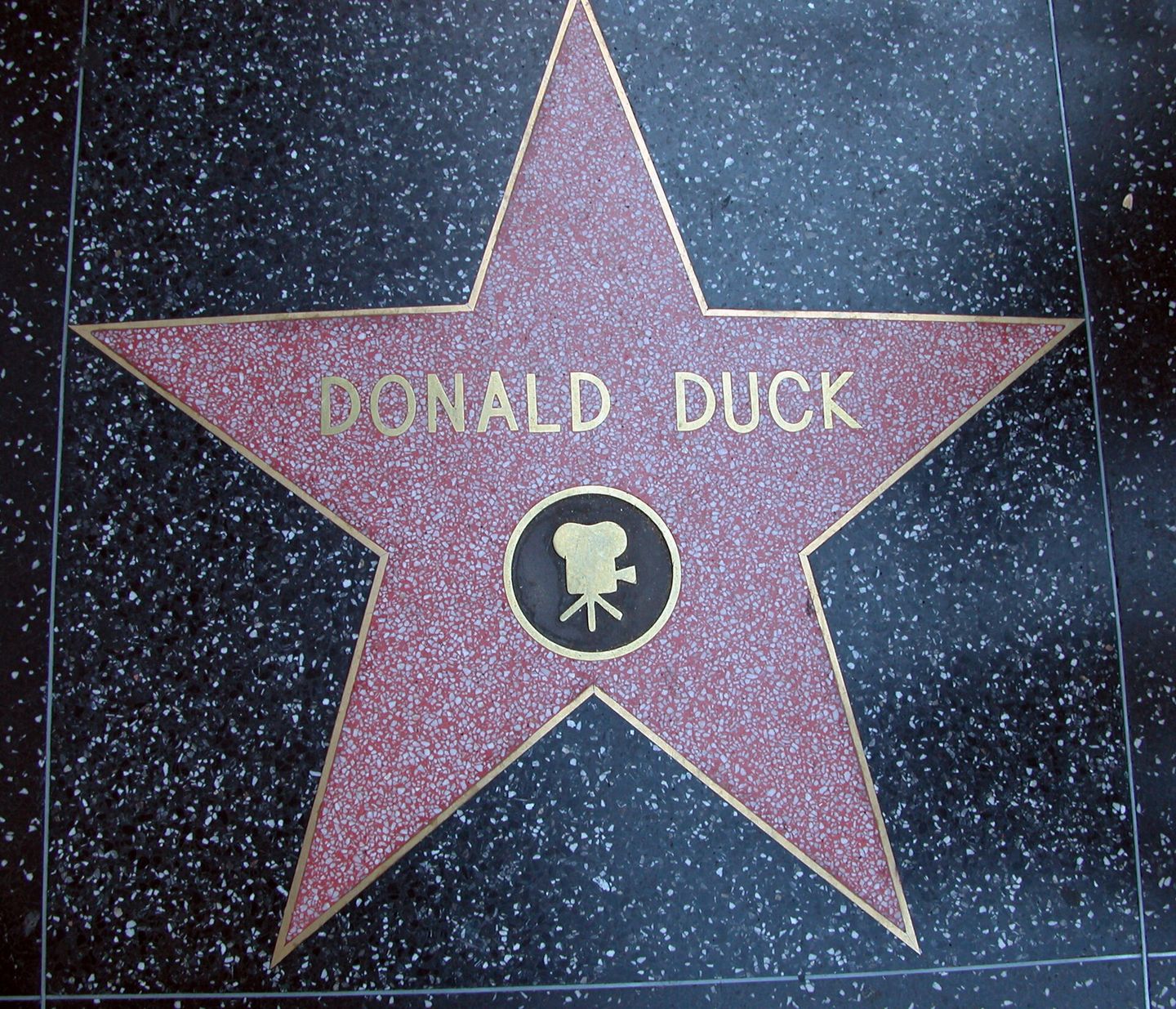
Donald Duck's star on the Hollywood Walk of Fame, one of only a few fictional characters to receive the honor. CC BY-SA 2.0 it, via Wikimedia Commons
The Angry Duck
On this day in 1934 — Donald Duck first waddled onscreen, a short-tempered cartoon bird who became a global design icon.
2 min read
Donald Duck made his first appearance on June 9, 1934, in a six-minute Silly Symphony cartoon called "The Wise Little Hen." He had a supporting role. The plot was simple: a hen asks Donald and his friend Peter Pig to help plant corn. Both refuse, feigning stomachaches. The hen plants the corn herself, and when it is time to eat, she excludes them. Donald's contribution to the story was minimal, but his voice and personality were immediately distinct. He was petulant, self-interested, and prone to outbursts. Unlike Mickey Mouse, who was cheerful and cooperative, Donald was irritable and flawed. Audiences loved him.
Donald was designed by animator Dick Lundy and voiced by Clarence Nash, who used a technique involving his cheek and throat to produce a squawking, half-intelligible speech pattern. The voice was absurd, but it worked. It gave Donald a physicality that transcended language. His frustration, his rage, his pride, all came through without needing clear diction. This made him translatable. By the 1940s, Donald Duck was more popular in Europe than Mickey Mouse. In some countries, he still is.
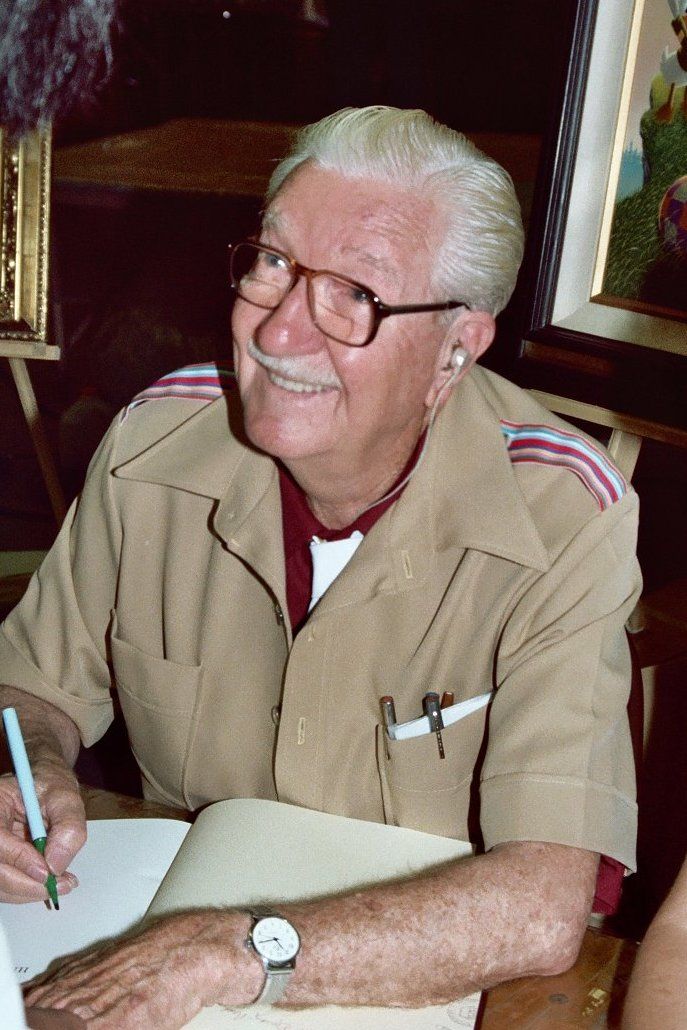
Carl Barks, the cartoonist who defined Donald Duck's character and created uncle Scrooge McDuck, known as "the good Duck artist." Alan Light on flickr, CC BY 2.0, via Wikimedia Commons
What made Donald resonate was not his virtue but his fallibility. He tried and failed. He lost his temper. He was vain, lazy, and vindictive. He embodied a specific kind of frustration: the sense that the world is rigged against you, that small injustices pile up, that you are doing your best and it is not enough. These were not traits you saw in most cartoon protagonists of the 1930s. Mickey Mouse represented aspiration. Donald represented reality.
Donald's design was simple but effective. White feathers, blue sailor suit, no pants. The sailor suit gave him a working-class identity, distinct from Mickey's vaudeville gloves and shorts. The lack of pants was a visual joke, but it also made him slightly ridiculous, which reinforced his status as an underdog. Over the years, his design would be refined. His eyes became more expressive. His beak became more mobile. But the core elements remained unchanged. He was immediately recognizable from any angle, in any context, in any medium.
During World War II, Donald became a propaganda tool. Disney produced a series of films in which Donald appeared as a U.S. soldier, a taxpayer, and a citizen doing his part. The most famous, "Der Fuehrer's Face," showed Donald suffering through a nightmare of life in Nazi Germany. It won an Academy Award. The U.S. government used Donald's image on war bonds and posters. His appeal was his ordinariness. He was not a hero. He was a working duck trying to get by, and that made him relatable in ways that more idealized characters were not.
Donald appeared in over 150 theatrical shorts, more than any other Disney character. He starred in comic books, video games, television shows, and theme park attractions. His nephews, Huey, Dewey, and Louie, became characters in their own right. His uncle, Scrooge McDuck, created by cartoonist Carl Barks in 1947, became one of the wealthiest and most complex characters in the Disney universe. The extended Duck family became a sprawling fictional ecosystem, with its own history, geography, and internal logic.

Donald Duck as a costumed character at Tokyo Disneyland, ninety years after his debut and still drawing crowds far from Hollywood. Sahaib, CC BY 4.0, via Wikimedia Commons
Donald Duck is not profound. He is not revolutionary. But he is enduring. For ninety years, he has been getting angry, getting cheated, and getting back up. He is a design that works because it reflects something true: frustration is universal, failure is frequent, and sometimes the best you can do is squawk about it.
studio / on-this-day / Jun 9