studio / on-this-day / Mar 11

Douglas Adams, author and satirist. Michael Hughes, CC BY-SA 2.0, via Wikimedia Commons
Don't Panic
On this day in 1952 — Douglas Adams was born, and would decide the answer to life, the universe, and everything was a tidy, useless 42.
3 min read
Douglas Adams was born on March 11, 1952, in Cambridge, England. He became a writer who treated the universe as a design problem with no solution. His most famous work, The Hitchhiker's Guide to the Galaxy, started as a BBC radio series in 1978 and expanded into novels, television, stage shows, and eventually a film. The premise was simple: Earth is destroyed to make way for a hyperspace bypass, and the last surviving human hitches a ride with an alien who writes travel guides. What followed was a cascade of absurdist logic, deadpan humor, and ideas that felt both ridiculous and uncomfortably accurate.
Adams wrote like an engineer who had given up on efficiency and decided to optimize for weirdness instead. His universe operated on rules that made internal sense but violated every expectation. Vogons were bureaucratic aliens whose poetry was the third worst in the galaxy. The Infinite Improbability Drive powered spaceships by exploiting quantum uncertainty. Dolphins were smarter than humans and left Earth before it was demolished, leaving behind the message, "So long, and thanks for all the fish." The jokes were not decoration. They were the structure.
The number 42 became Adams's most enduring contribution to popular culture. In the story, a supercomputer named Deep Thought spends 7.5 million years calculating the Answer to the Ultimate Question of Life, the Universe, and Everything. The answer is 42. The problem is that no one remembers what the question was. Adams chose 42 because it was ordinary, unremarkable, and funny precisely because it resolved nothing. It was a perfect encapsulation of his worldview: the universe does not owe you meaning, and searching for it might be the joke.
Adams was also a technologist. He bought one of the first Macintosh computers in the UK and became an advocate for digital tools long before most writers considered them. He wrote on computers, composed music on synthesizers, and obsessed over new gadgets. He saw technology not as a threat to creativity but as another medium to explore. His later work included Starship Titanic, a computer game developed with a team that included some of the era's best designers, and Last Chance to See, a nonfiction book about endangered species that combined humor with genuine environmental concern.
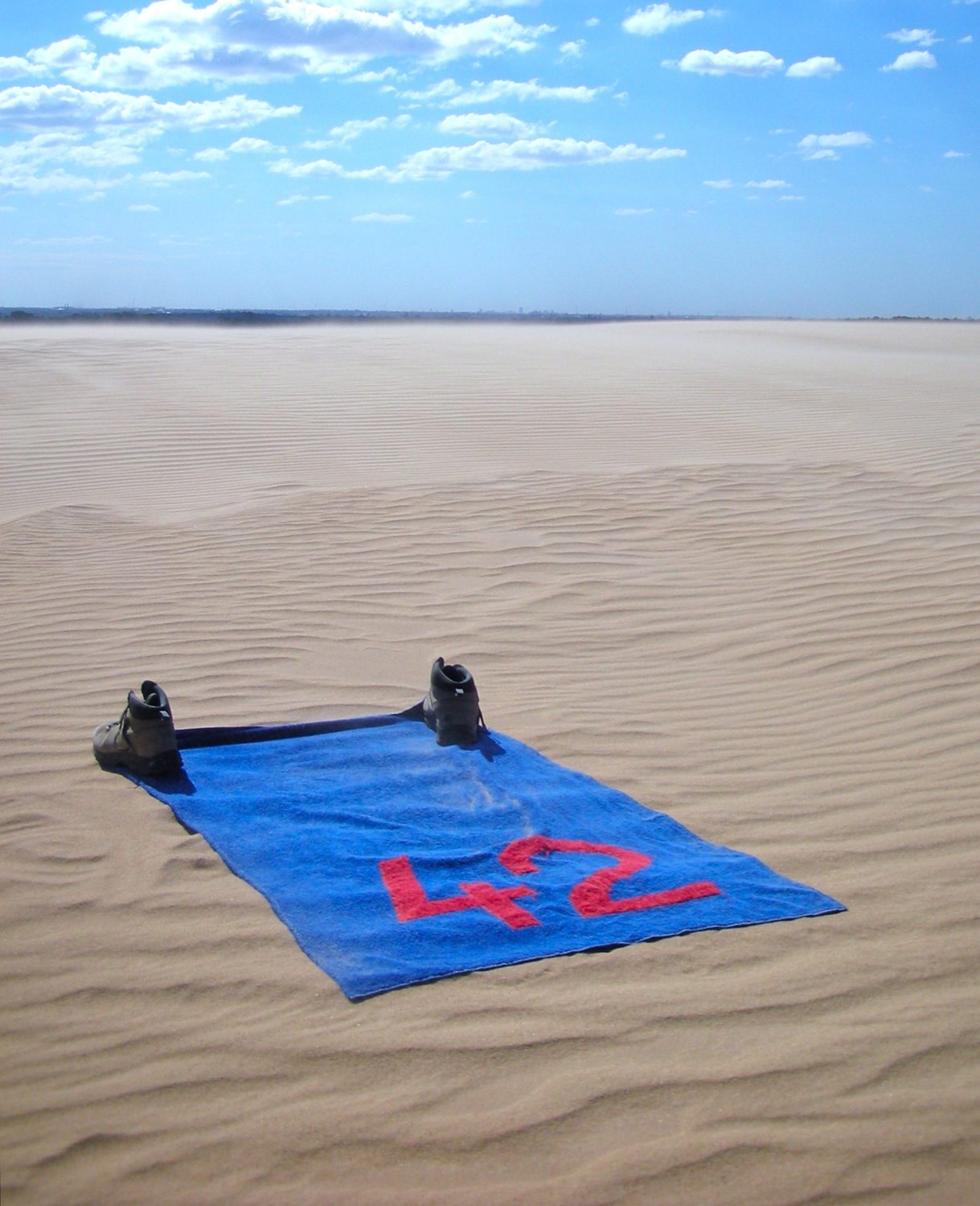
An homage to Douglas Adams; fans mark Towel Day in tribute to The Hitchhiker's Guide to the Galaxy. Julian Hammer, CC BY-SA 3.0, via Wikimedia Commons
What made Adams's work resonant was its emotional undertone. Beneath the absurdity was loneliness, the sense that the universe is vast and indifferent and that human attempts to impose order are both futile and necessary. Arthur Dent, the protagonist of Hitchhiker's, is an ordinary man yanked out of his ordinary life and forced to navigate chaos without a manual. The Guide itself, with its cover advice to "Don't Panic," is a design object: a repository of mostly useless information presented with absolute confidence. It is both a parody of reference books and a sincere attempt to make sense of the incomprehensible.
Adams struggled with deadlines. He famously said, "I love deadlines. I like the whooshing sound they make as they fly by." His writing process was slow, agonizing, and frequently interrupted by distractions. He would spend weeks on a single sentence, revising endlessly, searching for the exact rhythm and structure. The result was prose that felt effortless but was actually the product of intense iteration. Every joke had been stress-tested. Every absurd detail had been calibrated. The lightness was engineered.
He died suddenly in 2001 at age 49, from a heart attack while exercising. He left behind an unfinished novel and a legacy of ideas that have permeated internet culture, science fiction, and design thinking. Towel Day, celebrated annually on May 25, honors his work by encouraging people to carry towels in reference to the Guide's assertion that a towel is the most useful thing an interstellar hitchhiker can have. It is a small, absurd ritual, exactly the kind of thing Adams would have appreciated.
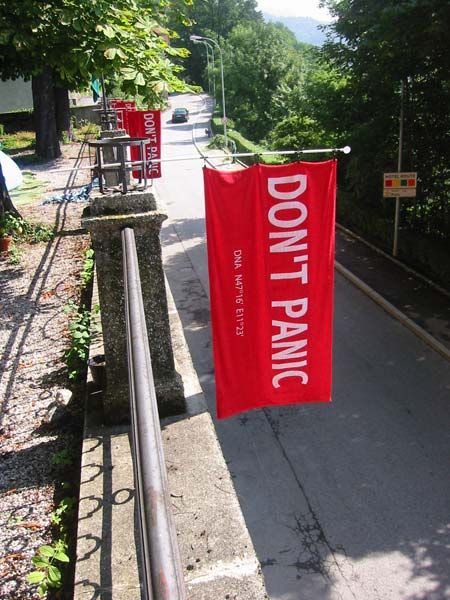
Towel Day — fans carry towels every May 25 in Adams's honor. Bazillus on the English Wikipedia, CC BY-SA 3.0, via Wikimedia Commons
Adams's work endures because he understood that humor is a design tool. It can reveal contradictions, defamiliarize the familiar, and make complex ideas accessible. The Hitchhiker's Guide is not just comedy. It is systems thinking disguised as entertainment, a way of looking at the world that treats absurdity not as a bug but as a feature. The universe is badly designed, poorly documented, and utterly indifferent to user experience. The only reasonable response is laughter.
studio / on-this-day / Mar 11